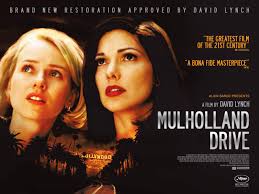
They have seen that film so many times but have never understood it.
NEGATIVE:
I have not read My Sassy Girl
I haven’t read The Great Gatsby
Question:
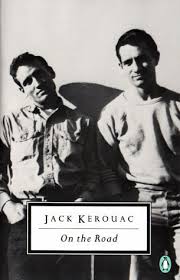
Have you read On The Road ?
[Have / has + subject + verb 3 … ?]
To talk about something in the past but not when it happened
He has looked at the report YES
He has looked at the report last week NO He looked at the report last week
Can use with ‘for’ and ‘since’
I have lived in Los Angeles (LA) since 2010
I have lived in Chicago for seven years
Change the verb into the correct form:
I (read) your book several times. I have read your book several times 2. She has (wear) that skirt many times. [worn /wear / wore] 3. My family (visit) Brazil a few times. 4. I (eat) already. 5. Marta (finish) her homework. 6. You (break) the glass again. 7. They (pay) for everything. 8. It (never snow) like that. 9. I (meet) Anna once. 10. We (see) him before.
Snow in New England, USA
Dialogue
Hello, how’s it going ? Long time no see.
Yes, I’ve been in Texas
Amazing! I want to go. I’ve never been there.
Really ? You must go, the food is great.
I’ve heard the people are incredibly nice and friendly.
And they just love a barbecue. I’ve never eaten so much in my life !
Have you been trying to call me ? I was in Seattle.
What were you doing there ?
I was working. I had an interview for a new company.
I’ve also been on the lookout for a new job. My job is so tedious !
Mine too. Same thing, day in, day out. But … it’s a job. Oh, Tom has been fired.
No ! Why ? I’ve known him for a long time.
He hasn’t been pulling his weight. He’s been incredibly lazy !
Tom hasn’t been doing his work
Have you heard about John Jones ?
Yes ! He’s been transferred to Boston. He’s gotten a promotion.
I knew he’d do well. He’s a bright spark. I’ve seen Boston. I visited my friends.
IELTS students need to know an incredibly wide array of adverbs so, with that in mind, here’s an exercise which can be easily adapted as a team game. Complete the sentences with suitable adverbs. Piece of cake, right ?
Use a thesaurus and dictionary to boost your vocabulary.
Word Fill
Adverbs of manner & ‘but’, ‘so’ and ‘even though’
(Fast or quickly – both can be used as adverbs, fast more for speed, quickly for time e.g. the animal runs fast and eats quickly.)
Note: ‘well’, ‘fast’ and ‘hard’ are irregular adverbs of manner.
Use a positive adverb for (+) and a negative one for (-)
Example: She sings (+) beautifully but plays piano (-) terribly.
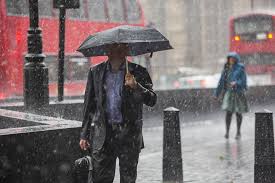
It is raining (-) heavilyso I will bring an umbrella
WELCOME TO LONDON
I will go along with you ……I am not really hungry
……….I am not hungry, I will go with you to KFC
Grabbike is cheap …..they drive so (-).
She failed her test ……..she studied (+)
Do I look like Batman ? Then why are you speaking so …..(-)
Batman has amazingly good hearing … but not all teachers have so SPEAK UP !
We have learnt many idioms ….that is just the tip of the iceberg.
He loves music …much ….he sings (-).
She never eats the food ………she works there.
……..she speaks English very (+), she is afraid to speak to westerners.
As I continuously tell my students, being able to form complex sentences, and then say them fluently, is key to passing IELTS.
One way to make longer sentences, as well as introducing subordinate clauses, is to become a master of …
Relative Pronouns
This lady, who wants to work in Australia, is studying hard for her IELTS.
who For people: This is the man who sold me the fake Rolex !
which For things: We tried fish and chips which is delicious.
where For places: Let’s go to the shop where we saw the great bargains.
Whose Possessive: That’s the singer whose record we heard last night.
The Italian car, whose driver was young, won the race.
Exercises
We arrived at a nice beach ______ we could swim and lie in the sun.
A man ______ mobile phone was ringing did not know what to do.
The patient, ______ had a serious disease, was taken to hospital immediately.
Smithsfield is a small village ______ people live a quiet life.
The boy ____ sister is in my class was in the bank at that time.
I know a person ____ can speak seven languages.
We visited the church _____ is in the middle of the square.
It is a protected area of land _____ you can see a lot of interesting wildlife.
This dress is made of silk, _____ is a very expensive and delicate material.
A police officer, _____ car was parked at the next corner, stopped and arrested them.
Go that extra mile – extra practice
IELTS, which can be very challenging, tends to be rather formulaicby which I mean it follows a pattern. Students can pretty much predict, with a fair degree of certainty, the type of subjects they will be expected to encounter.
With that in mind, try making complex sentences about these people:
Name: Ms Chen // Age: 19 // From: China // Lives: London // Studies: Business.
Ms Chen, who is studying Business in London, is 19 and originally from China.
Originally from China, Ms Chen, who is 19, is currently living in London, studying Business.
NOW … YOUR TURN
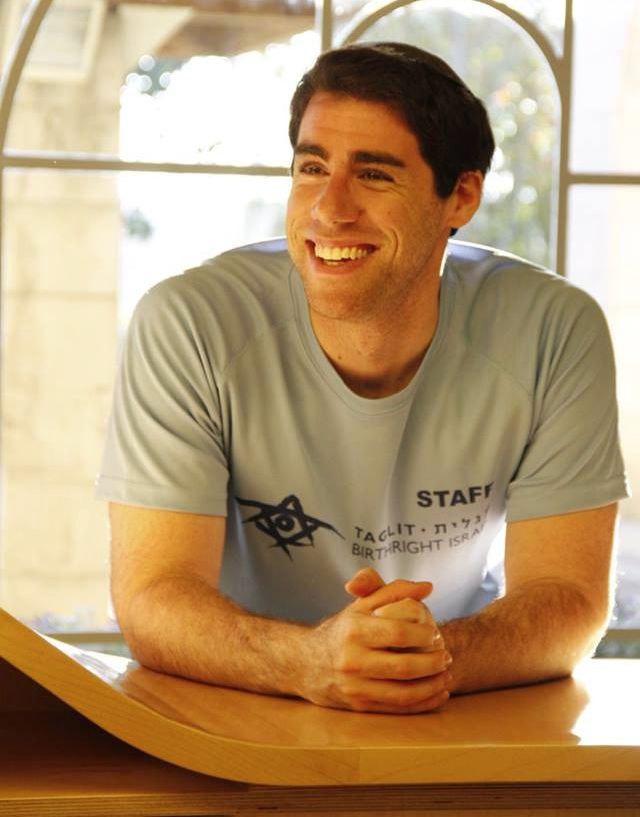
Name: Adam // Age: 24 // From: Israel // Lives: New York // Job: Writer for a magazine and blogger
Name: Boran // Age: 34 // From: South Korea // Likes: drawing manga // Job: singer, rapper and dancer
Name: David // Age: 28 // From: Leicester, UK // Passion: Music // Plans: To live in LA and record a CD
How often do you drink coffee with a beautiful Korean actress ?
To review recent expressions
once in a blue moon / not as much as I use to / not as much as I’d like to / from time to time / now and then / occasionally / only in my dreams !
How often do you:
Watch foreign films ?
See your boss smile ?
Play badminton ?
Hang out with friends ?
Go to the movies ?
Get a pay rise ?
Linking words:
and / as well as / and also / along with
These link positives or negatives:
I like tea as well as coffee He plays football and also badminton
Big C is quite cheap and also has a great choice
but / however / having said that / on the other hand
These link positives to negatives / negatives to positives:
Jet Mart is convenient. Having said that, it is (it’s) extremely expensive.
Czech beer is not easy to find in Sai Gon, however it’s fantastic quality.
‘therefore’ is a conclusion word:
King BBQ is outstanding and has a magnificent salad bar. Mr Park is reasonable (so-so) quality, but more expensive. Therefore, we will eat at King BBQ in future.
Theme: coffee in Sai Gon
There are so many choices in Sai Gon. Tran Nguyen has the best quality but is very expensive. On the other hand, Milano is incredibly cheap and very convenient however, many people smoke there. Highlands is really popular. Having said that, it is not cheap. Street coffee is extremely cheap but terrible quality !
Last Friday, I went out for dinner with Claire and Helen. Helen’s got a new job so we went out to celebrate. Claire booked a table for 7.30pm at her favourite Italian restaurant in town. When we arrived, the waiter showed us to our table, gave us some menus and took our drinks order. We were really hungry so we decided to have a starter and a main. We placed our order and chatted for a while. Our garlic bread soon arrived. We were hungry, so it disappeared very quickly! Next, the waiter brought our mains. He said, “Buon Appetito!”, which is Italian for ‘Enjoy your meal!’. Claire and Helen chose pasta and I had pizza. The food was delicious, but I couldn’t manage a dessert! Claire and Helen had some ice cream, but I just had a coffee. I can’t wait to go again!
You are standing outside the Palace, at the corner of Birdcage Walk. You want to get to (go to) Victoria Station.
Excuse me, how do I get to Victoria Station ?
Walk straight down Buckingham Palace Road. Walk across the street and you can’t miss it (you will see it easily).
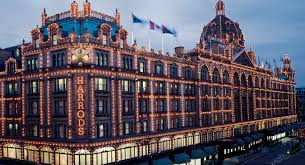
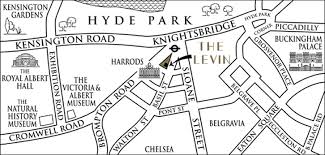
You are outside the front door of Harrods and want to visit the Royal Albert Hall
WELCOME TO LEYTONSTONE
Leytonstone is an area in east London, and was the birthplace of the film director Alfred Hitchcock, footballer David Beckham and singer Damon Albarn of the band Blur.
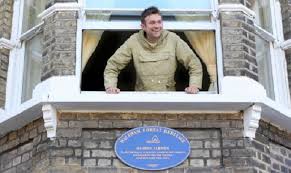
Damon Albarn showing where he lived in Leytonstone
Next, asking for local directions:
Sorry to bother (disturb) you, but I’m looking for a pub. Is there one near here ?
Yes, there is one quite close, ‘The Birkbeck Tavern’, maybe five or ten minutes’ walk away. Turn left until you come to Bridge Street. Turn left again, and keep walking, past the park, until you reach the bridge. Cross over, and Bob’s your uncle (there you are). It’s on the corner, you can’t miss it.
NOW: A local map
You are in LISTER ROAD (at the bottom) and want to get to GROVE ROAD.
Take turns asking each other questions.
The red circle with a blue band is the symbol for an underground station, which we call ‘The Tube.’ Here is Leytonstone Tube:
Plan a day
What would you like to do, where would you like to visit ?
Things to consider:
Time / lunch / travelling around / a variety of activities
In the early 1990s, I inherited an 8mm Bell & Howell cine camera and, with my flatmate Martin O’Shea as actor, began making short films in the East End of London.
8mm cine camera late 1950s / early 1960s
We had a two-bedroom flat near Mile End Tube Station (which we could somehow afford on a student grant), walking distance to Bethnal Green, Brick Lane and Limehouse, areas synonymous with names such as Hawksmoore (the architect), The Kray Twins (local crime lords) and Jack the Ripper (local ripper).
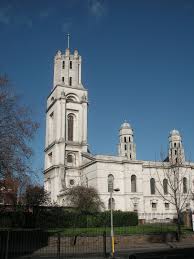
St George in the East, a Hawksmoore church
The area is incredibly historic, and well worth a walk for local historians, psychogeographists, or anyone with a passing interest in this less salubrious quarter of London.
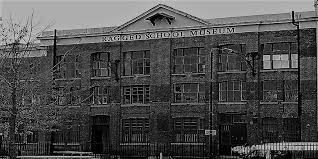
Ragged School Museum, Mile End
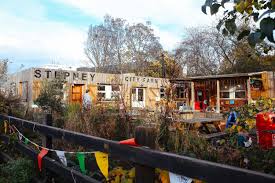
Walk is what we did, one Saturday night, up to Victoria Park, down to the street markets of Brick Lane and back home via the city farm at Stepney and a visit to St Dunstan and All Saints Church, where we had a lovely chat with the vicar. He was in his working outfit, white, pressed and clean … us, none of the above.
This was where we decided to film what was, I believe, our first film together, ‘A Day Well Spent’, and I think this would be Spring 1992.
St Dunstan and All Saints Church, Stepney, East London
Now the technical side. 8mm film lasted four minutes in total. The film had to be thread, in a figure 8 shape, in the camera, then reversed after 2 minutes. This meant keeping careful time, and not shooting anything vital in the dying seconds before the film ran out.
The film was silent and the camera, I believe, had no zoom and no auto-aperture; the light had to be set manually. Basically, it was a ‘point and shoot’ affair. Close-ups had to be physically close, long-shots, far away.
So, we had four minutes to tell a story, beginning, middle and end. Martin plays a tramp, a happy-go-lucky, Chaplinesque character. He awakes, on a rubbish heap, scratches himself, looks around and gets up. He wanders through the City farm at Stepney
Stepney City Farm
Naturally, he’s hungry and seeing the chickens gives him an idea; he has to ‘procure’ an egg for breakfast, without being detected or suffering an avian assault. With his cunning and agility, he is successful, and celebrates his victory by holding his prize aloft as he runs past St Dunstan’s.
However, when he searches his pockets, he only has a fork with twisted prongs … not a suitable implement to eat his breakfast. Disappointed, he throws the egg away, and decides to go back to sleep.
We also had a recurring event, namely a visit from the rozzers (London slang for police). One burly boy in blue was curious what we ne’re-do-wells were up to in his manor. To see a young guy, in trenchcoat, asleep on a rubbish tip alerted his instincts. And we had a recurring escape, namely I showed my camera and all became clear … “Oh, they’re making art,” heavy irony on the pronunciation of ‘art’, and that sarcasm has repeated through the years.
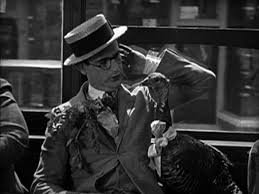
Or maybe, like most people of my generation, he would have seen some short compilation films on BBC1 after 5.30 pm and before the 6.00 pm News. This was how so many of my friends were introduced to the world of Harold Lloyd.
Everyone knew Chaplin, most people had heard of Buster Keaton, but Mr Harold Lloyd was totally unknown. That all changed with a series of 20-minute programs featuring scenes from his silent films … and all my school-friends were knocked out by them. You would even hear people shout out as they left school, “Don’t forget to watch Harold Lloyd.”
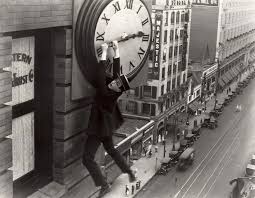
Harold Lloyd, referred to as ‘The Third Genius’ was, and remains, a major influence, especially in how to tell a story by images alone and how comedy works. This photo from ‘Safety Last’ (1924) is iconic … and even more amazing when you know that Lloyd lost a thumb and finger in an accident on a film set.
His films and many clips are available on YouTube. I used to show them during break time to my Kindergarten class, and they loved him … I was able to silence 15 hyper-active kids with a silent movie star.
Meanwhile, Mr O’Shea is busy in Berlin with a massive project: to put all our 8mm and Super 8 films onto computer, add commentaries and upload them on social media. Wish him luck, and take some time to watch Harold Lloyd … you won’t be disappointed
Today, I was very successful at work because I got my salary as well as a bonus (extra money).
When do you get your salary ? When do you get paid ?
Salary = career, professional job – usually once a month
Paid – for a job, can be daily, weekly, monthly – low-income job
Building longer sentences:
I teach at public school which can be extremely tiring because there are many students who, I feel, do not want to learn. Having said that, there are also many wonderfully gifted students who make me feel happy.
Relative pronouns– who (person), which (thing), where (place).
Adverbs– add information – extremely, wonderfully
Opinions– I feel, I believe, in my opinion, from my point of view.
Turn and link – although, despite, however …
VOCABULARY
gifted – talented, skilled- natural talent
You have a gift for …. music, laughter (laugh – larf), accounting, singing
Noun there was laughter NOT there was laugh
For example – we had karaoke – there were many people singing; some were extraordinarily gifted while others were … not so talented ! There was a laugh of smiling and laughter.
Extraordinarily – very special
Now … Your Turn
Tell your neighbour or the class about your job
Where you work
The good things
Anything bad
How do you feel
I went to the office where I work and I had a very busy day. However I think it’s good because I can finish my task. I was really excited and happy because today is the last day of the month so I got my salary and holiday bonus. I want to spend my salary for traveling or on clothes.
GRAMMAR
I can finish subject + modal verb (can, could, might) + main verb
I got my salary I was paid so we use past tense ‘got’.
I want to spent subject + helping verb (want, like, need) + infinite (to + verb)
Today, I went to my company where I met everyone in the office. After, I worked with my customer, who is very pleasant, and we spoke about payment. Later, I went to the bank where I withdrew a little money from the company account. It was an ordinary day but interesting because today is payday !