There ___ an old school, and there ____ many students.
[2 points]
2 Name a country in North America / South America / Asia / Europe / Africa
[5 points]
3 Possessive pronouns. I have a pen, it is mine.
You have a pen, it is _____ // He has a pen, it is _____ //
She has a pen, it is ____ // we have a pen, it is _____
// they have a pen, it is _____
[5 points]
4 Use capital letters when needed:
many people go to london because it is so famous. tourists come from canada and new zealand to see buckingham palace where king charles lives.
[10 points]
5 Do you live in Thailand ? // Do Peter and Jane like dogs (YES) // Does Peter like snakes (NO) // Does Jane like cats (YES)
[4 points]
6 Every Thursday Tony puts out the recycling. He walks his dog at 6 o’clock and at 4 o’clock. He reads English on Monday, Wednesday and Friday, and plays football on Saturday and Sunday.
How often does Tony: recycle ? // walk the dog ? // Read English ? // Play football ?
[4 points]
7 Tell me three things you like to do; use full sentences
[6 points]
8 Use these words correctly in a sentence:
proud // advisor // understand // artist // greatest
[10 points]
9 some or any ?
There’s ____ milk // There isn’t ____ soup //
Is there ___ rice ? // There are ____ pancakes.
[4 points]
10 Use present continuous (verb + ing)
Example I swim = I am swimming
You eat pizza // he plays tennis // she reads science // we (not talk) quietly // they visit london // I (not make) my teacher angry.
[6 points]
11 Tell me about yourself; what do you like to do and why. What do you want to do when you are older ?
[10 points]
66 points. Pass mark is 60 % [39 points]
Please Note: All photos are taken from Google Images or free photo sites, and are used for educational purposes only. No copyright infringement or offense is intended. If I have used your photo or image, and you wish me to remove it, just ask. This site is not monetized, I run it on my own dollar. Thank you.
Furthermore, she loves to wear Givenchy perfume but I prefer to spend my hard-earned* on Dior.
In the modern parlance, ‘Did you see what I did there ?’ I followed four auxiliary verbs (‘hate,’ ‘love,’ ‘like’ & ‘prefer’) with infinite verbs. I sense that I’ve already lost the interest of 90% of my readers with these grammar terms, but hold your horses and I’ll explain, I’ll ‘cut the crap‘, if you will.
OK, breaks down like this: an auxiliary verb is a ‘helping’ verb; we need more information to understand what the speaker means e.g.
I want … (what do you want ?) // He needs … (what does he need ?) // She loves … // We want … etc
An infinite verb simply means a verb in no tense (past, present or future). It is simply formed thus:
to + base verb
Examples: to eat / to go / to study / to procrastinate
Infinite has no tense, by which I mean it is incorrect to say,
“Last night I to see a film,” (past tense)
“She to go home,” (present) or
“Tomorrow he will to take a test.” (future tense).
We can combine an auxiliaryverb with an infiniteverb, as demonstrated in the heading and subsequent paragraph.
Occasionally, a student may question my use of grammar, or mention that they have been told a different rule, to wit, last night a student informed me that, according to a different teacher, auxiliary verbs such as ‘like,’ ‘love.’ ‘hate,’ HAVE TO BE followed by a continuous verb:
I hate shopping NOT I hate to shop
He loves watching films NOT He loves to watch films
We like drinking wine after work NOT We like to drink wine after work
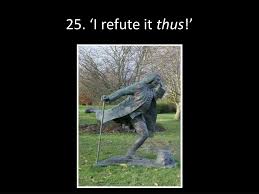
To Quote Dr Johnson:
“I refute it thus,” :
I like to play guitar / I hate to hear karaoke / I love to listen to my friend Pete’s online radio show
We can use hate, like, love and prefer with an –ing form or with a to-infinitive:
I hate to see food being thrown away.
I love going to the cinema.
I prefer listening to the news on radio than watching it on TV.
He prefers not to wear a tie to work.
In American English, the forms with to-infinitive are much more common than the –ing form.
There is a very small difference in meaning between the two forms. The -ing form emphasises the action or experience. The to-infinitive gives more emphasis to the results of the action or event. We often use the –ing form to suggest enjoyment (or lack of it), and the to-infinitive form to express habits or preferences.
So there you have it, straight from the horse’s mouth.
What can we learn from this ? Well, teachers are only human (mostly) and can make mistakes. Teachers who are not native-speakers often teach from books that may simplify grammar and may, inadvertently, be incorrect in their assertions. The books may be outdated; they may even be wrong.
Just because something is written in a book, doesn’t mean it’s true.
Check for yourself, be proactive in your learning; if you have internet access, check reputable websites.
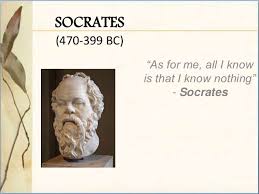
Furthermore even native-speakers can make mistakes and I’ll be the first to admit this (even if I don’t have the wisdom of Socrates, not by a long chalk).
The Bash Street Kids … from ‘The Beano’ which is a famous comic from the UK, first issued in 1938.
Tonight we have a listening lesson which, although tremendously important, not to say imperative, can be somewhat tedious for the students.
One factor is the vocabulary. If students don’t know some of the words, they will not be able to answer some of the questions; that stands to reason.
that stands to reason = it is obvious, it is common sense, it can be understood. I live in Vietnam but only speak a little Vietnamese. It stands to reason that if I spoke Vietnamese, I would be more independent.
Therefore, allow me to explain a little about the UK educational system while, at the same time, pre-teaching some new vocabulary.
First up, we have Kindergarten or nursery:
As you can see, the age for Kindergarten is 3 – 5. It can be free, or parents can choose to send their children to a private Kindergarten or nursery.
Maybe the word Kindergarten looks a little strange in an English lesson – quite right, it is, in fact, a borrowed word from German. If you have seen my other IELTS posts, you may have come across ‘prima donna‘, which is a borrowed word from Italian. If you can use borrowed words in your IELTS tests, it will surely impress the examiner.
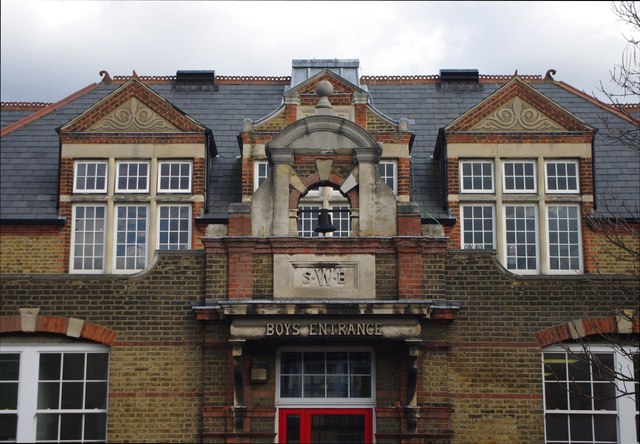
Next, we have primary school for children of 5 to 11. When I was at school, it was broken down into Infants and Juniors. Infants school was two years, then we moved up into a new building, attending four years of Junior school. This was a mixed school by which I mean boys and girls were in the same class.
Woodside Primary school in north-east London
Following on from Primary school we have, quite logically, Secondary school:
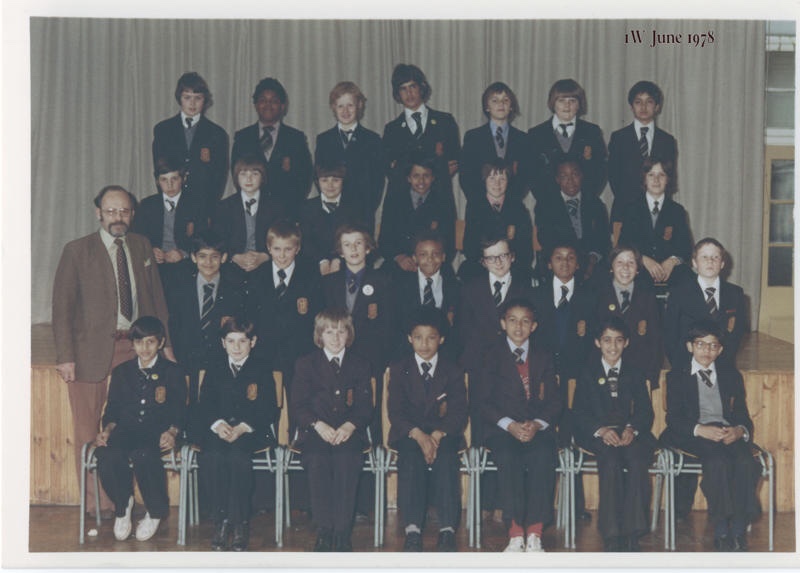
A typical class photo from the late 1970s. As you can clearly see, this is a single-sex school. Furthermore, the pupils had to wear school uniform of trousers, blazer and school tie.
Pupils spent three years here, from ages 11 – 14 at Junior High, after which they progressed to Senior High:
Pupils have to attend school until they are 16; it is compulsory.
You must then do one of the following until you’re 18:
stay in full-time education, for example at a college
Pupils can either stay at school and enter the VI (Sixth) Form, or go to a Further Education College which differ in that they offer a much wider selection of options such as vocational courses which are more practical and can help students train for a specific job. VI Forms, on the other hand, are academic (theory), preparing students for university.
The VI Form is usually in the same building as the Senior High, so pupils are familiar with the teachers and students. Going to a new college, meeting new staff and students means that time is needed to settle in or settle down.
Qualifications are imperative these days, so many students want to go to University.
Finally, we have Adult Education which, as the name implies, is for adults who wish to further their job prospects, or simply learn for their own pleasure. As many people are working, these type of education often takes place in the evening or at weekends.
New Vocabulary:
term – part of the teaching year for example First Term is from September to December
it’s a pity – it is sad or it is unfortunate
Fresher’s Week – a week for new students (Freshmen in USA) to get to know what their college has to offer, such as clubs and events.
GCSEexams – tremendously important exams taken at age 15 or 16. Good results mean the student can to VI Form or have to re-sit the exam.
tertiary – means the third – after Primary (first) & Secondary (second), tertiary refers to Higher Education, taken after the age of 18.
NVQ National Vocational Qualification – this is more practical as opposed to academic, designed to teach skills needed for a particular job:
An NVQ card stating that the holder has passed exams to work in the construction industry
BA or BSc – (Bachelor of Art or Science) degrees in the arts or science. Usually attained after a three-year course. The next step is a MA (Master’s Degree) and then a PhD.
internship – gaining real-life experience by working for a company, often for low or even no pay.
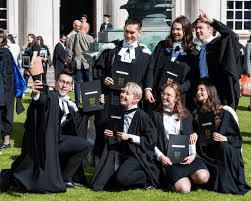
Graduate Fair – a chance for students to think about what career to follow, or what company to join. They can speak to people who represent organisations:









 Thay Paul's Notes