Korean Cinema: Shades of a Heart (2019)

4th February 2023

Director: Kim Jong-kwan
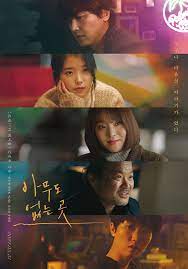
A tale of loss and loneliness, memories and dreams and the dichotomy between life and art. Various unrelated people relate their personal tragedies to a seemingly dispassionate protagonist until we piece together his own story, and the film feeds back on itself; we end where we entered but now enlightened. A trailer may be viewed on YouTube:

‘Shades of a Heart’ is a rather slow-paced movie, somewhat in the style of fellow Korean director Hong Sang-soo. The supporting characters, detached from each other, give the film a vague European, existential air, while the cinematography and use of colour remind me of Hong Kong’s Wong Kai-wai, who also explores similar themes.

What follows is my interpretation of the film and as such, I shall be writing about the film beginning to end.

Watching the first time, I did find the film a little slow in places probably because we learn so little about the main character, Chang-seok. However, by the end I knew I had to rewatch the movie. My second viewing was now informed by my first. Yes, it was well worth the time.

The film is divided into six unequal chapters, four devoted to the supporting cast, one as a voice-over, and only at the end in chapter six do we learn about Chang-seok. Most chapters take place in one location, giving the film a theatrical quality.

Imagine a black stage. We hear a male voice saying that he sees himself, from behind, walking next to an old woman. His wife ? Mother ?

Cut to Chapter One, Mi Yeong

A café that is located in an underpass or subway. A young lady is sleeping, resting against the glass, then wakes. Our first view of Chang-seok is a close-up of the book he is reading. Immediately, we have themes of dreaming and literature. Suddenly the camera angle changes, and their positions are reversed. Mi Yeong is now camera right, Chang-seok on the left. We also view them from outside the café, giving a disconcerting, distancing effect.

After apologising for sleeping, Mi Yeong (played by K-Pop star IU) asks the man why he sits with her when there are so many empty chairs. He is here to meet her; they have been set up, a blind date which gets off to a bad start when she sees the book. Mi Yeong doesn’t trust fiction, as it is made up. Chang-seok is a writer. He makes up a story for her, about a tramp who revisits a hotel where he used to rent a whole suite. Only the old bellhop remembers him. A throwaway story, but another chance to introduce themes of loss and memory.

Mi Yeong appears bored and about to sleep. Before doing so, she tells about her boyfriend, how they met in this very café on a blind date. She then warns Chang-seok not to smoke, as his father had done.
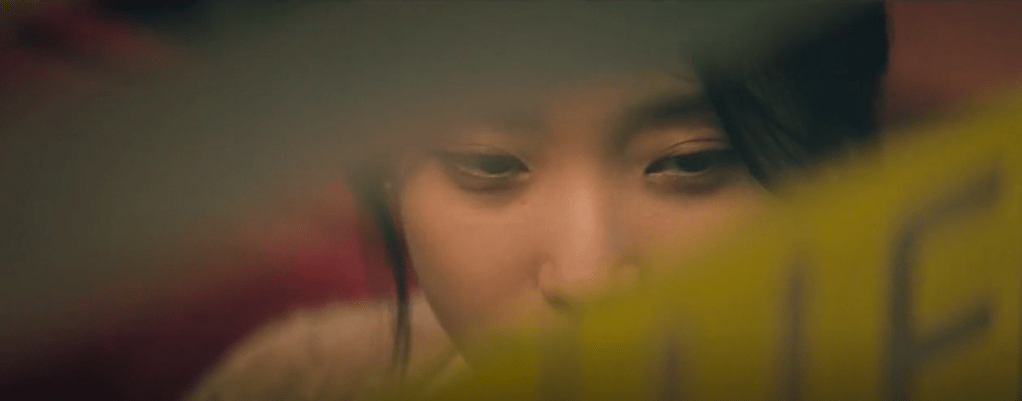
Short focus lens, representing reality and unreliable memory.

“So now you recognise me ?” he asks.

The camera cuts back to the former reverse angle, only now, Mi Yeong has been replaced by an old woman. She has been reliving her meeting with Chang-seok’s father, who has now passed away. We see her wedding ring. Mi Yeong is not some flighty sassy girl, but a grieving, possibly ill, elderly lady.

Look around the café; solitary people sit, reading books or newspapers. One man even plays a board game alone. Loneliness, literature and loss.

We cut to an street scene and get a little of Chang-seok’s backstory. He has returned to Korea after seven years, and has noticed how people have aged. His mother, we learn, will live in a nursing home. Yet, this voice-over doesn’t seem to be addressed to us, the audience, or to a friend. Is Chang-seok making notes for a new novel ?
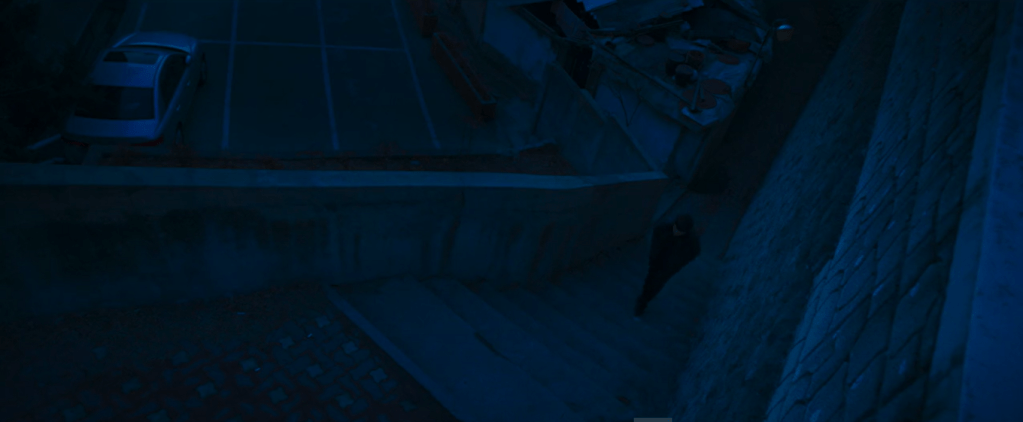
Yoo Jin is the next character we meet. Spring, we learn, is late this year, and the colours are still deep burgundy and brown as Chang-seok waits for this young lady who works for his publisher. We learn that she worked for him as editor, so they have a professional history. Yoo Jin feels that his last novel was too personal to be fiction, even though the main character dies, which could be a reference to Chang-seok’s emotional life. Something has been lost, but we, at this stage, still have few clues, only that he feels he has no more stories to tell.

Yoo Jin is dismissive of her CEO’s work, and is referred to as ‘harsh,’ and ‘cold.’ However, when she sees a dying bird, she appears troubled and sympathetic. Meanwhile, we see a middle-aged lady talking to herself, muttering about the wind, and asking to hold hands.

A short time later, as they are smoking (Chang-seok has ignored his mother’s warning), we hear Yoo Jin tell her story, about having an Indonesian boyfriend. She got pregnant and had an abortion.

Chang-seok doesn’t immediately react and when he does, it is with a non sequitur, an anecdote about Buzz Aldrin’s book (more literature) ‘Return to Earth,’ meaning that it is harder to return than to leave. Clearly he is speaking about himself.

Yoo Jin fails to see how this connects with her story.

We cut to night scenes, Chang-seok eats in a restaurant, while some women are using sign language in the background. Communication, the need to connect. We see a bar, a close up of a ship in the window. Chang-seok decides not to have a drink. Instead he goes to a phone box, but it has been vandalised. No communication is possible.

Part Four is where we meet Sung Ha, a middle-aged man and former acquaintance. Chang-seok is working on his laptop in another café, and the two meet by chance. Sung Ha seems very upbeat, a little too much, as if it were forced. As Yoo Jin masked her pain by a cold exterior, Sung Ha is the reverse. We see he carries cyanide with him, which he will take when he wife dies.

Sung Ha’s wife has been in a coma and, desperate for any remedy, he sees a Buddhist monk and follows his instructions. Incredibly, the wife seems to have come out of the coma and has opened her eyes.

Then Sung Ha excuses himself as he has a phone call. In that time, Chang-seok takes the cyanide bottle. Sung Ha returns and says he must go to the hospital. His wife has just died.

Ju Eun is the lead in part five. She is working a quiet bar, has short black hair, wears black and has tattoos. Additionally, one eye seems lighter. She exudes an air of coolness, aloofness and indifference. Tonight is, she informs Chang-seok, her last night, so he can stay as long as he likes.
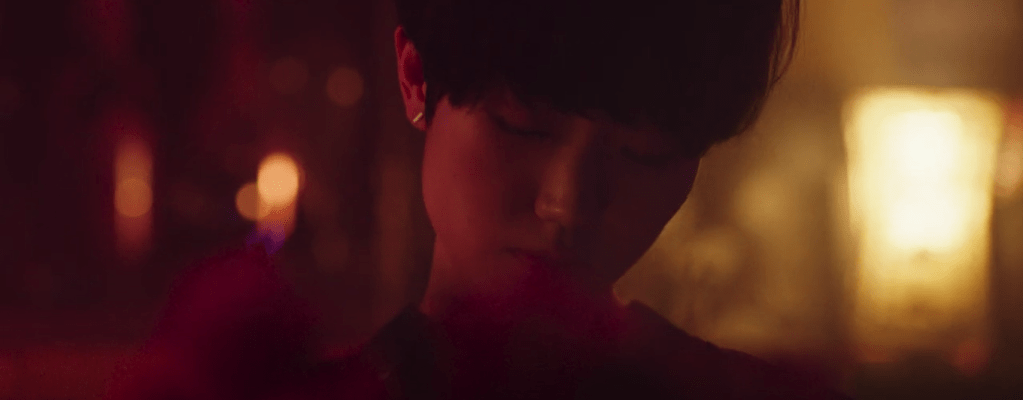
Chang-seok is writing in a notebook, and tells Ju Eun that he is waiting for someone (rather than admit to being alone), but his story doesn’t convince her at all.

Ju Eun likes that he uses pen and paper in this modern age, saying that she uses a voice memo app to record ideas, then transcribes them later. She writes poetry based on her customer’s stories. If the stories are boring, she invents a reason why they are boring.
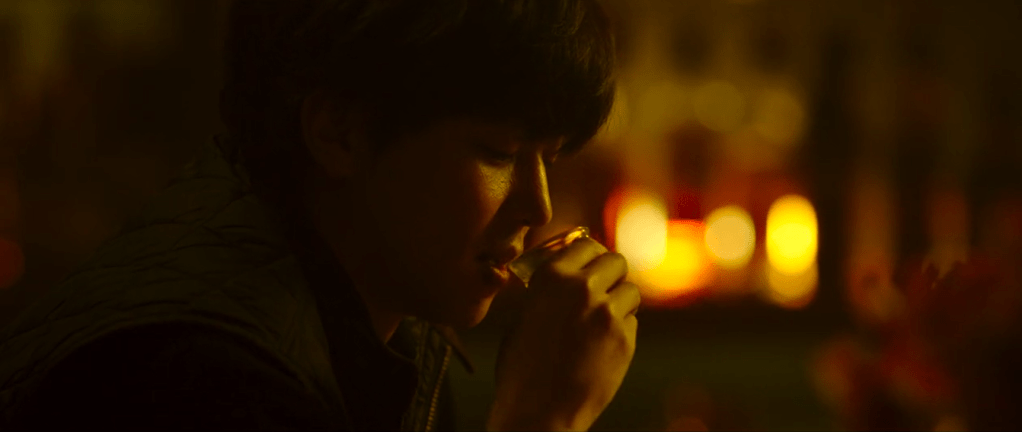
Without waiting for the question, Ju Eun opens up, explaining that she was in a serious accident, where she lost her eye, was scared on her chest and has lost most of her memory. She offers free drinks to customers who ‘sell’ her a memory which she can record, a form of a Faustian pact.

Chang-seok’s memory story is, perhaps predictably, disappointing and uninspired, yet it pleases Ju Eun. They drink together. Ju Eun’s favourite glass is shown to be chipped, imperfect. She kids him again about waiting for a friend; she has heard all the stories. Chang-seok doesn’t ask her about her future plans
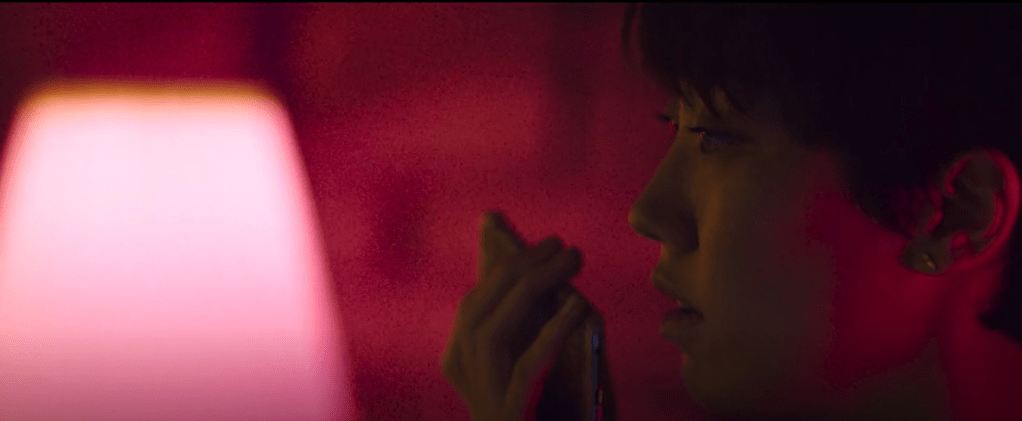
The final part is where we learn about Chang-seok. At home, on his desk, sit the cyanide. He leaves the apartment and goes to a phone box, calling his wife in England. The background music is unobtrusive but ominous.

During the conversation, the wife, who is also Korean, says she misses him and agrees to get back together.

“Soo-yeon misses her Daddy.” This stops Chang-seok, and he tells his wife that their daughter is dead. The wife dismisses this, saying that their child is sleeping next to her. However, the unemotional voice leads us to believe that she hasn’t accepted the death and still thinks the child is alive.

Chang-seok knows that both his daughter and, at least for now, his wife are gone. This can explain why he appeared so indifferent to Yoo Jin’s confession. At home, he prepares the cyanide.

We cut to the blue light of dawn, a new day, new hope. Chang-seok walks past the bar, the toy boat still prominently displayed in the window. He looks up. In the distance, an old man is helping an old lady to walk up a street. Is this Chang-seok in the future ? Does he find happiness with a new wife, or does he reconnect with his present one ?

The picture turns black and white. Suddenly the woman from the Yoo Jin sequence appears, but now she has a small boy with her. The boy is carrying the toy boat, from the bar, and the mother tells him to hold her hand, to stop him losing her.

We see Chang-seok writing. He has a new idea for a novel. He is writing about the happiness he lacks, literature is creating a life. A made up life is better than no life.

He is with his wife. They still love and care for each other after all these years. A young mother is so happy, her son is her entire life. We hear the lines from the beginning, Chang-seok sees himself from behind, he is both observer and observed.

‘Shades of a Heart’ keeps the audience guessing until the very end when we have to re-evaluate Chang-seok and his life. We know things are not what they seem when Mi Yeong transforms from a young girl to an elderly lady, but we are kept waiting until the end for the emotional release, the tears about the dead daughter, the dying mother and a mentally scarred wife.

Kim Jong-kwan has made a film that demands several viewings to appreciate its beauty, delicacy and pain.

IELTS: Talking Pictures. Describe a favourite film

16th March 2022

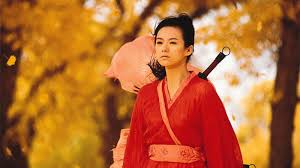
Zhang Zihi in the visually stunning film ‘Hero’
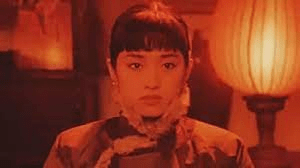
Exquisite cinematography in ‘Raise The Red Lantern’ with Gong Li

A typical IELTS question

Talk about a film you like. Why do you like it, and what is the story ?

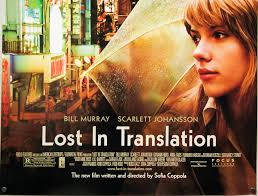
The film I would choose is ‘Lost In Translation‘ starring Scarlett Johannsson

STRUCTURE:

Short introduction – do not answer the question immediately

Organised structure – one point per paragraph

A change of attitude – a critical view

Short conclusion

LOOK OUR FOR

Low-frequency words

Complex sentences – combining two or more bits of information in the same sentence.

Discourse markers – words to link ideas together

Adverbs and less common adjectives

So, without further ado, the question:

Talk about a film you like. Why do you like it, and what is the story ?

INTRODUCTION – talk about cinema or films in general DON’T immediately talk about your favourite film.

Watching films and going to the cinema is one of my passions, so choosing just one film is going to be terribly difficult, not to say impossible. However, if I have to select one film, it would be ‘Lost in Translation’, with Scarlett Johannsson.

First paragraph. Information about the film and the main characters.

The film, directed by Sophia Coppola, daughter of Francis Ford Coppola, was made in 2003, and takes place in Tokyo. A young newly-married girl, named Charlotte, is alone in her hotel because her husband is constantly out working. Staying at the same hotel is a middle-aged, world-weary American actor, Bob Harris, in Japan to make a commercial for Japanese whiskey.

Second paragraph. The plot: what happens and why.

Both characters appear to be suffering from culture shock and seem afraid to leave the security of the hotel. For example, despite seeming to be impressed by all the neon and energy of the city, Bob spends his night in the hotel bar with other tourists, while Charlotte reads and listens to music in her room.

Third paragraph. Develop the plot.

They meet in the hotel where, age difference notwithstanding, they seem to get on extremely well, extremely quickly. Furthermore, they give each other energy and courage to venture outside. We learn that Bob is less than happy in his current life, while it becomes apparent that Charlotte is doubting her own marriage. At one point it look like they will get together, hook up. However, Bob decides to go back to the USA leaving Charlotte, but not before they share an embrace on the street in which Bob whispers something in her ear. We, that is the audience, do not get to hear what he said; we have to speculate.

Fourth paragraph: Something negative for balance.

Some people could be irritated that the final words are a mystery, other could be somewhat disappointed by this love story that never happens. This negativity is like a black cloud on an otherwise bright, sunny day. The film is quite melancholic as we are left to wonder what might have been.

Conclusion: A short summary.

‘Lost in Translation’ is described as a romantic-comedy-drama. The characters are totally believable and likeable, while, technically, the cinematography is stunning. Furthermore, in my view, it is a charming, heart-warming, and life-affirming albeit bitter-sweet movie.

An iconic shot from the opening of the film

NOW … YOUR TURN

LIGHTS, CAMERA, ACTION !

Please Note: All photos are taken from Google Images or free photo sites, and are used for educational purposes only. No copyright infringement or offense is intended. If I have used your photo or image, and you wish me to remove it, just ask. This site is not monetized, I run it on my own dollar. Thank you.

Book into Film: The Painted Bird

29th July 2021

9780553124606 - THE PAINTED BIRD by Jerzy Kosinski

Over twenty years ago I read ‘The Painted Bird’, by the Polish-born author Jerzy Kosinski and, as I was reading it, I knew the images, the emotional impact, would be indelible. Last night, I watched the 2019 film version, and now I hope this blog introduces the work to a new audience.

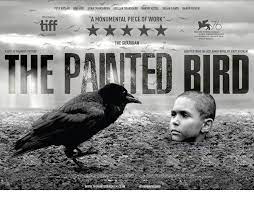
The book cover succinctly simmarises the tale. The setting is an unspecified area of eastern Europe during World War II. The Nazis are invading, bringing with them their ideology of racial superiority. The Communists are pushing back from the east, while brigands of bandits are attacking hamlets. Destruction, torture and violence. Mankind without the humanity, a return or regression to barbarity. There is – almost – no right or wrong, merely who is the strongest.

The film opens with a boy, Joska, running through some woods, clutching a pet stoat. We can tell he is being chased, although we do not see by whom. Inevitably, he is out-run and out-numbered and Joska is beaten by boys his own age, who take the animal. This is war time, maybe the animal will serve as food for starving villagers … but, no … the animal is gruesomely tortured. This scene encapsulates the theme: brutal violence for the sake of brutal violence. This is the world Joska was born into. No compassion, no empathy, no mercy; kill or be killed.

The Nazis, foreshadowed early in the film by a solitary plane observed by Joska, are just one of many threats. This world, this mid-C20th Europe, is dominated by ignorance, superstition and cruelty, it is the Bible of the Old Testament, animated by Bruegel and Bosch.

Already we have seen boys, children, symbols of innocence and purity, torturing for pleasure. Joska moves from place to place, at the mercy of adults, and cannot comprehend the brutality that is done to him or in his presence. He witnesses a miller, obsessively jealous of his young wife, rip the eyes out of a young apprentice because he dared look at the mistress. While the miller is beating his wife, Joska runs away, looking for the apprentice. The boy tries to help by giving the apprentice some round objects to replace his eyes, then continues his flight realising he has, inadvertently, caused more pain.

Each act of violence serves as an allegory of that world. Blindness, not knowing, not wanting to know. Genocide victims are numbered in hundreds of thousands, in millions. Such figures are beyond our comprehension, so the power of the story comes from seeing evil on an individual level. We become desensitised viewing death en masse. Watching a solitary act of brutality has a far more powerful effect. We feel the victim’s pain and fear, we abhor the evil personified by small groups of people. People who look the same as us.

The title is taken from an episode in which a seemingly pleasant older man collects small birds. He derives pleasure from painting one, then releasing it into the flock. The other birds sense something different and begin attacking. Just one of many incidents of cruelty, but a suitable metaphor, that justifies its prominence.

However, there are some glimpses of hope. A Nazi, expected to kill Joska because he is Jewish, allows him to run away, instead firing two shots into the air. Later a Russian sniper takes to Joska, protecting him. When four Russian soldiers are attacked by locals, the sniper calmly goes to the village and with a long-range rifle, kills four people. He teaches Joska the, “Eye for an eye,” policy.

Read as an allegory, we see all vices and perversions, the depravity that humans can sink to. Yet we also, fleetingly, see hope, warmth, friendship and compassion. We see how insidious intolerance and prejudice can be and what evils it can inspire.

‘The Painted Bird’ is intense in the extreme. For me, it is an unforgettable experience.

Art Cinema: The Cranes Are Flying 1957, USSR. Director : Mikhail Kalatozov

13th June 2020

The Cranes Are Flying | Jerusalem Film Festival
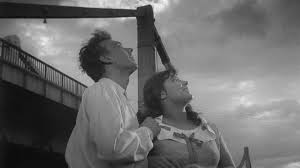
Looking up to see the cranes, flying

First, a thank you to Darrel over at ‘A World Of Films’:

https://aworldoffilm.com/2019/05/11/my-current-favourite-films/

Darrel lists his (current) top ten films, and topping the list was this Soviet film which I hadn’t seen. So I started searching online, and the clips I saw were so mesmerising, so dazzling, the reviews so laudatory, I had to see it. I began with a review:

https://www.youtube.com/watch?v=XCDHExdjO0M&t=6s

This introduction gives context and commentary on the film, as well as placing the film in relation to other noteworthy examples of Russian or Soviet cinema.

Despite only finding short, two-minute excepts with English text, I wasn’t going to be deterred. Instead, I decided to read the synopsis on Wikipedia:

https://en.wikipedia.org/wiki/The_Cranes_Are_Flying

and then watch the original Russian version sans subtitles. I’ve recently been considering how cinema should (could) be told, and how so much exposition text is actually needed, how much text, in fact, is needed. As F.W. Murnau has beautifully shown in ‘The Last Laugh’ (1924), a film, a great film can be told without any need for dialogue or title cards. But that, as they say, is for another blog …

I will briefly relate the plot, then what attracted me to the film.

SPOILER ALERT: in order to highlight the creative camerawork and staging, the plot details need to be mentioned.

Boris and Veronika are young sweethearts, staying out late and risking family censure by sneaking home, trying not to wake their parents.

Film Reviews: The Cranes Are Flying
Happy in love, the sun reflecting off the water, life is a dance

However, when the Germans invade Russia, Boris, along with his close friend Stepan, join up. Boris has to catch a train to get to his battalion and Veronika rushes to say goodbye, but the crowds are so thick, she has no hope of seeing him. In vain, she throws her gift, but it falls and breaks on the ground. This clearly foreshadows the fate of their romance; they will never meet again.

Meanwhile, the War comes to the city, and Veronika’s parents are killed during an air raid. With nowhere else to go, Boris’ family take her in and during another air raid, with the living room symbolically shaken, glass shattered, Boris’ younger brother, Mark, sexually assaults Veronika. Her shame compels her to marry Mark, to the disdain and contempt of the family.

With the German advance, the Russians are moved eastwards. We see both the mounting Russian casualties and the sorry sordid state of the sham marriage.

Veronika is told that Boris is dead and runs frantically, racing a train under which she plans to throw herself … yet a young boy, who we later learn is also called Boris, diverts her attention, and she takes him home.

The film ends with Veronika waiting at the train station for the victorious Soviet soldiers to return. Amidst all the tearful reunions, Veronika meets Stephan; he confirms that Boris is indeed dead. Veronika is again denied any further contact by the sheer force of the crowd, her tears of heartbreak juxtaposed against the tears of happiness. As at the beginning, she looks up and sees, in a V-formation, the cranes flying.

I love the idea of the camera-stylo – the camera being able to move as freely as a pen, the director (and cinematographer, art-director, the whole team) being able to put their personalities on to the film so that by a mere shot or two we can detect a Hitchcock from a Hawks, a Kurosawa from an Ozu, a Godard from a Truffaut. Naturally, this will later clash with Roland Barthes’ essay, ‘The Death of the Author’ (1967) … again, for another blog.

I love the idea of a camera being free, released from the constrains of the studio, allowed to move and as it were, to breathe. From an actor’s point of view, it could be different, with concerns about hitting exact marks at exact times, instead of focusing purely on the performance (yes, another blog), but as a viewer, as a lover of cinema, ‘The Cranes Are Flying’ features some breathe-taking shots and said shots add meaning to the film … they are not mere decoration. Take this shot:

The Cranes Are Flying | Pima County Public Library

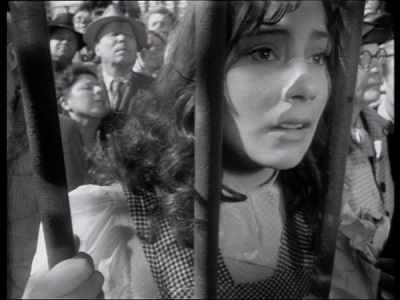
Veronika is so close to her goal yet blocked … and she had no where to turn, she is trapped, confined. This next still can’t capture the circular spinning of the camera, whirling up the stairs, as their hearts whirl with love, happiness and hope … none of which will last.

Russian Film Trailer: "The cranes are flying" 1957 - YouTube

Then we have the crowd scenes … and what scenes … the camera is like a character, bustling and elbowing its way through, between people, around vehicles, forcing its way off buses or onto trains.

The Cranes Are Flying - YouTube
The Cranes Are Flying (1957)
Marx and Matryoshka · The Cranes are Flying
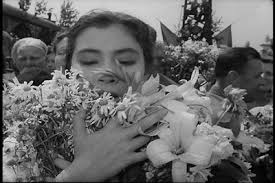
Flowers for the lover destined never to return
The Cranes Are Flying: A Free Camera | The Current | The Criterion ...

I hope you enjoy it

Allez, ciao !

quote movie quotes talking jean-luc godard Vivre Sa Vie ...
Vivra Sa Vie – Jean-Luc Godard 1962