This blog is aimed at IELTS level students, or anyone who wants to learn how to speak or write in longer sentences.
This involves the use of complex sentences and discourse markers. Furthermore, a wide vocabulary is necessary to prevent repetition and to maintain interest as well as, of equal importantance, to make you feel that you are able to express what you really want to say.
One must not forget that when speaking, intonation, stress and body language will all help to make you sound more like a native-speaker.
To recap, a complex sentence uses different clauses (part of a whole sentence) to make a longer, more interesting sentence.
(I will write a blog just about complex sentences, with examples and exercises, in the near future)
Example: Thay Paul plays guitar. Thay Paul is from London. London is the capital of the UK
Thay Paul, who plays guitar, is from London which is the capital of the UK.
The bold text is the main clause, the plain text is a supporting clause. Which and Who are relative pronouns (Paul = who, & which links London to “capital of the UK”). Therefore, we have three pieces of information in one complex sentence.
Discourse markers link ideas together. Look out for ‘although’, ‘therefore’, ‘furthermore’ which should all be part of your everyday vocabulary.
For vocabulary, you can look at your work; could you replace a basic word with a better one ? Make use of a thesaurus, and note down any new words you encounter.
Now, moving on, today’s theme is cultural differences. This doesn’t have to mean travelling to a different country or continent, but even in the same country. For example, one of my neighbours told me about a business trip she took. Ms Phuong is from south Vietnam, but she had to travel to Ha Noi in the north. This is her account of the journey:
I asked Ms Phuong to tell me what happened.
Hanoi old quarter
Last week I went to Hanoi and it was partly business, partly pleasure.
I wanted her to elaborate:
I went to Hanoi, last week, and it was partly business, partly pleasure.Although my expectations were low it turned out to be a greatly rewarding experience.
That was a great introduction, please continue:
I have mixed feelings
I was curious, so I allowed Ms Phuong ten minutes to gather her thoughts, write notes, then tell me:
I have a love-hate relationship, as I believe many south Vietnamese do, with Hanoi. On one hand, I really enjoy the cuisine, the flowers and the colonial architecture. Good points notwithstanding, I have one serious issue with the city and that is the work culture.
Being born in the south, I am used to long working hours, up to ten hours a day and, if need be, working on Saturday mornings. Southern workers tend to be highly focused on work and are always seeking ways to improve their performance. In contrast, workers based in the north seem to lack such a strong work ethic. The working day is limited (is capped) to eight-hours a day and, in my experience, this is a common practice. Furthermore, staff frequently go out for refreshment or leave early.
I noticed this while I was living in Hanoi, and when I return to the city on business. Fortunately, my staff comply with a strict office working policy; I encounter this issue when dealing with suppliers. I have to waste time waiting which makes me feel frustrated as there is nothing I can do to expedite matters.
NOW – what did you make of Ms Phuong’s answer ? I’m speaking in terms of the English, not necessarily the point she makes about Ha Noi.
(make of = think about).
How many complex sentences did you notice ? How about discourse markers ? Were there any words you didn’t know ?
Oh, no … we are not finished, not by a long chalk (not by a long way). Now it’s your turn. Write a short piece based on cultural differences or, if you prefer, write a rebuttal to Ms Phuong’s experience.
Guidance:
A short introduction
First point with reasons to support your view.
A contrary (opposite) view.
Short conclusion.
For those studying for IELTS, read it to yourself, and use a stopwatch … can you speak for two minutes ?
Talk about a film you like. Why do you like it, and what is the story ?
Cinema Paradiso 1988 Italy
This blog will serve as a model to IELTS students to help with their speaking and writing skills.
IELTS has lots of ‘open’ questions, to enable the student to speak freely on subjects about which they feel comfortable.
In my last online lesson, I mentioned a film that I though a student would like, as she had chosen to speak about Scarlett Johannsson.
The film in question is ‘Lost In Translation‘. Here is a little piece about the film.
An iconic shot from the opening of the film
NOTE:
Short introduction – do not answer the question immediately
Organised structure – one point per paragraph
A change of attitude – a critical view
Short conclusion
LOOK OUR FOR
Low-frequency words
Complex sentences – combining two or more bits of information in the same sentence.
Discourse markers – words to link ideas together
Adverbs and less common adjectives
So, without further ado, the question:
Talk about a film you like. Why do you like it, and what is the story ?
INTRODUCTION – talk about cinema or films in general DON’T immediately talk about your favourite film.
Watching films and going to the cinema is one of my passions, so choosing just one film is going to be terribly difficult, not to say impossible. However, if I have to select one film, it would be ‘Lost in Translation’, with Scarlett Johannsson.
First paragraph. Information about the film and the main charcters.
The film, directed by Sophia Coppola, daughter of Francis Ford Coppola, was made in 2003, and takes place in Tokyo. A young, newly-married girl, named Charlotte, is alone in her hotel because her husband is constantly out working. Staying at the same hotel is a middle-aged, world-weary American actor, Bob Harris, in Japan to make a commercial for Japanese whiskey.
Second paragraph. The plot – what happens … and why.
Both characters appear to be suffering from culture shock and seem afraid to leave the security of the hotel. For example, despite seeming to be impressed by all the neon and energy of the city, Bob spends his night in the hotel bar with other tourists, while Charlotte reads and listens to music in her room.
Third paragraph. Develop the plot.
They meet in the hotel where age difference notwithstanding, they seem to get on extremely well, extremely quickly. Furthermore, they give each other energy and courage to venture outside. We learn that Bob is less than happy in his current life, while it becomes apparent that Charlotte is doubting her own marriage. At one point it look like they will get together. However, Bob decides to go back to the USA, leaving Charlotte, but not before they share an embrace on the street, in which Bob whispers something in her ear. We, that is the audience, do not get to hear what he said; we have to speculate.
Fourth paragraph: Something negative for balance.
Some people could be irritated that the final words are a mystery, other could be severely disappointed by this love story that never quite happens. The two protagonists return to their lives which will, possible, be unfulfilling. This negativity is like a black cloud on an otherwise bright, sunny day.
Conclusion: A short summary.
‘Lost in Translation’ is described as a romantic-comedy-drama. The characters are totally believable and likeable, while, technically, the cinematography is stunning. Furthermore, in my view, it is a charming, heart-warming, and life-affirming movie.
As I constantly inform my students, IELTS is not a typical English class … it is IELTS English by which I mean, students have to demonstrate a command of the language that includes a wide range of vocabulary, the confidence to speak fluently, the correct stress and intonation to keep your listener engaged, the ability to form complex sentences and link them with appropriate discourse markers. Additionally, a knowledge of how English is REALLY spoken, to wit, sounding like the student has been interacting with real native-speakers, not merely repeating verbatim from a text book, is a must.
Piece of cake, no ? (an English idiom – you will need to learn some basic expressions, phrases and idioms to make your spoken language more natural and interesting).
OK, let’s break it down. IELTS requires a lot of work, study and practice. Students that come to my class expecting to kick back and be entertained are in for a shock, and then some. As such, I will not be defining the idioms I employ in this blog, e.g. Piece of cake – YOU will have to look them up yourself.
Don’t worry, young lady, I’m here to help you. Having said that, if you’ve been on a three-month course and you’ve left it to the last week to study … then you will probably fail, and deservedly so. Yes, life in the IELTS lane is tough, it’s dog eat dog (though ‘devour’ would be a more IELTS-friendly word than ‘eat’).
Where to start ?
OK, IELTS wants what they term ‘low-frequency’ words. Basically, look at your English; replace any basic adjective or verb or indeed noun, with a ‘better’ word, a word that would be used by the higher-educated native speaker. Your best tool here is a thesaurus of which there are many online, or downloadable for free.
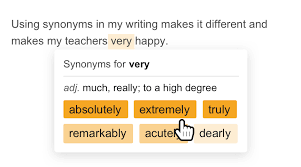
It works thus: Let’s start with a very basic adverb ‘very’. This is too simplistic for IELTS, so type in the word and click enter.
A number of words will appear. As above, the darker-shaded words are what the computer’s algorithm indicate would be more suitable, while giving additional options in lighter shades.
The proof of the pudding is in the eating – so let’s try it: rewrite these sentences using low-frequency words:
I think Bangkok a better destination than Chiang Mai
She bought a cheap bag
The film was good
Stage Two
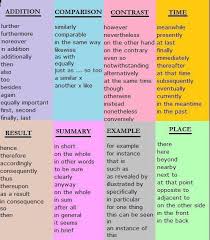
Linking ideas with discourse markers. I give all my students a print-out of common words and expressions that must be consulted and utilised. I hope that all my students take them home and study them religiously. Conversely they may use the paper to line the bottom of a bird cage. In all reality, the majority of students say, ‘Thank you,” have a glance, put said sheet in their bag and forget all about it. Consequently, several weeks later, the students are still resorting to ‘and’, ‘but’ with a possible ‘however’.
You can lead a horse to water but you can’t make the horse drink
Discourse Markers
I recommend my students learn at least two from each section.
Adverbs are incredibly powerful and so easily inserted into everyday text
I worked at another large and prestigious language centre, and had the pleasure of marking some essays by teenagers. From twelve pieces of ‘writing’, I found only ONE adverb.
Adverbs add information and interest to your language, but my students seem to avoid them like the plague. They may deign to insert a ‘very’ to please me … but it doesn’t ! I expect, nay, DEMAND more.
Without further ado
An example. IELTS will give students a very open-ended subject and then expect a well-constructed piece of writing, or fluent, coherent speech upon said subject, with no deviation, hesitation or repetition. It is a chance for the student to perform a solo, to demonstrate how much they have learnt and studied … or otherwise … generally it is ‘otherwise’.
Time for an anecdote. I was teaching one class, and endeavouring to give them ample opportunity to speak and practice English. Nobody spoke. If I selected some students, they would make an appalling act of not having heard the question, or to answer in a single word. Some students even began laughing that teacher was asking the class but nobody was responding. Hilarious … but he who laughs last, laughs longest. I decided this class was a waste of my time (because it WAS a waste of my time) and left them to their fate … CUT TO some weeks later, it’s the day of their speaking test … suddenly, they are running up to me for help, “What should I say ?”, “I don’t know what to do”, “I’m going to fail.” Temptation was to tellthem where to go ( that is an expression that does NOT imply direction !), but I gave them what help I could in the minute I could spare. Needless to say … most of the class were disappointed with their score, and no doubt, upon arrival at the family nest, were met were screams and derision. And no doubt they put the blame squarely where it belongs … on the foreign teacher !
The concluding line was an example of irony. I’m not going to tell you what irony is, look it up for yourself ! Do you want a fish or a fishing rod and knowledge of how to catch your own fish ?
So now, a fairly run-of-the mill IELTS question:
Tell me about your favourite gadget
This piece is, as one would expect, quite lengthy and jam-packed with information and detail. I don’t expect you to write or speak at this level … but I expect you to TRY.
As you read, look out for:
Low-frequency words
adverbs
adjectives
discourse markers
complex sentences (sentences which coney more than one piece of information)
expressions, phrases and idioms
THEN – practice reading aloud. Not just once and, “Teacher, finished,” but again … and again … and again. Yes, this is not entertainment but it WILL help you get the score you want from IELTS
My Kindle
One of my favourite electronic devices is my Kindle, an ebook reader, which is small and light. I always take it with me when I travel; I’d be lost without it.
The Kindle is primarily a way to buy, store and read books in electronic format. At first, I wasn’t convinced; I liked reading real books. However, books take up a lot of space and, at least in the UK, are rather expensive. When I saw what a Kindle can do, and that so many books are free, I was hooked ! I had to get one. I bought my device in 2014 and I’m still using it today.
As mentioned, I use my Kindle for reading. Literature, including poetry, is one of my passions. Instead of going to a shop, I just browse the online store, click and wait for it to download. With reasonable wifi, this can just take a minute or so … then I can start reading. It is no surprise that ebooks are ubiquitous in the UK.
Although I read a lot, the Kindle is more than just an ebook. It has wifi so I can access the internet, can play music, write notes and play games.
The wifi is vital, especially when I travel. I can maintain contact with friends and family, watch YouTube if the hotel TV is less than enthralling, or read travel guides such as Trip Advisor. Naturally, I can also book tickets or make reservations and therefore pay significantly less.
I recently travelled to Thailand to meet some friends. I didn’t want to buy a new SIM card, and my friend only had an old phone, so there was a dilemma; how to stay in touch ? Thanks to my Kindle, I had email access, so we could plan when and where to meet.
I can’t watch Vietnamese TV, due to the language barrier. Consequently, the Kindle plays an even bigger part of my life, as I need some way to relax after toiling away for hours at work.
The choice of books is amazing. In the stores, a single book can cost around £10, but recently I downloaded the entire output of the Russian write Tolstoy for less than £1.50 … incredible !
Kindles come in many shapes and sizes, so before you buy, you need to ascertain how you’ll be using it. For example, do you want a basic ebook reader, just for books, or the latest model with wifi ? This will, naturally, affect the cost. Then you have to decide upon the extras, for example how much storage space do you require, or a super-fast charger or protective case ? All of these bump the price up considerably.
If you’re interested in purchasing one, I have some information for you. I did a quick Google search and saw prices started at under 2 million VND, averaged around 5 million, but some were over 15 million. That, for me, is too extravagant.
In conclusion, my Kindle is very much a part of my life. It accompanies me everywhere. I simply don’t know what I would do without it.
Now … YOUR TURN
Write a piece about YOUR favourite gadget, using the above as a model
Best of British to you
Please Note: All photos are taken from Google Images or free photo sites, and are used for educational purposes only. No copyright infringement or offense is intended. If I have used your photo or image, and you wish me to remove it, just ask. This site is not monetized, I run it on my own dollar. Thank you.










 Thay Paul's Notes