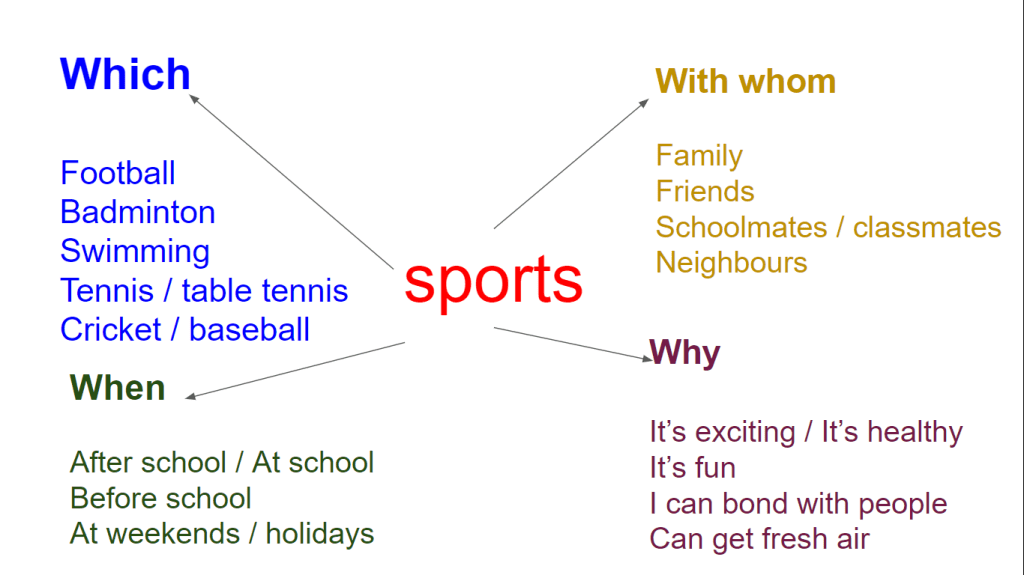
1) Landscape 2) the men 3) the birds 4) the cheeky bird
1) Landscape
Where is this ? What can you see ? Describe the scene
(China, mountains, river, lake, trees, rocks. The sun is rising with a golden light. The scene is peaceful and tranquil.)
2) The Men
What do they look like ? What do they do ?
(The men are old, with lines on their faces. They smoke and have disgusting teeth, yellow and black. They dance and chant. They feed the birds tiddler fish.)
3) The Birds
Describe them
(The birds are intelligent and talented. They are expert hunters and can swim well. Also, they can count, up to 7. After 7, they refuse to work unless they get some tiddlers to swallow.)
4) Cheeky bird
What does the cheeky bird do ?
Now, write your short story about fishing with birds. Advanced students can practise writing in the simple past, using verb 2.
Good luck !
Please Note: All photos are taken from Google Images or free photo sites, and are used for educational purposes only. No copyright infringement or offense is intended. If I have used your photo or image, and you wish me to remove it, just ask. This site is not monetized, I run it on my own dollar. Thank you.
In the early 1990s, I inherited an 8mm Bell & Howell cine camera and, with my flatmate Martin O’Shea as actor, began making short films in the East End of London.
8mm cine camera late 1950s / early 1960s
We had a two-bedroom flat near Mile End Tube Station (which we could somehow afford on a student grant), walking distance to Bethnal Green, Brick Lane and Limehouse, areas synonymous with names such as Hawksmoore (the architect), The Kray Twins (local crime lords) and Jack the Ripper (local ripper).
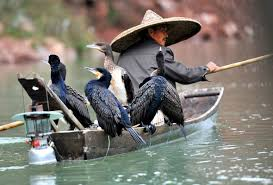
St George in the East, a Hawksmoore church
The area is incredibly historic, and well worth a walk for local historians, psychogeographists, or anyone with a passing interest in this less salubrious quarter of London.
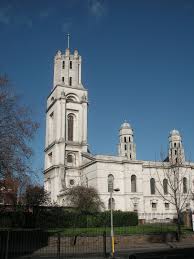
Ragged School Museum, Mile End
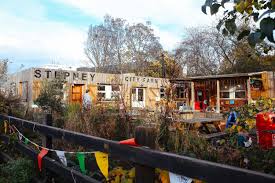
Walk is what we did, one Saturday night, up to Victoria Park, down to the street markets of Brick Lane and back home via the city farm at Stepney and a visit to St Dunstan and All Saints Church, where we had a lovely chat with the vicar. He was in his working outfit, white, pressed and clean … us, none of the above.
This was where we decided to film what was, I believe, our first film together, ‘A Day Well Spent’, and I think this would be Spring 1992.
St Dunstan and All Saints Church, Stepney, East London
Now the technical side. 8mm film lasted four minutes in total. The film had to be thread, in a figure 8 shape, in the camera, then reversed after 2 minutes. This meant keeping careful time, and not shooting anything vital in the dying seconds before the film ran out.
The film was silent and the camera, I believe, had no zoom and no auto-aperture; the light had to be set manually. Basically, it was a ‘point and shoot’ affair. Close-ups had to be physically close, long-shots, far away.
So, we had four minutes to tell a story, beginning, middle and end. Martin plays a tramp, a happy-go-lucky, Chaplinesque character. He awakes, on a rubbish heap, scratches himself, looks around and gets up. He wanders through the City farm at Stepney
Stepney City Farm
Naturally, he’s hungry and seeing the chickens gives him an idea; he has to ‘procure’ an egg for breakfast, without being detected or suffering an avian assault. With his cunning and agility, he is successful, and celebrates his victory by holding his prize aloft as he runs past St Dunstan’s.
However, when he searches his pockets, he only has a fork with twisted prongs … not a suitable implement to eat his breakfast. Disappointed, he throws the egg away, and decides to go back to sleep.
We also had a recurring event, namely a visit from the rozzers (London slang for police). One burly boy in blue was curious what we ne’re-do-wells were up to in his manor. To see a young guy, in trenchcoat, asleep on a rubbish tip alerted his instincts. And we had a recurring escape, namely I showed my camera and all became clear … “Oh, they’re making art,” heavy irony on the pronunciation of ‘art’, and that sarcasm has repeated through the years.
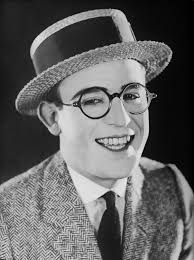
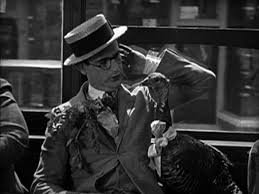
Or maybe, like most people of my generation, he would have seen some short compilation films on BBC1 after 5.30 pm and before the 6.00 pm News. This was how so many of my friends were introduced to the world of Harold Lloyd.
Everyone knew Chaplin, most people had heard of Buster Keaton, but Mr Harold Lloyd was totally unknown. That all changed with a series of 20-minute programs featuring scenes from his silent films … and all my school-friends were knocked out by them. You would even hear people shout out as they left school, “Don’t forget to watch Harold Lloyd.”
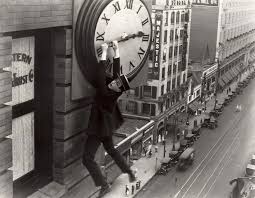
Harold Lloyd, referred to as ‘The Third Genius’ was, and remains, a major influence, especially in how to tell a story by images alone and how comedy works. This photo from ‘Safety Last’ (1924) is iconic … and even more amazing when you know that Lloyd lost a thumb and finger in an accident on a film set.
His films and many clips are available on YouTube. I used to show them during break time to my Kindergarten class, and they loved him … I was able to silence 15 hyper-active kids with a silent movie star.
Meanwhile, Mr O’Shea is busy in Berlin with a massive project: to put all our 8mm and Super 8 films onto computer, add commentaries and upload them on social media. Wish him luck, and take some time to watch Harold Lloyd … you won’t be disappointed
Taiwan has featured in many online news clips recently. Here are some which caught my eye (made me notice) and which, furthermore, will be useful for students to practice listening to ‘real-world’ English speaking; the rhythms, stresses and intonations of everyday speech.
As with other blogs, I will drop in certain phrases or expressions, which I will highlight. In addition, there will be a lot of new vocabulary in the listening clips. Watch them in short sections, writing down any new words or phrases.
Feel free to ask me to explain anything you can’t understand
Additionally, I’d like to share a blog from my online friend, Silk Chatters, who is based in the USA, and writes extremely interesting articles. One such article, a blog which caught my eye, is about being critical when listening to news reports. Silk ends her blog with:
Question what you read and hear, and avoid a steady diet of one type of information, it’s as bad for the mind as eating only one type of food is for the body.
I know she will be delighted if you read and ‘like’ her blog.
In the UK, we pride ourselves on having a free press – newspapers, TV and other media are able to write what they want without fear of persecution (there are exceptions, naturally, but that is outside the scope of this blog).
However, newspaper readers generally know the political views of the paper they’re reading. In the USA I believe I’m right in saying that many TV news stations report the news according to their political opinions … or of those who own the station. For example, Fox News is seen as Republican (right-wing), while CNN is viewed as Democrat (left-wing).
Readers in the USA, please correct me if I am mistaken.
Therefore, when you see or read news, remember to ask questions and try to check the facts for yourself. A sophisticated readership will necessitate more sophisticated journalism … ideally … and what can be more ideal than the search for truth ?
The Corona Virus, COVID 19, continues to spread, and there are opposing theories as to its origins. The consensus is that it started in Wuhan Province, Mainland China. Taiwan, which is so close, has relatively few cases (at time of writing, 388 cases with 6 deaths compared to the official figures for China 82, 052 and 3, 339).
Relations between China and Taiwan are contentious (if you don’t know the history, the internet will help to fill you in – give you information)
Taiwan, whose capital is Taipei, “Shall be a democratic republic of the people, to be governed by the people and for the people.” Tsai Ing-wen is the President, and she features in our first clip: A YouTuber called Potter King met Tsai Ing-wen, and angered China by addressing her as ‘President’.
We now move on to a video clip that went viral. Dr Bruce Aylward was asked about Taiwan being admitted to the WHO (World Health Organisation). This is what happened:
‘The Guardian’ is seen as a liberal, left-leaning paper, and is probably more for the educated reader than mass circulation. As such, the language will be challenging but rewarding for English-language students.
In the interests of fairness, I will show the WHO reaction to the above interview, which was somewhat awkward or embarrassing, to say the least.
The following websites are good for practicing listening. What are the pros and cons of each one ? What do you like or dislike about them ? How helpful do you find them ?
British Council (learn English teens). Home – skills – listening
And … listen to music (with lyrics), films (short clips – 30 seconds to 1 minute) and TV shows with subtitles.
Try these:
Music
Any English song with lyrics (words) will be a great way to learn, and fun as well.
Film ‘King’s Speech’
TV show – ‘Eastenders’
This is a ‘soap opera’ – a TV drama that is shown two or three times a week. Each episode last 30 minutes and has many different characters. This drama is set in eat London, so many people have an accent typical of that area. See how much you understand.
For individual letter sounds, the British Council has many good videos:



 Thay Paul's Notes