Adult Class, Level 3: Tell me more, tell me more …

19th November 2019 AEF 2B pp. 18 – 19

Tonight’s lesson will focus on listening, which is always a challenge for the students so, to lighten the load, not to mention the mood, I’ll organise a lot of speaking activities.

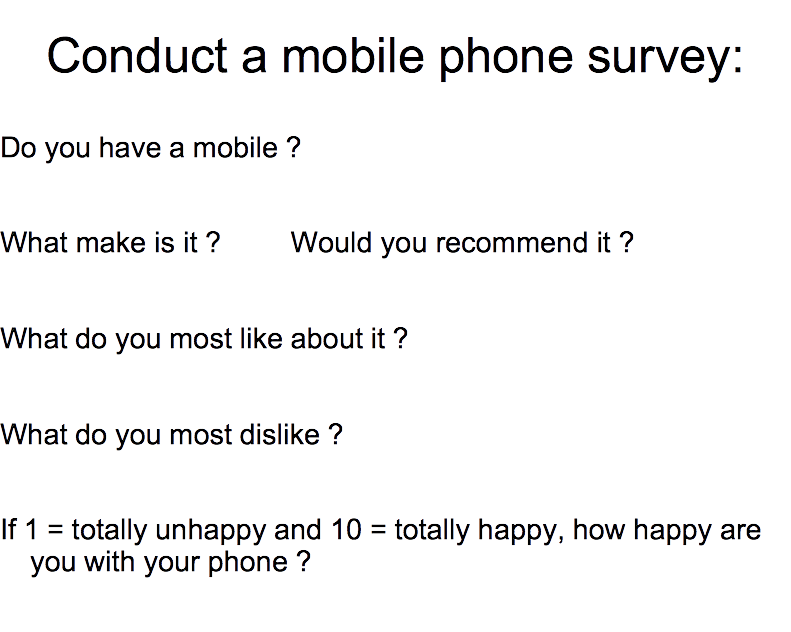
First up, a mobile phone survey:

One of many online review posts

The students will be arranged in small groups. One member will be responsible for gathering the information, then reporting back to me.

Next up – a new persona.

Students are put into two or three groups, with about four in a group. Each member is given a card with some information about their new identity. They read the information to the group who have to try to understand and write down details such as email addresses, phone numbers or Facebook accounts. Example:

Hello, my name is Tony

I’m 23 and I love shopping for shirts and ties.

I’m not into reading or books. I find them boring.

My mobile number is 0943 552 8207

It’s highly probable the other students will need to hear some of the information again, so they can use the following:

I’m sorry, I didn’t catch your phone number (email address etc)

Could you repeat that, please ?

Could you spell that, please ?

Would you mind speaking slower, please.

And then, to book work and listening exercises.

Grammar: Past perfect (for and since)

Why is this young lady so upset ?

Image result for angry asian woman

Maybe this is the reason …

Image result for man renovating

Her neighbour has been renovating his house the whole day !

He has been making a lot of noise since 8 o’clock in the morning.

He has been drilling for six hours, non-stop !

First, the past perfect formulae

Subject + have or has + been + verbing

Since used for a given time or date

For used to tell how much time.

Example – John joined his company, LPR Productions in November 2018.

He has been working for LPR since 2018

OR

He has been working for LPR for one year.

Students than have a chance to practise by asking each other a variety of questions, on subjects ranging from work or school, to friends, holidays, sports, interests etc.

Just a Minute

Students are put in pairs. They have to speak for one minute on a subject without hesitating, repeating or deviating (speaking about a different subject). This will test the students’ ability to speak fluently, as well as giving opportunities for using discourse markers and new vocabulary learnt so far. Subject are deliberately open, for example:

food // travel // work or study // life in Sai Gon // their family // their house.

Viet Nam presentation – where should I go on holiday ?

Three teams, representing Ha Noi, Hue and Nha Trang.

Image result for ha noi
Image result for hue postcard
Image result for nha trang postcard

This exercise encourages team work and, furthermore, allows the students to develop their intonation skills; they will have to sound excited and optimistic.

To assist, here are some words and phrases to embellish their speech:

cultural centre // historical importance // breathe-taking scenery // tranquil // relaxing // hustle and bustle // mouth-watering food // never to be forgotten //unforgettable // once in a lifetime experience.

To give some help, I can perform a quick example:

Image result for london postcard

COME TO LONDON, UK’s magnificent capital city and one of the world’s GREAT cities.

SEE such iconic, historical sights such as:

Buckingham Palace, home of our Queen, Tower Bridge over the Thames river.

Visit the world-famous British Museum to see the wonders of the world, or watch a football match at Wembley Stadium, in the country that invented the sport.

There is something for everyone:

Shops; you can buy everything here, to suit all budgets, from street markets to high-end department stores. To relax, London has so many tranquil parks, right in the centre of the city. Maybe see famous movie stars at one of London’s many, beautiful theatres, or dine out at restaurants cooking traditional British food or anything from anywhere.

London – one of the world’s GREAT cities

A holiday of a lifetime ! Book early !

Mr Paul tours – visit our website mrpaultours@ukonline.co.vn for more information

Special discount 10% for my students 🙂

And that should be a wrap !

Image result for londoners waving

Please Note: All photos are taken from Google Images or free photo sites, and are used for educational purposes only. No copyright infringement or offense is intended. If I have used your photo or image, and you wish me to remove it, just ask. This site is not monetized, I run it on my own dollar. Thank you.

IELTS 5- 6.5: All you need is love … and relative pronouns

25th September 2019

Tonight I want to focus on forming complex sentences in order to boost the speaking prowess of my students. Being able to speak in long sentences, with subordinate clauses and relative pronouns, linked by appropriate discourse markers, will improve their scores in the speaking tests, along with use of stress, intonation, chunking, and a liberal smattering of expressions and vernacular, thereby demonstrating a familiarity with different uses of English.

So, without further ado … complex sentences. Let’s kick off with some basic information about my friend Pete:

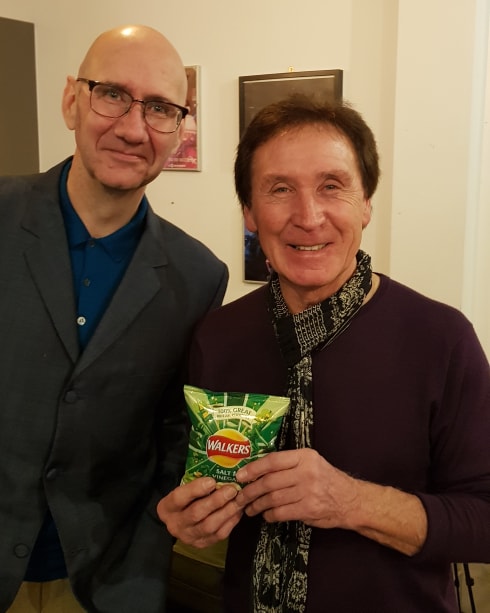
Pete (left) with drummer Kenny Jones of The Small Faces & The Who

Pete’s family are Irish. He was born in Kent, south England. He loves music especially Jazz and he can play saxophone, keyboards, guitar and bass. He is 40 years old. He is bald, and wears glasses. Currently he plays bass in a band called ‘The Deep Six’. They have a video on YouTube. In the photo, Pete is with the famous 60s drummer Kenny Jones. He was in The Small Faces. Later he joined The Who after their original drummer died.

Example:

Pete, who was born in Kent in the south of England, is of Irish heritage. Although he is just forty, Pete looks older, probably due to the fact that he is bald, as well as having to wear glasses. His great passion in life is music, especially Jazz, but his interest is not merely passive; he plays several instruments. In addition to saxophone and keyboards, Pete is proficient on guitar. Having said that, he actually plays bass now in a band named The Deep Six, who have a video on YouTube. Pete is seen here with the legendary drummer Kenny Jones who rose to fame in the 60s as drummer for chart-topping band The Small Faces before joining The Who following the death of their original drummer.

And here is said video:

https://www.youtube.com/watch?v=W-_u-W_3jWk&list=LLfquznE0joCgmA3v1PIQ0CQ&index=6&t=0s

I am sure if you watch the video, give it a ‘thumbs up’ and ‘like’, Pete will be tickled pink.

Now, a quick practice:

This is Wei Minzhi. She was born near Beijing. She was chosen to be in a Chinese film called ‘Not One Less’. She was 13. She played a substitute teacher but had no experience teaching (and no experience acting). The area is very poor. Some of the children have to leave school to work. The film was shown all over Europe, even at special film festivals. She was famous. She did no more acting. She studied in USA. She lives in Hawaii. Wei is married and has two children.

Students have five minutes to reorganise this information into a style more suited to an IELTS student.

Now – a Socratic activity; students are arranged in small groups, selected by choosing a card (Ace, 2 or 3), given a task and have to collate information and present it to the class, utilising the resources available, namely internet for facts, images or videos. Let’s revisit some old friends; first one of my favourite authors, Dr Franz Kafka:

Image result for kafka

Born: 1883 Prague, Czech Republic (at the time, part of the Austro-Hungarian empire) // Died 1924 in Austria. Never married, engaged twice. Had three sisters. Was vegetarian. Difficult relationship with his father. Famous for writing, but only produced three novels, all of which were published after his death. Most famous of these is ‘The Trial’ which has a famous opening line, “Somebody must have made a false accusation against Joseph K., for he was arrested one morning without having done anything wrong.” This book is seen as a warning about totalitarian governments. He lived in Prague which is Czech and Protestant, but he spoke and wrote in German, and he was Jewish. He is one of the most influential writers of the Twentieth Century, and his name has become an adjective, ‘Kafkaesque’ meaning impenetrable, convoluted, mysterious and unsolvable. More information can easily be found online, for example:

https://www.dw.com/en/franz-kafka-the-trial/a-45774582

Now let’s turn to John Lennon, seen here with his Japanese wife, Yoko Ono (also an artist, but more avant-garde).

Image result for john lennon

John was born in Liverpool, during World War II, in 1940. Liverpool was a port, so was a target for German bombers. He grew up very poor. At school he was rebellious, but liked art. When he first heard Rock ‘n’ Roll, he knew he had to be a singer. He formed The Beatles. His guitar playing was enthusiastic but basic. He wrote many songs which have become classics. When The Beatles split up in 1970 he went solo. His most famous solo work is the ‘Imagine’ LP. The title track has the lyric, “Imagine there’s no countries
It isn’t hard to do
Nothing to kill or die for
And no religion, too.” He protested against the war in Vietnam. He was shot in 1980 outside of his New York apartment. He has two sons, Julian by his first wife, and Sean from Yoko.

The third group will get NO help from me – they shouldn’t need it. Their subject is “the father of the Indo-Chinese people, and his name is Ho Chi Minh.”

Image result for Uncle Ho

This task involves the students working together, assigning tasks, then producing and presenting their report. All members of the team have to speak. Furthermore, they should be encouraged to use English during the preparation stage, only resorting to Vietnamese for clarification or translation of new words.

Quick end game: After the book work, which I have to teach, my hands are tied, we can unwind with some speaking practice.

Using discourse markers: I give teams two words which they have to incorporate into a sentence, for example ‘therefore‘ and ‘subsequently‘.

having said that & furthermore

moreover & consequently

initially & eventually

likewise & specifically

meanwhile & notwithstanding

on the whole & instead

What Difference Does It Make ? : I give students a paper with two words or phrases that are related but different. They have to clarify the distinction, for example

teacher / headmaster

educate / bring up

take an exam / retake an exam

do homework / do housework

quite common / ubiquitous

required subject / optional subject

similarity with / disparity between

skim / extrapolate

And to play us out, let’s go back to John Lennon and his iconic song, ‘Imagine’. The music starts around 0:40:

https://www.youtube.com/watch?v=YkgkThdzX-8

Nothing to kill or die for … Peace xx

IELTS 5 – 6.5: I come from a land down under.

21st August 2019. Pages 10 – 12

Lesson focus: Reading; speed reading to extrapolate information in a limited time.

Theme: Culture shock, specifically life in Australia.

Objectives: Review new vocabulary and phrases and give a chance to practise using them. Continue work on Englishes – how written and standard English can seem to bear NO relation to spoken English.

Today’s reading is centred on life in Australia for non-native speakers so, to set the scene, a warm up song from the Australian band (and one-hit wonders) Men At Work and their chart-topping song, ‘Down Under’.

https://www.youtube.com/watch?v=XfR9iY5y94s

What stereotypes are displayed in this video ?

Image result for Australian stereotypes

Language review: The first lesson generated many new words and expressions. The following adverbs should be a part of the students’ everyday vocabulary:

always / usually, normally, frequently / sometimes / hardly ever / never

definitely / probably / possibly / unlikely / definitely not

Vocabulary: precious / arrogant / mug (two senses) / lingua franca /

To ask politely: May I …. (May I ask your name ? May I open the window ?)

Discourse Markers: although / despite, despite that / however / on the other hand /additionally / furthermore

Collocations: To practice law or to practice medicine (a lawyer, or a medical professional)

Expressions: Fair exchange is no robbery / If I’m not mistaken

Idiom: To let off steam / time flies (when you’re having fun)

London slang: well knackered (‘well’ is used to mean very and ‘knackered’ can mean very tired, or broken. EXAMPLE – I’m well knackered = I’m extremely tired.

PRACTICE: Try to use as many of the above by commenting on these photos. This is not a writing test; I only want one or two sentences. I’m more concerned with lexical choice AND delivery – how you use stress, intonation and rhythm.

EXAMPLE:

Related image

These young Asian people are letting off steam by singing their hearts out in a Karaoke room, if I am not mistaken. Very probably there are professionals, maybe they practice medicine because they look very stylish and affluent.

Image result for Arrogant lawyer
Image result for mother and child

Book work: today we will be developing speed-reading, that is, reading a large amount of text in a limited time, in order to find specific information. Students will have to scan over the text and home in on what they need to know.

As a break, here’s a little clip about Australian slang:

https://www.youtube.com/watch?v=9QCgqQdmr0M

What is this news story about ? How much slang did you hear ?

Group work: 

Prepare a guide to Sai Gon for tourists.

Allow students access to the class computer for Google images if required.

Students, in groups, can organise an itinerary for two of my friends who will be visiting Sai Gon soon. They want to see all the iconic sights and partake of typical Vietnamese activities. Having said that, their interests differ widely.

Canadian/English couple looking for a double room ‹ SpareRoom

Simon loves culture, history and museums as well as being into sports and physical activities. Therefore he wants to see and try as much as possible. He has heard about snake wine and is very curious.

Jenny finds museums unbearably boring and dull. She is a shopaholic, can shop till she drops. Furthermore she can’t take the heat, and is also vegetarian. 

Clearly, they will need to compromise … what do you suggest ? Be creative – think outside the box.

Include 

What to see and do // where and what to eat // what to buy //

What they can do for entertainment 

Travel tips

Safety and scams 

Cultural differences – what should people do or NOT do in Vietnam ?

Use interesting adjectives to describe the city centre.

Groups can then present to the class, with all students taking turns speaking. I shall be listening for relevance, pronunciation and use of expressions and discourse markers. Furthermore, I may learn some interesting tips.

Image result for Saigon centre hcm
Image result for City museym hcm

End activities:

Just a minute: To practice for the speaking tests, give the students a choice of subjects and let them speak for one minute without repeating themselves, deviating from the subject or hesitating.

Call my bluff: Class in two teams. One team reads a low-frequency word and the team give three possible definitions including examples of usage. The other team has to guess which one is the correct answer.

IELTS 5- 6.5: Just like starting over

13th August for Wednesday 14th August. Unit 1 pp 8 – 9.

Lesson focus: Listening skills

Theme: Moving to a new country

Objectives: Improve conversation skills by using discourse markers, better vocabulary and supporting clauses.

Allow students to hear ‘real-life’ native speakers in song and vlogs.

Introduction song – John Lennon ‘Starting Over.’

https://www.youtube.com/watch?v=zPfB9KG9rao

Yoko Ono and John Lennon.

Songs are a great way to introduce new vocabulary and expressions, as well as how native speaking pronounce and link words together. Early in the song, we have words such as ‘precious‘ and expressions like ‘we have grown‘ and ‘time flies so quickly.’

Warm up: Mind map – Travel

I start by writing the word ‘travel’ on the board, and see how many avenues spread out from it. Start with the grammar; what type of word is it (noun) but it can be made into a verb (to travel, travelling) and the students should remember how to apply it to a person (traveller).

Then we have expressions such as ‘travel broadens the mind.’

We have this quote which introduces metaphor – the world as a book:

Then more pedestrian aspects of travel; how do we travel (transportation), preparation (booking tickets, hotels, visas etc), what do we bring with us (different clothes, sun cream, currency, sun glasses etc). How about culture shock ?

Next, what are the positive aspects of travelling (new cultures, fun, adventure, relaxation) and conversely, the negatives (delays, waiting in soulless airports, getting ripped off, tourist traps, bad hotels etc)

Pair work: students have to write a short passage using ‘although‘ and ‘despite‘ to encapsulate their travel experiences or wishes.

EXAMPLES: Although I absolutely love travelling, there are many drawbacks. Firstly, there is the cost; it can be incredibly expensive what with plane tickets and hotels not to mention having to eat out in restaurants. Despite these issues, travelling can be so relaxing or exciting, seeing new places and doing new things or simply as a break from our normal lives.

Vietnam has many beautiful towns and places of interest although I have only been to a few of them despite travel being relatively cheap in this country. We can fly everywhere within one or two hours, at very reasonable prices although some cheap airlines, such as Vietjet, are notorious for delays.

I have always wanted to visit Beijing in China which is not excessively far from Sai Gon. Despite that, I haven’t been because I am not sure about the visa and how expensive it would be to visit. Additionally, I hear some negative things such as terrible pollution and many tourist scams. Despite the drawbacks, I really want to see the Great Wall, the Forbidden Palace and all the temples. Although Vietnam and China have a complicated relationship, most Vietnamese would agree that Chinese food is delicious.

These exercises help to increase vocabulary and confidence. Furthermore, the repetition helps to make the target language part of the students’ lexical resources.

As a break from the book work, I’ll show the class a vlog from YouTube, two tourists who come to Sai Gon and what they think of the city. https://www.youtube.com/watch?v=2iw_K-1AmVk

How do the tourists feel about the city ? As residents, do they agree with the review ?

Students can discuss the video using the following language:

I agree totally // I agree to an extent // I disagree // I’m not entirely sure // No way ! They don’t know what they are talking about !

optimistic // uninformed // delusional // open-minded // enthusiastic

Group work: Prepare a guide to Sai Gon for tourists.

Allow students access to the class computer for Google images if required.

Include

What to see and do // where and what to eat // what to buy //

What they can do for entertainment

Travel tips

Safety and scams

Cultural differences – what should people do or NOT do in Vietnam ?

Use of interesting adjectives to describe the city centre.

Groups can then present to the class, with all students taking turns speaking. I shall be listening for relevance, pronunciation and use of expressions and discourse markers. Furthermore, I may learn some interesting tips.

IELTS Revisited

10th April 2019

I’m now taking my second IELTS class, and the great thing is that I’ve already made lesson plans. Additionally, my class is much smaller – seven students as opposed to 17 – and they seem slightly more motivated and animated.

But there is still room for improvement … and I’m referring here to myself, as a teacher. My centre tries to promote as much student talking-time as possible, ideally aiming for as high as 80% student conversation … ideally. In reality, the teacher has to face a number of obstacles. I’ll save those for another, more general blog, as I want to dedicate this post to extra work, and tips to get the students talking.

First up, I need to make the students take notes (Vietnamese are not in the habit of doing this, as my centre manager explained). Instead, they will often just take a photo of the board. Secondly, once the student has sat down, they generally will not move until it is time to leave … three hours later.

I will now insist that they take out and use notebooks, the rationale being that the active process of writing will help them remember the words or phrases much better than taking a photo (which they may never look at) or relying on their memory.

Likewise, I will strongly recommend that instead of sitting and talking with the same person all class, they get up and move around, practice with different people (“But teacher, I am tired, I am lazy,” – I have actually heard these from people half my age ).

Now, without further ado, some extra work.

In Lesson Two, I started off with some compound nouns, based upon shopping. This was a way to introduce new vocabulary as well as filling time while late students arrive.

My manager suggested that this could be developed into a speaking exercise. For example, using the compound nouns ‘bulk shopping’, ‘window shopping’, ‘binge shopping’, ‘impulse shopping’ and ‘dumpster diving’, make a presentation with questions:

Have you ever made an impulse purchase ?

How often do you go window shopping ?

Do you ever buy in bulk ?

Is dumpster diving popular in Viet Nam ?

Then, what are the pros and cons of:

Typical street market … but is the fruit safe ?
District 7 shopping mall: food courts, cinema, shops and stalls.
Souvenir store in District 1. Are the prices fixed or does it depend on how rich the buyer looks ?

Basically, get the students speaking as much as possible. To help them develop longer, more complex sentences, I’ve given them sheets of discourse markers, and each week we focus on one type and select three words. For example, last week was ‘addition’; instead of saying ‘and’, they could use ‘additionally’, ‘furthermore’, or ‘moreover.’

This gets practiced when they have to link two basic sentences:

I like coffee. I like tea.

They could be linked by a simple ‘and’, but try using new discourse markers.

Sentences can be built up by using adjectives, adverbs, discourse markers, and by the use of clauses. This will entail relative pronouns … but that is for another lesson. The students have two months and hopefully they will see improvements after every lesson.

Adult Class Level 3 Jan 2019: When life gives you lemons, make lemonade.

8th January 2019

This blog site really saved my bacon last night – allow me to explain …

Those who know me know that, as much I love the idea of technology, I know NOTHING about it. People have to show me how my iPhone works, how to access websites, even basics such as how to turn the computer on in the first place ! Then, when I’m on a piece of equipment … it breaks, crashes, gives up the ghost, malfunctions … dies (just last weekend I broke BOTH the office photocopiers – technicians had to be called).

In Greek mythology, there was a King called Midas who asked for a gift – he wanted to be able to turn everything to gold, just by touching it. I seem to have the ‘anti-Midas touch’ – every piece of hardware I touch breaks.

Last night, in the classroom, I wasn’t able to access the class ebook, nor my Powerpoint presentations (ppt) which I was going to use as warm-ups for the class. Fortunately, this blog page opened and I was able to use the IELTS blog for the class. The theme last night became ‘keep clam and carry on.’

So, in case a similar event occurs, here’s tonight’s Adult Class:

When I looked at the work, my heart sank. The text books are not aimed specifically at Vietnamese students, but for all students, possibly mixed-language classes. Subsequently, some of the themes are of limited interest to my students; consequently my class are going to be less than enthralled. I need to jazz up the lesson !

These classes are arranged in blocks of four, the last part of the last lesson being a spoken exam. Therefore, I will allocate the second part of tonight’s class to speaking activities and, to warm up, I’ll have them speak to each other but in the form of a market research survey. Quite simply, I need a new mobile / cell phone.

However, I don’t know which one to buy ..

It is very confusing – I am confused.

I love Apple but … they can be very expensive

In addition, the reviews have been less than favourable:

So I need to do some research, read some online reviews or do some market research.

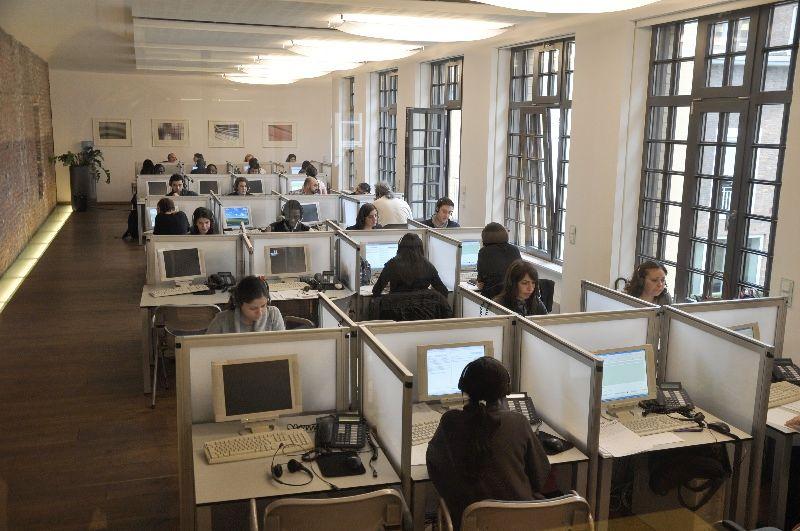
A typical market research office
One of many online review posts.

I need my students to carry out / to conduct a survey for me


The students will be arranged in small groups. One member will be responsible for gathering the information, then reporting back to me. I shall then collate all the data and display the findings in chart form (which will be beneficial for those who wish to study IELTS later).

After this, I shall do a vocabulary- building exercise – showing some basic words and a ‘better’, higher-level word (a ‘low-frequency’ word as some books term them).

boring mortifing

confusing irritating

embarrassing tedious

exciting bewildering

frustrating exhilarating

Spelling rule:

‘I’ before ‘e’ except after ‘c’

Examples: believe field niece priest achieve

but

receive ceiling receipt deceive

These are exceptions to the rule

This leads into the book work. Many study get confused with the I am / It is structure. For example, some teenagers and university students have wished to proclaim their disapproval of my classes, and have very politely shouted out, “I am boring.” They of course mean to say ‘I am bored’, which causes laughter from those who know the grammar, and a certain satisfaction on my part. Instant karma, baby !

The class will then practise the correct -ed or -ing form of the words, before moving into the reading and listening part of the lesson.

I like to use real-life videos for listening when appropriate. Tonight I’ll show a YouTube clip from Mark Wiens, who is a food enthusiast. In this clip, he tries a typical Vietnamese breakfast, and I want to see how much my class understands. Here, the paralinguistics are important; body language, intonation, word stress

https://www.youtube.com/watch?v=crPVJ3CXs1g

Mark tries what is basically a pretty normal breakfast but he seems to be really enjoying it. Other students have found him very amusing, though feel he was overcharged at 91 000 VND (for two).

After break, I want the students to practise speaking, so I’ve prepared a list of general questions.

Speaking exercise

What did you do on New Year’s Eve ?

What was the last film you saw ? Did you like it ?

How many people live in your house ?

What is hard about learning English ?

How often do you chat online ?

Which social media sites do you use ?

What is your favourite food ?

Do you often eat western food ? Do you sometimes eat fast food ?

What sports do you play ?

What do you feel about shopping ?

What would you most like to buy ?

Do you like living in the city or countryside ?

Have you ever sang karaoke ? 

What country would you like to visit ?

Do any of your family live outside of Vietnam ?

Have you tried Korean or Japanese food ? What did you think ?

This can be arranged in a ‘speed-dating’ format. Students sit facing each other, speak for a few minutes, then move on to the next student. This way, they are able to practise speaking and listening with a variety of people, not just their friends. There is generally some resistance (or even refusal) with adult students to comply, so I encourage them by using non-confrontational words such as ‘suggest‘ or ‘recommend‘. Having said that, last night in my IELTS class I used, “Teacher says ‘stand up’ ” … and half the class actually DID stand up and mingle. Hey – whatever works !

A good game to end is a variation of the British radio show ‘Just a Minute.’ Students are given a subject (for example, HCM City) and must speak for one minute without repetition, hesitation or deviation. This can be done in pairs, and they can time each other on their mobiles. In order to practise for next week’s test, we can discuss what makes a good answer, and how to use discourse markers to link ideas together.

Another ‘trick’ is the use of phrases or words to ‘buy time’ while they think of an answer. This can include:

Let me think ….

How can I put it ?

That’s an interesting question …

Well,

And also repeating, in part, the question but using intonation:

Q: What will you do tonight ?

A: Tonight, I will ….. (go home and study / meet friends)

Then, if time allows, I’ll play the ‘eyewitness’ game. This involves showing some faces (three men followed by five women) for a limited amount of time, then seeing how much they can remember.

Tonight’s objectives will be for students to be able to differentiate between confused / confusing, learn some new vocabulary and be more confident and proficient speaking in longer, more fluent sentences … and to hear how an American ‘foodie’ loves Vietnamese breakfasts.

Please Note: All photos are taken from Google Images or free photo sites, and are used for educational purposes only. No copyright infringement or offense is intended. If I have used your photo or image, and you wish me to remove it, just ask. This site is not monetized, I run it on my own dollar. Thank you.