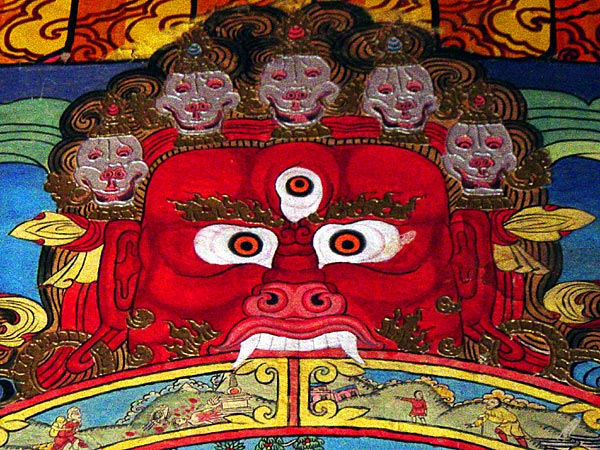
from the ‘Hall of Yama’ sequence, an underground Berlin dance club.
Part 2 of the OST (original soundtrack)
‘Hari Karachi & the Durango 4’
The music was composed and performed by Jingo Harleyman, and is royalty-free; anyone may download the music or use it for non-profit purposes.
Furthermore, all the music is free to use for no-budget or low-budget projects. Please credit the composer:
Music by Jingo Harleyman ⓒ 2022
Hari Karachi is a cybertective, notable for wearing crocodile boots.
In Part 2 Karachi, acting on a tip-off from Tiger Girl, flies to Berlin to meet an old accomplice, Seymore (sic) Green. The two talk in a pulsating, deafening underground nightclub, and Green organises a nightdrive to a safehouse … but for how long will the safehouse remain safe ?
The Durango 4 are approaching.
Now, without further ado, the video:
The story (spoiler-free) will continue in the next blog post, Part 3 of the OST.
Part 2 is dedicated to the memory of the British actor Seymour Green (1912 – 1998)
From medieval Florence to modern-day Berlin, a film shot on both Super 8 and digital video, with a professional actor and professional sound engineer / cameraman. And all on no budget, as usual.
This is a retelling of ‘Inferno’ or Hell, an epic poem by Dante.
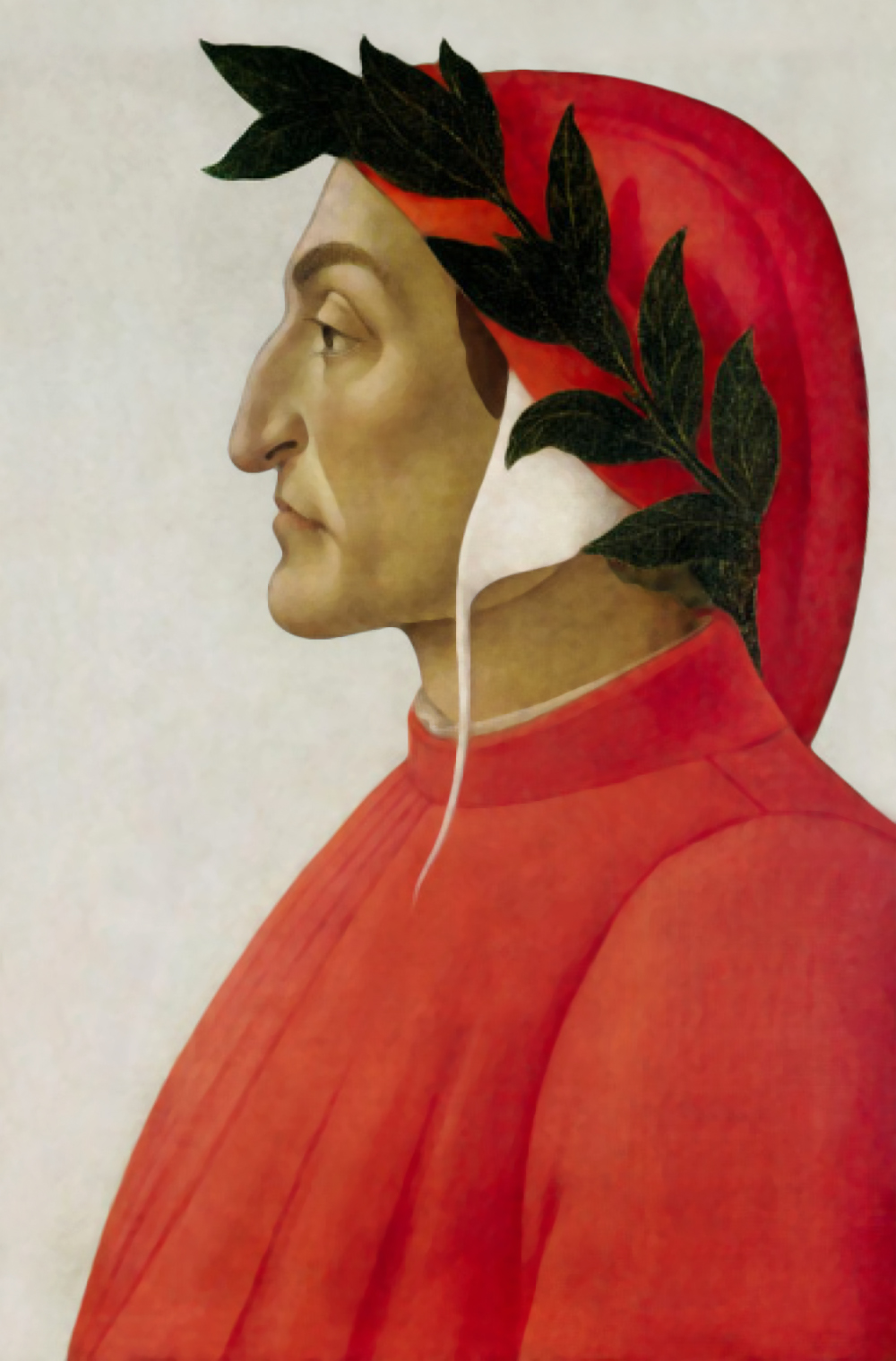
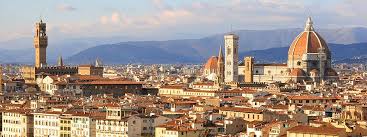
Dante Alighieri born around 1265 in Florence during a turbulent time of political infighting. He studied to be a pharmacist, and books actually were sold in pharmacies at this time.
Modern – day Florence with the incredible architecture
Dante is most famous for his Divine Comedy, a three-part poem, starting in Hell, Part 2 in Purgatory and finally Part 3 in Paradise. Of these, ‘Inferno’ is by far the most widely-read.
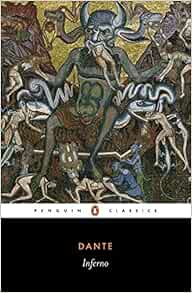
A recent edition of ‘Inferno’.
The poem starts with Dante in a dark wood, having ‘lost his way’. The poem is full of allegory and symbolism, the dark wood representing uncertainty and danger, as he has stepped off the path to God and salvation. He meets the Roman poet, Virgil (70 BC – 19 BC), who acts as a guide. Virgil will help to get Dante back ‘on the right path’ but this will mean going through the Inferno.
What follows is a journey where Dante sees the souls or ‘shades’ of the dead who are being eternally punished, in appropriate ways, for their sins on Earth. The Inferno is arranged in nine circles, the ninth being reserved for Lucifer.
Virgil guides Dante through the Inferno
As the two poets descend, the crimes, and the punishments get worse, until, finally, in the lowest circle, Dante sees the Devil.
This poem is a major work of European and World art, inspiring countless artists, including the German Gustav Dore, who etched these pictures.
The Devil in Inferno, by Gustav Dore
Dante had an idealised love, a young lady called Beatrice, and her purity gives Dante the courage to continue his horrific quest.
In the film, I have a young lady (Katerina) who reads by a small river holding a lily (the symbol of Florence). A man sees her and goes to speak to her, but she goes, leaving a book behind – the book is the Aenid by Virgil.
The Man then walks through modern day Berlin, to reach his salvation.
I used the new dome of the German Parliament building, the Reichstag, to represent the circular arrangement of Dante’s Inferno, and the Man walks over, or by, several rivers, symbolising the rivers of Hell.
The Reichstag dome
For the crimes against nature, I updated the book to mean environmental issues; the Man walks against a skyline criss-crossed with electric wires and factory smokestacks, like Blake’s ‘dark Satanic mills’.
We also filmed at Sachsenhausen Concentration Camp, which is in north Berlin, to represent the unspeakable horrors of genocide, all genocide perpetrated by any nation against any person due to race, religion, sexuality or politics.
Many thanks to my team who all worked and contributed their time and talents for free:
Mr Martin O’Shea, Mr Philipp Pressmann, Ms Manuela Fresard & Ms Katarina Worner.
All the technical, digital camera-work and editing was done by Herr F.T. Pen, and the incredible foley artist Herr Max Bauer.
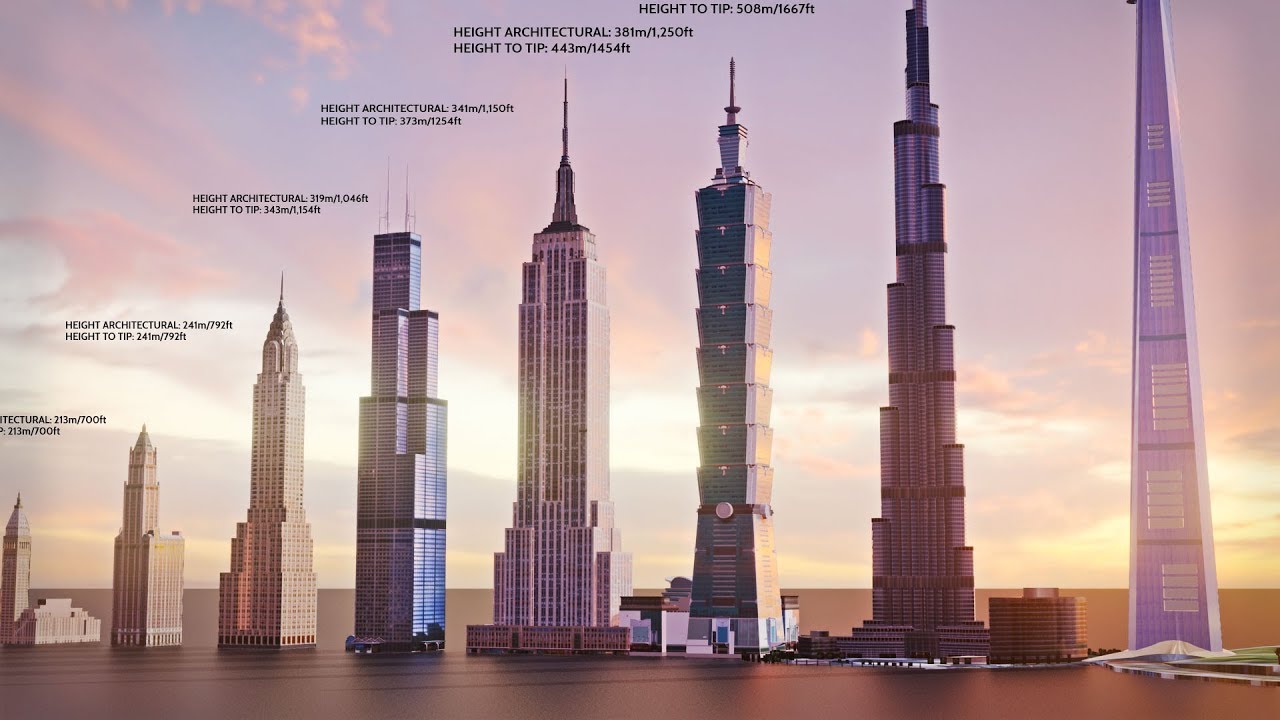
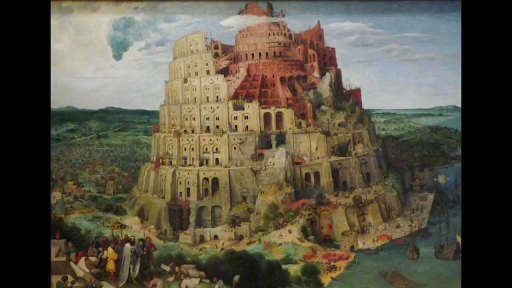
Are we getting close to the Biblical Tower of Babel ?
Tower of Babel by Peter Breughal 1563
For those who are interested in the story, here is the extract from The Bible, Genesis 11
Genesis 11 New International Version (NIV)
The Tower of Babel
11 Now the whole world had one language and a common speech. 2 As people moved eastward,[a] they found a plain in Shinar[b] and settled there.
3 They said to each other, “Come, let’s make bricks and bake them thoroughly.” They used brick instead of stone, and tar for mortar. 4 Then they said, “Come, let us build ourselves a city, with a tower that reaches to the heavens, so that we may make a name for ourselves; otherwise we will be scattered over the face of the whole earth.”
5 But the Lord came down to see the city and the tower the people were building. 6 The Lordsaid, “If as one people speaking the same language they have begun to do this, then nothing they plan to do will be impossible for them. 7 Come, let us go down and confuse their language so they will not understand each other.”
8 So the Lord scattered them from there over all the earth, and they stopped building the city.9 That is why it was called Babel[c]—because there the Lord confused the language of the whole world. From there the Lord scattered them over the face of the whole earth.






 Thay Paul's Notes