Now it’s time to put the work of previous lesson together in order to come up with more rounded character descriptions.
You can tell me what people are wearing by using adjectives (what we think of the clothes, the size, colour, pattern, material, country of origin).
Additionally, you should have enough vocabulary to tell me what a person looks like (length, type and colour of hair), height, age, what they look like.
Furthermore, I expect you to remember some personality adjectives.
If we put all these together, we have some very detailed descriptions, as well as having the opportunity to use relative pronouns (who, where, which, whose) in order to develop sentence-building which is absolutely essential for IELTS students.
And so, without further ado:
Describing people
What do they look like ? What are they wearing ? What kind of person are they ?
As always, I’ll give you an example of what I want, then it’s your turn:
Billy Office manager 32
Works staff very hard. Never gives pay rises
Buys clothes and electronics. Never gives to charity
Becomes angry after beer. Member of a gym.
Not many close friends. Does not like kids
Billy, who is 32 and an office manager, is a very strict boss. He is very serious and also very mean because he doesn’t give his staff more money. Furthermore, he never gives money to charity so he is selfish.
Although he is only 32, he is almost bald. However, he has a neat beard and moustache. He has brown eyes, and he doesn’t like to smile. Billy stands with his arms across his chest, so he doesn’t look very happy.
He wears a bright and expensive cotton shirt with a white collar, but with red, white and blue stripes. Furthermore, he wears an extremely expensive watch.
In his free time, Billy goes to the gym, and also likes to drink beer. However, after too many beers, he can become aggressive. He is a loner, not having many close friends. He spends his money on himself, buying clothes and gadgets. He has no plans for a family as he doesn’t like children.
NOW … YOUR TURN:
Tell me about Ji-yeon and Kofi
Ji-yeon singer 24. Kind to her musicians. Shares money with band. Gives money to family. Performs free shows. Just drinks 1 beer. Uses Instagram & Twitter. Wants 2 children
Kofi civil engineer 37. Very professional. Buys his team lunch. Helps his brother study. Gives money to UNICEF.
Likes to dance and sing. Meets friends weekly.
Goes jogging and diets. Loves swimming. Loves all children.
To make the lesson come alive, have the students act out scenes or give them a set time to make up sentences containing as many phrasal verbs as possible.
Same as Shakespeare … English is meant to be USED and SPOKEN … not just studied in a dry text book.
So, without further ado:
Phrasal Verbs
Put
the cat out / the fire out / up with it (something unpleasant) / on a happy face
it in your own words / up or shut up ! / it away / it another way
Get
well soon / over it ! / on with it / away with murder / on the bus
stuffed ! (impolite) / with the program (US) / some fresh air
Make
a career move / your move a pig’s ear of something / a wish /
up for lost time / the best of something / fun of someone /
Do
the right thing / away with that old technology / your best /
a funny walk / the dishes / your hair
Bring
it on ! / it to me / “my bow of burning gold” (poem) / about change
it up at the next meeting / a smile to my face / up children well
Take
turns speaking / it up with the manager / up my trousers a little /
a good look at yourself / a hike ! / medicine / a deep breathe
phrasal verbs:
look after/ think about / wear out / give up / grow up / takes after
tell off / look up to / hang up / go for / passed away
Phrasal verbs work like normal verbs, so they can be used in the infinite (look,think), the past tense (I wore out, I looked up to ..) and in continuous (I am hanging up now).
Make sentences using phrasal verbs in:
present tense
past tense
present continuous
Examples
I need to think about that for a while. (present)
He gave up smoking ten years ago (past)
We are looking after our niece today (present continuous)
Phrasal verbs
verb + particle e.g. find + out = find out (learn something)
The verb can be present, past, future or continuous:
I give up
I gave up
I’m finding out about HCM City.
I will (I’ll) find out about the cost.
buy out / up
call off
carry out
give up / away /
CLUE: first identify what tense is being used
They were __________ free samples
The computers are down; we have to ________ the meeting
A soldier has to _______ orders
The company was ______ by a Japanese company
The stocks are very low, we should ________ as many as we can
Don’t ________ on your dream 🙂
Make sentences with these phrasal verbs:
take care of // hold on // move on // take over // think it over
Phrasal verbs:
look after // think about // give up // grow up // takes after // tell off // look up to
Which phrasal verbs fits here ?
She really …………. her father, they are so alike.
I can’t go out, I have to ……….. my nephew.
Mandarin is too hard, I just …………. (past tense verb)
Many Vietnamese ………………. Uncle Ho
I’m not sure which bank is best. Let me ………. it and get back to you.
I had to ………….. my son because he ate all the cakes.
My manager is very immature. He needs to ………… and quickly !
Phrasal verbs
give up / go for / grow up / hang out with / hang up / look after / look up to / tell off / passed away / takes after /think about / wears out
Izzy is talking to Kate on Skype. Izzy can’t go out on Saturday because she has to
____________ (take care of, be responsible for) her little sister, Georgie. Izzy says she’ll __________ (consider) bringing Georgie too. Georgie interrupts, and Izzy has to
_____________ (end the phone/Skype conversation). Georgie’s hamster has ________
(died) and she’s upset. Izzy says she loves her little sister but she __________
(makes her tired).
Meanwhile, Sam is wondering why Izzy doesn’t want to _____________ (spend time with) them. He thinks Izzy should bring Georgie to the cinema, but maybe Izzy won’t ________
(like, agree to) the idea.
Izzy is annoyed because her sister is trying to look like her, but Kate says it’s sweet that Georgie _____________ (respects and admires) her big sister. Izzy disagrees that they are similar; Georgie ______________(is similar to an older relative) her dad, whereas Izzy is more like her mum.
When Georgie asks Izzy to get her a hamster, Izzy gets angry. She tells her sister
to ________ (become an adult). Georgie says their dad will _______(Izzy)_______
(speak angrily to Izzy because she’s done something wrong). In frustration, Izzy says
“I __________ (admit defeat)!”. Fred and Sam take Georgie to look at some kittens, then they all go to the cinema. Georgie is the only one who isn’t scared by the film.
Now – let’s get down
(have a dance and a great time)
What songs can you find that use phrasal verbs ?
Lighten up, it’s the laid-back sound of 70s California
Read this excerpt from a travel blog. How many adjectives can you see ?
This is my first visit to Turkey. It’s a wonderful place ! The people are friendly and the meals are delicious. Farmers here grow many different crops including many kinds of fruit. They also grow a lot of wheat, and the bread in Turkey is really good. Of course, the geography and climate in different parts of Turkey affect the kind of food farmers can produce in each region. In central Anatolia, the land is almost flat, and the weather is usually warm and dry. It’s a good place to grow crops and to raise animals such as cattle and sheep. High up in the mountains of eastern Turkey, farmers also keep animals as they can’t grow crops. Today, I’m visiting the coast of the Mediterranean Sea in southern Turkey. The weather here is hot and humid, but the fish and seafood are excellent.
features of a place, such as mountains, rivers, forest, desert
air with a lot of water in it
normal weather in a certain area
Turkish food
Welcome to Turkey
Grammar practice: past tense
Tell about your favourite, or more memorable holiday (UK English). You will have to use the past tense. Try to use adverbs and adjectives to describe the vacation (US English).
Activity:
Present a holiday using a mixture of advertising slogans and practical information. Remember:
It’s not what you say, it’s how you say it
Make your voice sound excited, as if this were the best holiday ever !
once in a lifetime experience / never to be forgotten / unbeatable prices
book now to avoid disappointment / best decision you’ll ever make
holidays to suit all budgets , from 7* luxury to backpacking
Structure:
To begin with / furthermore … additionally / the fact is … / therefore
Demonstration with an advert for London:
Now is the perfect time to visit London, England’s glorious capital.
To begin with, the weather is perfect for walking, so you can enjoy the lush parks, world-famous museums and incredible, unbelievable shops.
Furthermore, there is something for everyone … and more ! Like sports ? Go to one of the many Premier League football games. Love shopping ?
The fact is, everything is here – shop till you drop !
Additionally, if you adore culture – soak up hundreds of years of history.
Flights from TSN airport daily. Seven-day all-inclusive package tour starting from only 50m VND ! All transfers and transport included. Air-conditioned mini bus with Vietnamese-speaking guide.
Therefore, don’t delay … book TODAY !
Sell a holiday
Advertising vocabulary and intonation
Prepare a presentation to market / sell a holiday.
New vocabulary:
sensational / once in a lifetime / luxury / all-inclusive / unforgettable experience / mysterious / majestic / breathtaking
book now to avoid disappointment / exhilarating / world-famous
local food / new cultures / visit our website / worth every penny
fun for all the family/ the perfect getaway /
Plan a tour of your city for my friend
My friend Ethan is coming to visit your hometown
It is his first time in your hometown. He likes history, traditional food, and he wants to buy souvenirs.
Think about:
What time to start
What to do first
Where to go (remember the heat OR the rain could be an issue / a problem).
This level of English is for students who live, or plan to live, in English-speaking countries.
I advise my students to learn Standard English, as that will help them to communicate with other non-native speakers. Clarity in both pronunciation and meaning is paramount (of most importance).
However, that is NOT how everyday people speak in everyday situations. Therefore, here’s a set of examples and new vocabulary that you will need. Furthermore, you will feel more confident, using the language and vernacular of those around you.
Dialogue practice
phrasal verbs / collocations / idioms / adverbs
vocabulary:
fond – to like something.
more than likely = very probably, about 90% sure.
sip – to drink a very little.
rival – competitors
A: Hi, how’s it going with you ?
B: It’s going incredibly well today. I want to celebrate. Fancy a beer ?
A: I’m not so fond of beer, I prefer coffee. How does that sound ?
B: Brilliant ! Highlands or Coffee bean ? Which one ? I can’t make up my mind.
A: Is Highlands far ? They are Vietnamese, a rival to the American company.
B: It’s quite far. We ‘ll have to take a taxi. More than likely it will rain.
A: Let’s get a move on before it rains cats and dogs.
B: Too right ! We’ll have to give up getting a taxi once it rains. Let’s go !
At the coffee shop
A: Watch out! The coffee’s incredibly hot. Just sip it. What are you up to now ?
B: Just texting the office. They seem rather busy.
A: You should take a break. Tell them to just do their best.
B: Hold your horses… there ! Finished. Piece of cake.
A: You want some cake ?
B: No, hahaha. ‘Piece of cake’… means no problem. Having said that …
A: Right ! The cakes look amazingly tasty. Shall we … ?
They buy two gloriously large cakes
A: Let’s dive in ! Wow … I must admit, this is remarkably good. How’s yours ?
B: I think it’s too big for me. Let me try some … oh, blimey, that’s awful !
A: Yes, afterwards, we’ll need to work out.
B: A minute on the lips, a lifetime on the hips !
A: Do you have a minute ? I’d like to go over something with you.
B: Sure, what’s on your mind ?
A: Which video do you think is better for the students ? We need to inspire them.
B: This one looks good … oh, hold on … the vocabulary is very difficult … good !
NOW … YOUR TURN
Write a short dialogue scene about planning a holiday
An extended scenario that can be used for three speakers, or two, whatever the class needs. Here, a student goes to an expensive private language centre to enquire about course requirement and prices.
You will notice a lot of idiomatic speech as well as expressions. These are designed to show you how to use them in everyday conversation … have fun !
Dialogue Practice
A student comes to the office to get some information about courses
Objective: practice expressions and pronunciation of contractions.
Student Good evening, I’m looking for an English course
PEC 1 You’ve come to the right place !
PEC 2 How may we assist ? What exactly are you looking for ?
Student Well, I’d like to improve my pronunciation, as well as my grammar.
PEC 1 Seems to me that you are already quite good at English.
Student You’ re most kind, but one can always better oneself.
PEC 2 We’ve an interesting class starting soon … it’s upper-intermediate.
Student Yes, I’d prefer to hit the ground running. When does it start ?
PEC 1 Hold on, let me check …..
telephone rings
PEC 2 Hello, PEC … oh, hold the line please, she’s busy. OK, she’ll call back soon.
PEC 1 There’s a class commencing the day after tomorrow .
Student Or maybe a private lesson ?
PEC 2 I can check … bear with me … yes, with teacher John. He’s passionate about teaching.
Student Sounds good. May I ask the fee ?
PEC 2 Certainly …. she writes the price down on paper and hands it to the student.
Student Blimey ! I’ll have to think it over and get back to you. I must work now.
Darrel lists his (current) top ten films, and topping the list was this Soviet film which I hadn’t seen. So I started searching online, and the clips I saw were so mesmerising, so dazzling, the reviews so laudatory, I had to see it. I began with a review:
This introduction gives context and commentary on the film, as well as placing the film in relation to other noteworthy examples of Russian or Soviet cinema.
Despite only finding short, two-minute excepts with English text, I wasn’t going to be deterred. Instead, I decided to read the synopsis on Wikipedia:
and then watch the original Russian version sans subtitles. I’ve recently been considering how cinema should (could) be told, and how so much exposition text is actually needed, how much text, in fact, is needed. As F.W. Murnau has beautifully shown in ‘The Last Laugh’ (1924), a film, a great film can be told without any need for dialogue or title cards. But that, as they say, is for another blog …
I will briefly relate the plot, then what attracted me to the film.
SPOILER ALERT: in order to highlight the creative camerawork and staging, the plot details need to be mentioned.
Boris and Veronika are young sweethearts, staying out late and risking family censure by sneaking home, trying not to wake their parents.
Happy in love, the sun reflecting off the water, life is a dance
However, when the Germans invade Russia, Boris, along with his close friend Stepan, join up. Boris has to catch a train to get to his battalion and Veronika rushes to say goodbye, but the crowds are so thick, she has no hope of seeing him. In vain, she throws her gift, but it falls and breaks on the ground. This clearly foreshadows the fate of their romance; they will never meet again.
Meanwhile, the War comes to the city, and Veronika’s parents are killed during an air raid. With nowhere else to go, Boris’ family take her in and during another air raid, with the living room symbolically shaken, glass shattered, Boris’ younger brother, Mark, sexually assaults Veronika. Her shame compels her to marry Mark, to the disdain and contempt of the family.
With the German advance, the Russians are moved eastwards. We see both the mounting Russian casualties and the sorry sordid state of the sham marriage.
Veronika is told that Boris is dead and runs frantically, racing a train under which she plans to throw herself … yet a young boy, who we later learn is also called Boris, diverts her attention, and she takes him home.
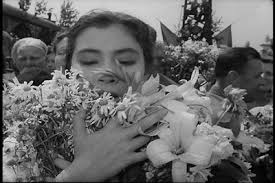
The film ends with Veronika waiting at the train station for the victorious Soviet soldiers to return. Amidst all the tearful reunions, Veronika meets Stephan; he confirms that Boris is indeed dead. Veronika is again denied any further contact by the sheer force of the crowd, her tears of heartbreak juxtaposed against the tears of happiness. As at the beginning, she looks up and sees, in a V-formation, the cranes flying.
I love the idea of the camera-stylo – the camera being able to move as freely as a pen, the director (and cinematographer, art-director, the whole team) being able to put their personalities on to the film so that by a mere shot or two we can detect a Hitchcock from a Hawks, a Kurosawa from an Ozu, a Godard from a Truffaut. Naturally, this will later clash with Roland Barthes’ essay, ‘The Death of the Author’ (1967) … again, for another blog.
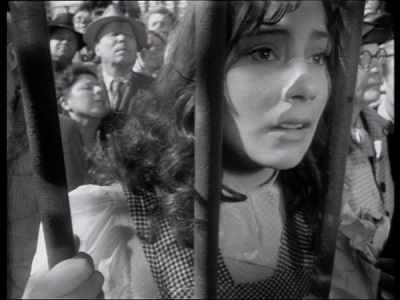
I love the idea of a camera being free, released from the constrains of the studio, allowed to move and as it were, to breathe. From an actor’s point of view, it could be different, with concerns about hitting exact marks at exact times, instead of focusing purely on the performance (yes, another blog), but as a viewer, as a lover of cinema, ‘The Cranes Are Flying’ features some breathe-taking shots and said shots add meaning to the film … they are not mere decoration. Take this shot:
Veronika is so close to her goal yet blocked … and she had no where to turn, she is trapped, confined. This next still can’t capture the circular spinning of the camera, whirling up the stairs, as their hearts whirl with love, happiness and hope … none of which will last.
Then we have the crowd scenes … and what scenes … the camera is like a character, bustling and elbowing its way through, between people, around vehicles, forcing its way off buses or onto trains.
Present perfect I have been to Ha Noi / I’ve been to Ha Noi
Idioms and expressions – bucket list
A: Hello, how’s it going ? Long time no see.
B: Yes, I’ve been in Ha Noi.
A: Amazing ! I want to go. I’ve never been there. It’s on my bucket list.
B: Really ? You must go, the food is great.
A: I’ve heard the people are not nice.
B: They are not the friendliest people in the world, but they are not so bad.
A: What were you doing there ?
B: Knocking on doors ! I had interviews for new companies.
This conversation is more complex and features more idioms and expressions
A: I’m sick of my job ! I need to change.
B: I’ve also been on the lookout for a new job. My job is so tedious !
A: Mine too. Same thing, day in, day out. But … it’s a job. Oh, Tom was fired.
B: No ! Why ? I’ve known him for a long time.
A: He was cooking the books.
B: You’re pulling my leg !
A: Yes ! Really, he went to Boston. He’s got a new job.
B: Good for him ! Now we should go to Boston.
cooking the books = writing false numbers in the accounts – a serious crime
You’re pulling my leg ! = joking with me
Downtown Boston, a very historic US city
A night out in Boston
Now, a quick customer service dialogue:
US restaurants serve LARGE portions
Speaking practice:
Try acting this out in the classroom, encouraging body language and appropriate intonation.
Café worker: Next, please! What would you like? Andi: Can I have a burger, please? Café worker: A cheese burger or double cheese burger? Andi: Double cheese burger, please. Café worker: Anything else? Andi: Yeah, I’d like some banana cake. Café worker: Would you like a drink? Andi: Yes, can I have an apple juice, please? Café worker: OK, so that’s one double cheese burger, one banana cake and an apple juice. What’s your table number? Andi: Table 3. How much is that? Café worker: That’s £8.37, please. Andi: Here you are. Café worker: Thank you … that’s £10.00 … and £1.63 change. Next, please …
































 Thay Paul's Notes