IELTS: Mindset, introduction lesson

23rd June 2020

Preparation Offline | IELTS Asia | British Council

A new class, so I have to assess their ability, motivation and potential.

Let’s kick off with a Family Fortune game – I give writing boards to the class, arranged in small groups, and ask for four answers to basic questions.

Example : Four places I’ve been to in Viet Nam / Four things I love about Viet Nam / Four things I hate / Four instruments I can play / Four languages I can speak. To test general knowledge, Four countries in Asia or capital cities / Four countries in Europe / Four cities in the USA

Next up, I want to get the class speaking as soon as possible so, they can interview each other asking basic questions. No one speaks alone, so this helps to cover any shyness as all the class are speaking at the same time.

Why are you studying IELTS ? /

Do you think IELTS will be difficult ? / Why ?

Do you use English at school or work … how ? /

What do you do in your free time ? /

What do you do or what do you study ? /
Would you like to live in USA or UK ?

Moving on, time to explain the importance of sentence building. We would expect new IELTS students to be able to speak quite fluently, in reasonable long sentences. If students answer in four words or under, or even single words, then the teachers know we have a ‘difficult’ class.

To give an example, I’ll introduce a standard IELTS-style question:

Where would you like to visit in Viet Nam (or your own country) and why ?

Example Answer:

I show them a plan:

Introduction / First good point / second good point / something bad / conclusion.

I choose Hoi An

Hoi An: Vietnam's most charming city - Exoticca Blog

Introduction: DON’T answer immediately but introduce the answer by repeating or rephrasing the question:

Vietnam has many beautiful places but my choice would be Hoi An.

First Good Point:

Firstly, Hoi An is a historical city with a wonderful Japanese bridge and lovely old shops. At night, the shops use romantic lanterns.

Second Good Point:

Hoi An is close to Da Nang, so I can fly there easily and quickly. There are many things to see and do in the local area.

Now, something negative

HoweverHoi An is very small and can be extremely crowded in summer. Maybe it will be difficult to find a hotel or a table at a good restaurant.

Conclusion

In my opinion, Hoi An is a very special place to visit because it is a town of Vietnamese culture.

How to build sentences:

Use adjectives to describe nouns (beautiful, historic, romantic)

adverbs to describe adjectives and verbs – give more information (very, easily)

opinion phrases (in my opinion)

linking words to connect positive to positive or positive to negative – discourse markers (however)

reasons why an action is being done (because)

Now – your turn:

Where do you want to visit ? This can be in Vietnam or anywhere.

Women wearing Vietnamese ao dai granted an imperial favor
Hue
Getting Around Hanoi [2019] Guide to Get Around Hanoi for ...
Ha Noi

Finally, to test knowledge of occupations and personality adjectives, I will show the class photos of five friends and elicit their opinions. https://thaypaulsnotes.com/2018/12/28/friends-men-teaching-sheet/

At IELTS level I would expect the students to form basic sentences such as:

“In my opinion, he is … “

“For me, he looks like … “

“He seems to be a … “

It will probably be a mixed-ability class, so I shall encourage the top learners, asking them to describe the photos, using as many adjectives and adverbs as they can.


Adult Speaking Class, level 2: Extended personality exercises.

20th June 2020

To practise and develop the use of adjectives when describing people:

Personality adjectives

Positive

funny / dependable / generous / witty / friendly / solid as a rock / reliable intellectual / light-hearted / life and soul

Negative

aggressive / a screw loose / hard as nails / unreliable / unpleasant / scary / serious / arrogant / boring mean / bossy / impatient

This man is ….

This chap is …

She is extremely … 

He doesn’t look very …

Add the missing word or words :

1 She gives money to charity. She is ……..

2 He never says ‘please’ or ‘thank you’ and never smiles. He is very …..

3 He is crazy ! He has …….

4 German cars are always …….. and ……..

5 She thinks she is better than everyone. She is so ………

6 The dog wants to bite everyone, he’s very ………….

7 You can believe what he says, he’s ………………

8 His girlfriend always tells him what to do. She’s incredibly ………….

Daisy and Anna
Peter

Speaking practice:

Ed How long will the pizza be ? I’m starving (very hungry) 

Bill Don’t be so impatient ! It’ll be here soon. Who’s coming tonight ?

Ed Anne, Daisy and her boring boyfriend Peter.

Bill Don’t be mean, he’s not so bad. He’s just a little serious.

Ed He’s really generous. He bought Daisy a new laptop.

Bill Yes, but from China. They are not very dependable.

Ed Anne’s very funny, always telling jokes. She’s so witty.

Bill She’s too intellectual for you and also too gorgeous!

Saying what you think – expressing opinions

I think …

In my opinion …

I feel that …

He / She / It seems ..

Will Vietnam win the World Cup in the next 20 years ?

Which is better ? Barcelona or Real Madrid ?

What do you think of these clothes:

Adult Speaking Class, Level 2: What type of person are you ?

19th June 2020

Free Images : person, people, woman, flower, asian, model, asia ...
Angry Arabian Businessman, Arabian Businessman Expressing Anger ...
People Are Hard-Wired To Be Kind And Generous, Says Study - Good ...
Discourage Policy and Procedure Non-Compliance in the Workplace

I feel I am …

an easy-going person // a very generous lady or man // highly motivated //

outgoing // short-tempered // kind // lazy // bone-idle ! // introverted // wise //

unmotivated // easily bored // open and friendly // stand offish // organised //

The wise son's question and answer | The Jewish Star | www ...
Seinfeld GIF by Reactions | Gfycat

Read the questions then discuss.

1 Are you organised ? Can you always find your keys, books, phone, papers ?

2 Do you ever lend people money ? When and why or why not ? Do you ever borrow money ? In what situation ?

3 Do you mind, does it bother you if someone borrows your … ?

clothes // sports equipment // camera // bicycle // CDs // money // food // computer games // project workbooks //

Is there anything you would NEVER lend ?

4 Do you correct people when their English is wrong ?

Do you correct people when their Vietnamese is wrong ?

5 You feel very ill / have the flu or a cold. Do you:

go to school or work or stay in bed ? (call in sick)

stay at home but not in bed ? (catch up on TV shops, online shopping)

put on a brave face and carry on as usual ?

Carry on but let everyone know you are ill ?

6 At a shop counter, do you try to get served first (push in) or do you wait for your turn ?

7 If you have bad food in a shop, do you complain, or just leave and decide never to go back ?

8 Do you give money to street beggars ? Charities ? Do you buy things from people because they look poor ?

9 You are shopping with a full trolley. The person behind you has just one item. Do you let them go first ?

Japan's obsession with cuteness - Without Baggage

Phrasal Verbs exercises

16th June 2020

img_uugs_seishun_namida_049 | Japanese kawaii idol music culture ...

To make the lesson come alive, have the students act out scenes or give them a set time to make up sentences containing as many phrasal verbs as possible.

Same as Shakespeare … English is meant to be USED and SPOKEN … not just studied in a dry text book.

So, without further ado:

COME ON, MAN! GET WITH THE PROGRAM! - Mad Samuel L Jackson | Meme ...

Phrasal Verbs

Put

the cat out / the fire out / up with it (something unpleasant) / on a happy face

it in your own words / up or shut up ! / it away / it another way

Get

well soon / over it ! / on with it / away with murder / on the bus

stuffed ! (impolite) / with the program (US) / some fresh air

Make

a career move / your move a pig’s ear of something / a wish /

up for lost time / the best of something / fun of someone /

Do

the right thing / away with that old technology / your best /

a funny walk / the dishes / your hair

Bring

it on ! / it to me / “my bow of burning gold” (poem) / about change

it up at the next meeting / a smile to my face / up children well

Take

turns speaking / it up with the manager / up my trousers a little /

a good look at yourself / a hike ! / medicine / a deep breathe

Spike Lee Do the right Thing – Analysis of the riot scene – Au cas ...

phrasal verbs:

look after/ think about / wear out / give up / grow up / takes after 

tell off / look up to / hang up / go for / passed away

Phrasal verbs work like normal verbs, so they can be used in the infinite (look,think), the past tense (I wore out, I looked up to ..) and in continuous (I am hanging up now).

Make sentences using phrasal verbs in:

present tense 

past tense

present continuous

Examples

I need to think about that for a while. (present)

He gave up smoking ten years ago (past)

We are looking after our niece today (present continuous)

Phrasal verbs

verb + particle e.g. find + out = find out (learn something)

The verb can be present, past, future or continuous:

I give up

I gave up

I’m finding out about HCM City.

I will (I’ll) find out about the cost.

buy out / up

call off

carry out

give up / away

CLUE: first identify what tense is being used

They were __________ free samples

The computers are down; we have to ________ the meeting

A soldier has to _______ orders

The company was ______ by a Japanese company

The stocks are very low, we should ________ as many as we can

Don’t ________ on your dream 🙂

Make sentences with these phrasal verbs:

take care of // hold on // move on // take over // think it over 

Phrasal verbs:

look after // think about // give up // grow up // takes after // tell off // look up to 

Which phrasal verbs fits here ?

She really …………. her father, they are so alike.

I can’t go out, I have to ……….. my nephew.

Mandarin is too hard, I just …………. (past tense verb)

Many Vietnamese ………………. Uncle Ho

I’m not sure which bank is best. Let me ………. it and get back to you.

I had to ………….. my son because he ate all the cakes.

My manager is very immature. He needs to ………… and quickly !

Phrasal verbs

give up / go for / grow up / hang out with / hang up / look after / look up to / tell off / passed away / takes after /think about / wears out

Izzy is talking to Kate on Skype. Izzy can’t go out on Saturday because she has to

____________ (take care of, be responsible for) her little sister, Georgie. Izzy says she’ll __________ (consider) bringing Georgie too. Georgie interrupts, and Izzy has to

_____________ (end the phone/Skype conversation). Georgie’s hamster has ________

(died) and she’s upset. Izzy says she loves her little sister but she __________

(makes her tired).

Meanwhile, Sam is wondering why Izzy doesn’t want to _____________ (spend time with) them. He thinks Izzy should bring Georgie to the cinema, but maybe Izzy won’t ________

(like, agree to) the idea.

Izzy is annoyed because her sister is trying to look like her, but Kate says it’s sweet that Georgie _____________ (respects and admires) her big sister. Izzy disagrees that they are similar; Georgie ______________(is similar to an older relative) her dad, whereas Izzy is more like her mum.

When Georgie asks Izzy to get her a hamster, Izzy gets angry. She tells her sister 

to ________ (become an adult). Georgie says their dad will _______(Izzy)_______

(speak angrily to Izzy because she’s done something wrong). In frustration, Izzy says 

“I __________ (admit defeat)!”. Fred and Sam take Georgie to look at some kittens, then they all go to the cinema. Georgie is the only one who isn’t scared by the film.

Now – let’s get down

(have a dance and a great time)

What songs can you find that use phrasal verbs ?

Lighten up, it’s the laid-back sound of 70s California

IELTS Project: Holidays and travel language

16th June 2020

Turkey to allow visa-free travel for six European countries ...

Theme: travel

Vocabulary builder

Read this excerpt from a travel blog. How many adjectives can you see ?

This is my first visit to Turkey. It’s a wonderful place ! The people are friendly and the meals are delicious. Farmers here grow many different crops including many kinds of fruit. They also grow a lot of wheat, and the bread in Turkey is really good. Of course, the geography and climate in different parts of Turkey affect the kind of food farmers can produce in each region. In central Anatolia, the land is almost flat, and the weather is usually warm and dry. It’s a good place to grow crops and to raise animals such as cattle and sheep. High up in the mountains of eastern Turkey, farmers also keep animals as they can’t grow crops. Today, I’m visiting the coast of the Mediterranean Sea in southern Turkey. The weather here is hot and humid, but the fish and seafood are excellent.

meals / crops / geography (dʒɪˈɒɡrəfi) / climate / flat / humid (hjuːmɪd)

describes land without mountains

plants grown for food

breakfast, lunch and dinner

features of a place, such as mountains, rivers, forest, desert

air with a lot of water in it

normal weather in a certain area

Happy bellies: 2020 to be a year of Turkish cuisine | Daily Sabah
Turkish food
The #Turkish people are great. Average age is 20. #Turkey is great ...
Welcome to Turkey

Grammar practice: past tense

Tell about your favourite, or more memorable holiday (UK English). You will have to use the past tense. Try to use adverbs and adjectives to describe the vacation (US English). 

Activity:

Present a holiday using a mixture of advertising slogans and practical information. Remember:

It’s not what you say, it’s how you say it

Make your voice sound excited, as if this were the best holiday ever !

Holiday terms:

transfers / half-board / inclusive / amenities / package tour / itinerary

Language:

breathtaking / stunning / sensational / incredible / remarkable / exclusive

once in a lifetime experience / never to be forgotten / unbeatable prices

book now to avoid disappointment / best decision you’ll ever make

holidays to suit all budgets , from 7* luxury to backpacking

Structure:

To begin with / furthermore … additionally / the fact is … / therefore

Demonstration with an advert for London:

Let's visit London - презентация онлайн

Now is the perfect time to visit London, England’s glorious capital.

To begin with, the weather is perfect for walking, so you can enjoy the lush parks, world-famous museums and incredible, unbelievable shops. 

Furthermore, there is something for everyone … and more ! Like sports ? Go to one of the many Premier League football games. Love shopping ?

The fact is, everything is here – shop till you drop !

Additionally, if you adore culture – soak up hundreds of years of history.

Flights from TSN airport daily. Seven-day all-inclusive package tour starting from only 50m VND ! All transfers and transport included. Air-conditioned mini bus with Vietnamese-speaking guide.

Therefore, don’t delay … book TODAY !

Sell a holiday

Advertising vocabulary and intonation

Prepare a presentation to market / sell a holiday.

New vocabulary:

sensational / once in a lifetime / luxury / all-inclusive / unforgettable experience / mysterious / majestic / breathtaking 

book now to avoid disappointment / exhilarating / world-famous

local food / new cultures / visit our website / worth every penny

fun for all the family/ the perfect getaway /

Plan a tour of your city for my friend

Ethan Hawke Sticks Up For Texas, Reps Beto and Turns a Dead ...
My friend Ethan is coming to visit your hometown

It is his first time in your hometown. He likes history, traditional food, and he wants to buy souvenirs.

Think about:

What time to start

What to do first 

Where to go (remember the heat OR the rain could be an issue / a problem).

Explain your choices

Try to incorporate (use) these adjectives:

interesting // historical // fascinating // authentic

typical // bustling // lively // thought-provoking

Theory into practice – it’s all relative (pronouns)

29th May 2020

Earlier this week, I had a teenage group in what could be termed a pre-IELTS class; at the end of this book, they progress to IELTS. That is, as mentioned in the blog for that lesson: https://thaypaulsnotes.com/2020/05/26/adult-speaking-class-level-3-relationships/

a quantum leap (which allowed me to introduce the idea of quantum mechanics into an English class). My centre is a business, so needs to generate revenue which is accomplished by getting as many students as possible. This is especially vital after the enforced lockdown.

Students, teachers practice social distancing on return to school ...
Stock photo from Google, but it depicts social distancing

However, not all students who enter an IELTS class are IELTS material … but that is another matter. I’ve decided to treat this class, which I really enjoy, as an IELTS class. Therefore, I push them to use language and style employed at that level.

To come to the crux of the matter, I set a relative pronoun test in the aforementioned class. Everyone was able to do the lesson, the theory, linking two or three pieces of information into a longer, single complex sentence. For example:

Jumping Jack cash: how young Mick Jagger planned his pension ...

Mick Jagger is in the Rolling Stones. He was born in London.

Mick Jagger, who was born in London, is in the Rolling Stones.

However, during the free practice session, the students reverted back to simple sentences.

Allow me to elucidate … wherever possible, I avoid working directly from the book, or using handouts (although that would save me about 80% of my dwindling energy). Instead, I look at the book, see what subjects are to be covered, and incorporate them into my blog.

Naturally, this only works with ‘top cat’ students, those who are motivated and willing to work (and I’ve noticed, telling students we will not be using the books boosts moral and energy off the chart).

Top Cat - Wikipedia
I’m not allowed to film inside my campus, so here are some top cats 🙂

To return to the case in point; the students can understand the grammar in theory but totally forget it, in practice, and Tuesday’s class afforded ample opportunity to practice. I showed a picture of a young beautiful Asian lady and a young Asian guy … here, see for yourself:

I wanted to the class to be creative, write a backstory for the two characters (the theme of the lesson was relationships), how they know each other, what are their jobs, how they get on together.

The class, which is only small, elected to work together and I was heartened to see Ms X, who normally spends the lesson playing with her phone, taking an active part and volunteering answers.

The upshot was that the beautiful Asian lady was a model, the guy a photographer and both were Japanese. As to be expected, this being a teenage class, someone (you know who you are) said they went to a hotel … but maybe so – in order to do a photo shoot.

From a teaching point of view, I was disappointed that in their speaking, they didn’t apply relative pronouns, enough adjectives or adverbs, all points that will be addressed in the next lesson … and covered in my next blog.

May a say a heartfelt THANK YOU to everyone who visits my site and scrolls through the posts.

IELTS: Complex sentences – it’s not that complicated.

24th May 2020

Portrait of a confused asian girl standing | Free Photo

Following another speaking test, I’ve noticed that my students are still speaking simple sentences and thereby losing marks, whereas with a little work, not to mention a little, or a lot, of practice, this omission can be redressed.

Therefore today’s blog, in it’s entirety, will be devoted to the forming of longer, complex sentences, altering sentence structure and general tips to improve not just speaking, but writing as well.

As you should have noticed the above two paragraphs, rather like this third one, employ several clauses, that is, parts of a sentence to give extra information without the need of a full stop, serving as examples of how this can be achieved.

You will, no doubt, experience a feeling of triumph once you have mastered this technique which, I admit, does require some new thinking and extra effort on your part but will, without a shadow of a doubt, enable you to attain the score for which you are aiming.

And now, without further ado, let’s kick off. First, a warm-up. Of today’s three highlighted expressions, which would you use for:

1 When you are certain or 100% sure about something

2 To start immediately, with no more interruptions

3 Great happiness when you have achieved or won something

Answers at end of blog

Here are some standard IELTS-type questions, followed by a typical answer and then, by way of comparison, an extended response to demonstrate improvements.

1 Tell me about your hometown 2 How often do you go online ?

3 What jobs will be important in your country in the future ?

4 Tell me about a time you received good news

An average answer, which would probably result in a middle score, around 4 – 5 would be, to take one example, (Number 2):

I go online every day because I need the internet to help me study. I use the internet to check new words in English. I go online for information for my school.

black-girl-at-laptop-378x382 - GSDM

What do you notice about this ? Firstly, what are the mistakes ?

The candidate answers the question immediately, with no introduction. This is not necessarily wrong, but a sentence leading into the response will make for a longer answer.

The second sentence is not directly relevant to the question, though it is acceptable for providing more information. I advise students to be careful, in case they start deviating from the subject.

Lastly, the third sentence just repeats what has already been said, even using the same phrase “I go online“, and then explaining the reason for using the internet NOT how often it is used.

Here’s a different way of answering.

Well, that’s interesting because I have internet access at school, at home and on my phone so I would say I’m absolutely online every day. How much time I spend online varies from day to day, but I am probably online about three hours every day, sometimes more if I have a project or if I’m playing a cool game.

See how this answer only uses two sentences , but is much superior. Let’s break down how it earns points.

Initially, we have a short introduction and the question is answered directly in the first, extended sentence.

Secondly, the first sentence includes a list of three, so this is a chance to practise speech rhythm (one, two and three) – remember, you get points by HOW you say something as well as what you say.

Thirdly, the answer uses three everyday adverbs (highlighted). ‘so‘ can also be used as an adverb, but here it is a conjunction (a word such as ‘and’, ‘but’, etc).

Additionally, the sentences employs an expression, “from day to day,” which examiners like to hear, as it shows familiarity with figurative language.

Lastly, the candidate explains what the reasons for being online, and how it affects the time spent on the internet.

Now … your turn Try to answer the same question, following this pattern.

Now … let’s move on. Question 1, my hometown.

Vietnam Student Tour, Vietnam Student Trip, Vietnam Student Holidays.

This time, I will give you facts and you arrange in an answer.

My hometown is Da Nang. Fifth largest city in Viet Nam. Is in Central Vietnam. Near historic town Hoi An. Important port. Many tourists. Has a cable car and a dragon bridge. Famous for its beach.

Dragon Bridge in Da Nang - Attraction in Da Nang, Vietnam - Justgola
Dragon Bridge at Da Nang

Thank you for letting me introduce to you my hometown which is Da Nang, one of the biggest cities in Vietnam, although it is much smaller than Ha Noi or Sai Gon. My hometown is in the middle … in central Viet Nam, I mean, sorry, and had many tourists. They come to see many things such as the Dragon Bridge, go on the cable car or for swimming. Also, Da Nang is very near many famous places such as Hoi An. As it is on the coast, my hometown is also a busy port.

Check for

Introduction

Information in first sentence

Discourse marker ‘ although

Correcting a mistake in line 3

A list of three items in lines 4 and 5

Change of sentence structure in the last line: instead of saying, “My hometown is also a busy port because it is on the coast,” I started with the end of that sentence (it is on the coast) and replaced ‘because’ with ‘as’ (though because would also be all right to use).

To practise:

Rearrange these sentences, starting with the section in italics.

The London Tube needs repairing because it is so old.

Many people have to stay home because of COVID 19

We must buy vegetables because Jenny doesn’t eat meat.

Colin is now studying in Boston because he got an 8.5 in his IELTS test.

Meet the Five Harvard Students Who Testified in the Admissions Trial

Answers at end of blog

Answers:

1 = without a shadow of a doubt

2 = without further ado

3 = feeling of triumph

Because it is so old the London Tube needs repairing.

As it is so old, the London Tube needs repairing.

As the London Tube is so old, it needs repairing (notice how the pronoun ‘it’ moves).

Due to / Because of COVID 19, many people have to stay home.

Because Jenny doesn’t eat meat, we must buy vegetables.

As he got an 8.5 in his IELTS test, Colin is now studying in Boston.

Diversity and Inclusion: Colleges with the most diverse student bodies
Keep studying

IELTS Mindset: Preparing for the speaking test.

14th May 2020

As usual, I use bold font to highlight words, expressions and idioms that students can learn and then use in their everyday speech. Remember, some expressions are only used in some situations, but an IELTS instructor will always notice an attempt to use a wider variety of English.

Những lầm tưởng về IELTS Speaking - AMERICAN STUDY

Next week, one of my IELTS classes has their speaking test therefore this blog will help, I sincerely hope, to prepare them, and enable them to achieve a commendable result.

With that in mind, tonight’s class will just be practice, practice and … more practice.

I try to relax my students by telling them that passing IELTS is easy (that normally gets their attention). I have to elaborate; IELTS is easy because they

TELL YOU WHAT THEY WANT TO HEAR

Namely, vocabulary, grammar, pronunciation and para linguistics (body language, eye contact, stress, intonation, rhythm) and fluency (the ability to speak without overlong pauses) as well as answering the question relevantly.

Let’s break that down:

Vocabulary: low-frequency words // idioms // expressions //

Structure: complex sentences employing discourse markers and clauses

Let’s kick off with complex sentences. Here’s a link to a previous blog regarding just that subject; there are a number of exercises for students to practise:

https://thaypaulsnotes.com/2020/04/30/ielets-mindset-complex-sentences/

Now some tips on using various expressions and phrases to introduce and close your speech. Again, this is from a previous blog (IELTS 12th May 2020):

https://thaypaulsnotes.com/2020/05/12/ielts-quick-fire-talking/

The above blog gives an example of answering a question about laptops, then allows students to compose their own response on subjects of their choice.

Finally, here are some expressions that can be used to ‘spice up’ a student’s talk as they are all everyday phrases though some will be UK-specific as they are part of the common culture:

Not my cup of tea = a polite way of saying you don’t like something.

I can take it or leave it = have no strong feelings about something.

I’m really into it = like or love something very much.

It does what it says on the tin = something that does the job, no more, no less (this is from a UK TV commercial).

Does exactly what it says on the tin - Story behind the logo

Vocabulary game:

To pracise using low-frequency words, put students in teams, giving each team a set of IELTS words (or phrases, idioms). They have a set time, maybe a minute, to use as many as they can, speaking about any subject they choose.

Some students may prefer to be given a set topic, so choose typical general subjects such as shopping, food, their city or country, free time etc.

Words and expressions are:

ubiquitous // somewhat // not my cup of tea // significant or significantly // I can take it or leave it // exhausting // challenging // miserable // having said that // I’m keen on // all in all // consequently // allow me to explain // eventually // thrilling // put up with

Vocabulary booster

Find low-frequency words for these adjectives:

boring // repetitive // tiring // interesting // relaxing

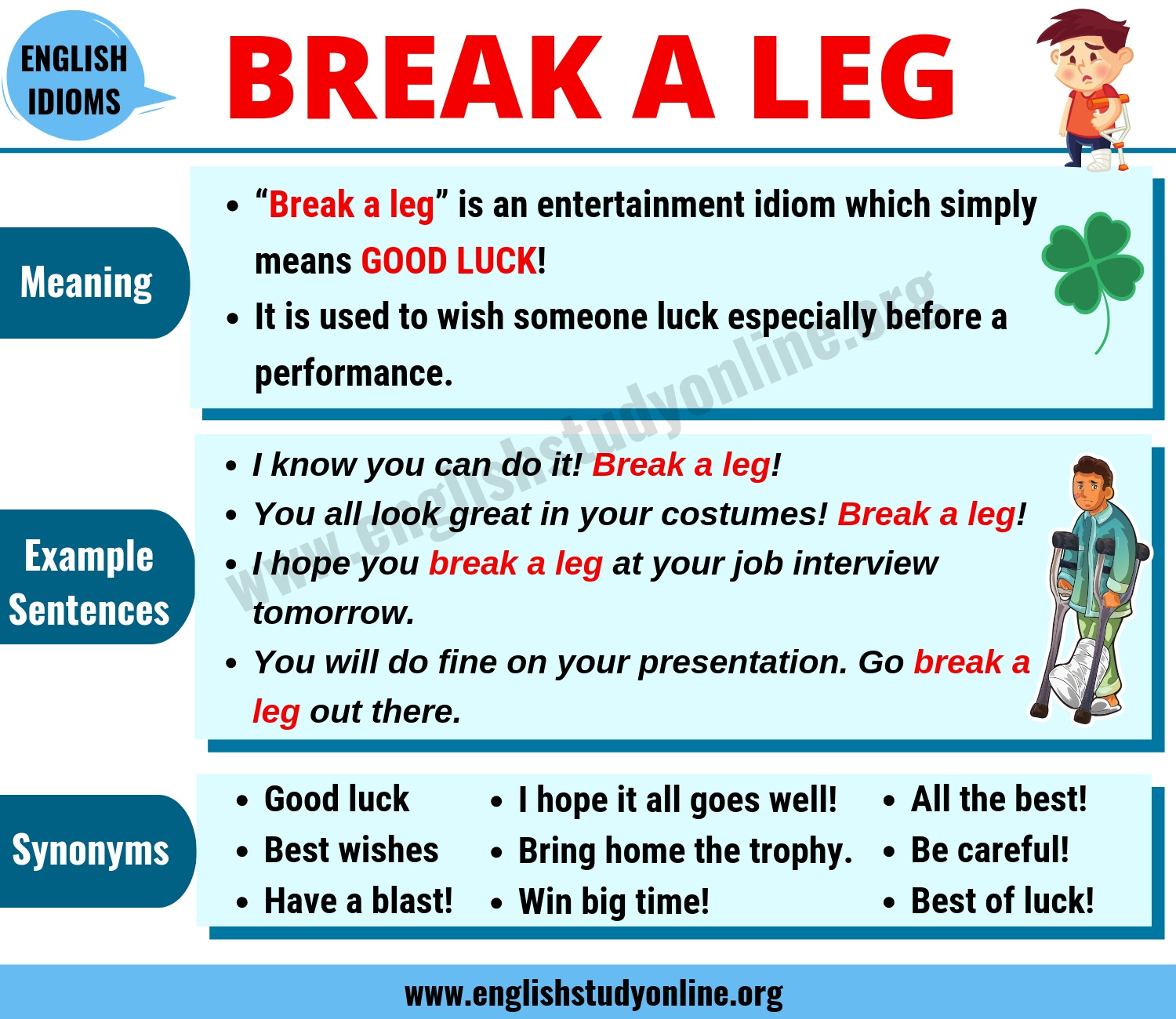
Break A Leg: What Does "Break A Leg" Mean? | Useful Example ...

IELTS: Speaking exercises

12th May 2020

Speaking exercises

In Israeli City of Haifa, a Liberal Arab Culture Blossoms - The ...

Today’s theme is the use … the correct use … of discourse markers.

Furthermore, speakers MUST NOT say ‘like’ or ‘kinda’.

It is a pet peeve of mine to hear people interrupt the flow of a conversation with the unnecessary and incredibly irritating application of the word ‘like’ as a … totally incorrect … discourse marker [or discourse particle]. To illustrate, at a previous centre, a centre with a very prestigious reputation, I heard some US teachers say the following:

“I went out last night and had, like, two beers.”

“Are you looking for, like, an apartment

This filters down to the students, some of whom deliberately say ‘like’, because they think it makes them sound American and cool. I correct that misconception; it makes them sound that they are unable to complete a simple sentence. When I notice this as a problem, I tell the student to listen to themselves and count how many times they use ‘like’ erroneously.

Why Do People Say "Like" So Much? | Grammar Girl

And so, to work …

Practice how to speak fluently and with the correct use of linking words. For example:

however // having said that // although 

firstly // following that // after that // and then finally

Just a minute

Students must speak for a minute with no deviation, hesitation or repetition.

Students can select a subject and then ask another student or team to speak for a minutes. Otherwise, choices could be:

books // local food // foreign food // clothes shopping // music // siblings //

Top 5 Yoshoku: Western style Japanese dishes | TokyoTreat ...
5 things only siblings of a disabled person would know

Platinum Fashion Mall: Bargain Shopping for Clothes and Accessories
Italy's bookshop crisis: 2,300 stores close in 5 years
Jazz it up: Arab musicians bring their songs ... | Taiwan News

Speaking Test

You meet a fellow traveller at the airport when your flight is delayed. Make small talk conversation including idioms and expressions.

To make this more of a competition, award two points for every idiom, one for every expression, and additional points for discourse markers.

Colleagues discussing over business card while sitting in waiting ...

Topics can be:

Talk about the flight. How bad the airline is, frequently late. Do they fly often ?

Introduce yourself. Why are they flying ? Business or pleasure ?

Ask about work – do they like it ? Where do they work ?

Ask about family … but not too personal

Ask about where they live

REMEMBER to react, and to use stress and intonation.

Oh, really // how interesting // tell me more // where is that exactly ? // Oh, right // Me too ! // I had a similar experience //

Conversation practice

You have plans to go to a new restaurant but one of you can’t make it because something turned up. Apologise and give the reason why you must change the plan. Offer alternative suggestions. 

Example:

Search for new partner leaves me wondering where she's waiting ...

Hello, Sharma ? I’m so sorry, I can’t make it tonight.

Sharma will ask why. Give your reason

Have to work late // family member is ill // have an exam tomorrow // missed bus // not feeling well // have to attend a family event //

Activity 2

In the UK we try to hide our emotions, keep a stiff upper lip, but sometimes people can get angry. Repeat the exercise, but this time, the person waiting is in a bad mood.

The Myth of the 'Angry Black Woman' — Her Culture

Now the person waiting does not accept your excuse.

This the the third time you’ve cancelled ! // I’ve already been waiting 30 minutes // You only tell me NOW ! // I don’t care, get here now or never call me again ! //

How could you apologise and offer to make it up to her ?

6 Creative Ways to Say Sorry Using Flowers

IELTS: Quick-fire talking

12th May 2020

A chance to practise IELTS-standard speech, answering questions on everyday subjects.

Speaking topics

laptops // holidays // engineering // work // travelling // study

motorbikes // family // living in your town or city //

laptops

Positive asian woman lying on floor with laptop | Free Photo

Introduction

1stpoint

2ndpoint

anecdote (personal story)

conclusion

This first example is a warm up; you will need to speak a little longer, but this introduces the main points to include.

Laptops are an incredibly useful piece of technology. They can be used for work, hobbies, music and to stay in touch with friends.

I use my laptop every day. I plan lessons and use the internet to search for lesson plans, English language games and interesting video clips to show my students.

Because I live so far from my home country, I find the internet essential. I can maintain contact with friends and family by using: Skype, Facebook, Viber, Instagram … well, there are so many social media sites.

I like Apple; I know there are very expensive, but they seem to work so well. I rarely have a problem with my computer which is great because I know nothing about IT !

There was one issue I had in Vietnam. My plug snapped and I had to buy a new cable. I eventually found a store in District 3. I had to wait 30 minutes but finally a man came with an ‘Apple’ plug … and it was less than half the UK price.

To conclude, laptops are part of my life. I use them every day for work, relaxing and chatting with friends.

Check how many adjectives and adverbs are used. Are you utilising such word types ? If not – do so !

Useful expressions

A strong introduction:

That’s a very interesting question

Well, there is so much to say about that subject, where shall I start ?

It’s funny you put that question to me because earlier today I was just thinking about …

To buy time, or to show the examiner that you have a wide vocabulary but need to check the correct word:

Let me think (about it)

How can I put it … ?

What’s the word … ?

To conclude:

At the end of the day

All in all

To wrap up

Now … your turn. Either in pairs, or at home by yourself, prepare an IELTS standard presentation, using the formula above. Choose from:

SaludTues Tweetchat 12/4/18: “Healthy Holidays - How To” | Salud ...
Family life
Despite high education levels, Arab women still don't have jobs
At work
Coronavirus | Tech-challenged Japanese struggle to work from home ...
Travelling to work
A List of Family Holiday Destinations in Africa — Bino and Fino ...
On holiday
Integrating the ultra-Orthodox | Gilad Malach | The Blogs
Studying