The Bash Street Kids … from ‘The Beano’ which is a famous comic from the UK, first issued in 1938.
Tonight we have a listening lesson which, although tremendously important, not to say imperative, can be somewhat tedious for the students.
One factor is the vocabulary. If students don’t know some of the words, they will not be able to answer some of the questions; that stands to reason.
that stands to reason = it is obvious, it is common sense, it can be understood. I live in Vietnam but only speak a little Vietnamese. It stands to reason that if I spoke Vietnamese, I would be more independent.
Therefore, allow me to explain a little about the UK educational system while, at the same time, pre-teaching some new vocabulary.
First up, we have Kindergarten or nursery:
As you can see, the age for Kindergarten is 3 – 5. It can be free, or parents can choose to send their children to a private Kindergarten or nursery.
Maybe the word Kindergarten looks a little strange in an English lesson – quite right, it is, in fact, a borrowed word from German. If you have seen my other IELTS posts, you may have come across ‘prima donna‘, which is a borrowed word from Italian. If you can use borrowed words in your IELTS tests, it will surely impress the examiner.
Next, we have primary school for children of 5 to 11. When I was at school, it was broken down into Infants and Juniors. Infants school was two years, then we moved up into a new building, attending four years of Junior school. This was a mixed school by which I mean boys and girls were in the same class.
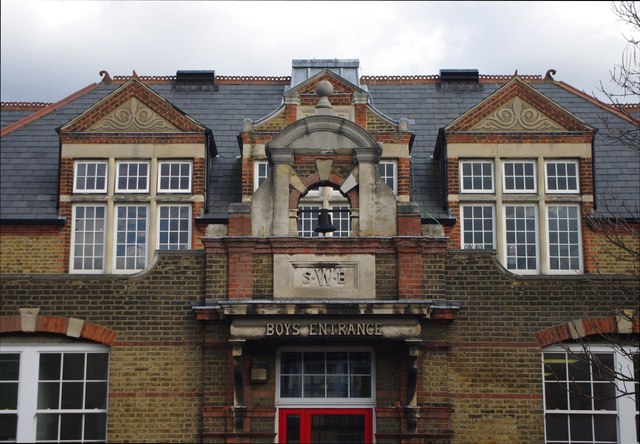
Woodside Primary school in north-east London
Following on from Primary school we have, quite logically, Secondary school:
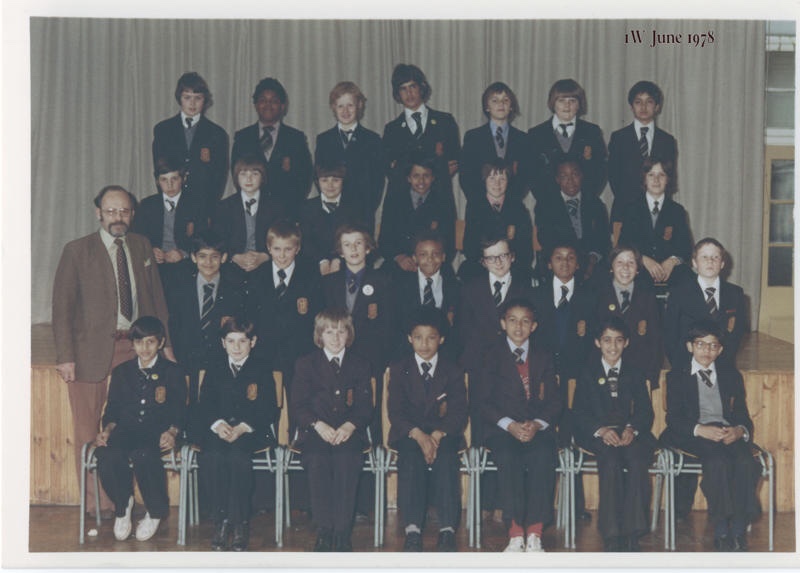
A typical class photo from the late 1970s. As you can clearly see, this is a single-sex school. Furthermore, the pupils had to wear school uniform of trousers, blazer and school tie.
Pupils spent three years here, from ages 11 – 14 at Junior High, after which they progressed to Senior High:
Pupils have to attend school until they are 16; it is compulsory.
You must then do one of the following until you’re 18:
stay in full-time education, for example at a college
Pupils can either stay at school and enter the VI (Sixth) Form, or go to a Further Education College which differ in that they offer a much wider selection of options such as vocational courses which are more practical and can help students train for a specific job. VI Forms, on the other hand, are academic (theory), preparing students for university.
The VI Form is usually in the same building as the Senior High, so pupils are familiar with the teachers and students. Going to a new college, meeting new staff and students means that time is needed to settle in or settle down.
Qualifications are imperative these days, so many students want to go to University.
Finally, we have Adult Education which, as the name implies, is for adults who wish to further their job prospects, or simply learn for their own pleasure. As many people are working, these type of education often takes place in the evening or at weekends.
New Vocabulary:
term – part of the teaching year for example First Term is from September to December
it’s a pity – it is sad or it is unfortunate
Fresher’s Week – a week for new students (Freshmen in USA) to get to know what their college has to offer, such as clubs and events.
GCSEexams – tremendously important exams taken at age 15 or 16. Good results mean the student can to VI Form or have to re-sit the exam.
tertiary – means the third – after Primary (first) & Secondary (second), tertiary refers to Higher Education, taken after the age of 18.
NVQ National Vocational Qualification – this is more practical as opposed to academic, designed to teach skills needed for a particular job:
An NVQ card stating that the holder has passed exams to work in the construction industry
BA or BSc – (Bachelor of Art or Science) degrees in the arts or science. Usually attained after a three-year course. The next step is a MA (Master’s Degree) and then a PhD.
internship – gaining real-life experience by working for a company, often for low or even no pay.
Graduate Fair – a chance for students to think about what career to follow, or what company to join. They can speak to people who represent organisations:
You buy a T-shirt from a shop, but when you get home, you see the quality is very bad.
How do you feel ? You feel terribly …
What would you do ?
When you return an item to the shop, what do you need in your country ?
Use this video for help. Listen out for new vocabulary or expressions as well as copying her accent.
Vocabulary
I am sorry to have to say this but …
I’m sorry to say this but I am really quite upset/angry/disappointed
Perhaps there was a misunderstanding but …
There appears to be a problem here …”
I’m sorry but I’d like to make a complaint about …”
Could you help me with …?
PRACTICE
One student is an shop assistant, the other an upset customer.
You have bought a dress but it is very bad quality.
How would you complain ? [Be polite, speak calmly and politely].
How about in this situation:
You go to a restaurant to celebrate a special event. When the bill arrives the amount is much, much more than you expected. It looks like you were charged for extra items you did not order.
What would you do ?
Speaking practice
Try to speak in long sentences. Tell me about something you like – say why you like it, but also something negative. Remember to use good discourse markers.
EXAMPLE:
I love Highland Coffee because I need damn fine coffee every morning and Highlands has a good choice as well as great quality. I can choose all different types of coffee, some hot, some cold, some with added flavour, and they come in different sizes. In addition, the chairs are comfortable, not to mention the free wifi and no-smoking policy. Having said that, it is rather expensive, especially compared with Milano however I feel the extra cost is worth it.
Now … your turn
Subjects – to help you, talk about smartphone // video games // sport // your pet // shopping // cooking // your best friend
Comparatives and superlatives.
Big / bigger / biggest
interesting / more interesting / the most interesting
Blog writing:
Your apartment block is starting a chat-site for working parents. They invite anyone to join who has both a job and children. They ask you to send a photo and give some brief information.
OR
Your apartment block is starting a chat-site for people who want to practise English
Write a short introduction about yourself for a blogpage.
What information do you need to add ? What is unimportant ?
A good introduction is not just beneficial but imperative for an impressive IELTS response. Therefore, this blog will mainly, although not exclusively, focus on a strong opening gambit, an attention-grabbing prologue.
Useful expressions
If you need some time to think, employ one of these ‘time-buying’ expressions:
That’s a very interesting question
Well, there is so much to say about that subject, where shall I start ?
It’s funny you put that question to me because earlier today I was just thinking about …
Let me think …
How can I put it …
Well, I would say …
Quick warm up: What do you do in your free time ?
I meet my friends for coffee
One of my favourite things to do, if I have some spare time, is to hang out with my closest friends
Which answer do you think would impress the examiner ?
Now … your turn
Where would you like to visit in Viet Nam (or your own country) ?
DON’T answer immediately; introduce the answer by repeating or rephrasing the question:
Vietnam has many beautiful places but my choice would be Hoi An.
Vietnam is famous for it’s beautiful beaches, vibrant cities and amazing nature but for me, Hoi An is the one place I would love to explore.
1 Tell me about your hometown
Thank you for letting me introduce to you my hometown which is Da Nang, one of the biggest cities in Vietnam, although it is much smaller than Ha Noi or Sai Gon.
2Talk about a film you like
Talk about cinema or films in general DON’T immediately talk about your favourite film.
Watching films and going to the cinema is one of my passions, so choosing just one film is going to be terribly difficult, not to say impossible. However, if I have to select one film, it would be ‘Lost in Translation’, with Scarlett Johannsson.
3 Do you use computers at work or school ?
Laptops are an incredibly useful piece of technology. They can be used for work, hobbies, music and to stay in touch with friends.
Practice: try forming introductions for these questions
Home
Do you live alone or with friends / family ?
How long have you lived there ?
Is there anything you don’t like about living there ?
What sort of accommodation would you like to like in ?
Shopping
Do you like going shopping for clothes
Is fashion important to you ?
Do you have to wear a uniform at school or work ?
Where do you normally buy your food and why there ?
Free Time
Do you do any sporting activities ?
What do you like to do at weekends ?
What would you change about your daily routine ?
Once in a VERY blue moon by Nanci Griffith
Review … from my recent classes, make sure you have learnt these words and expressions:
once in a blue moon (very rare) // put my nose to the grindstone (work especially hard) // achieve on merit (to get something by working for it) // burn the candle at both ends (work day and night) // give or take (about, approximately) // big time ! (absolutely, totally, very much) // I’ll mull it over (I’ll think about it) //
although // additionally // therefore // moreover // having said that // on the other hand
Rewrite the following using IELTS-language:
English grammar is (adverb) boring and I spend about two hours a day studying grammar. I work all day, and go to evening class and then study. I study all day and night.
I almost never have any free time. If I have free time, I go to drink coffee. Coffee shops are everywhere but in some the prices are not cheap.
My friend Tom never studies. His uncle will give him a job, but I want to deserve my job. Tom is (adverb) lazy. I tell him to try to study grammar, to work very hard / but / he never listens. He thinks video games are very interesting. He (adverb) says he’ll think about it but nothing changes
so the result will be a ‘FAIL’
Coffee shops in Sai Gon are ubiquitous although in some, the prices are sky-high.
Words and expression to use, tips, phrases and idiomatic language
Recap: to pass IELTS with flying colours, you will needs to demonstrate a command of everyday English, the ability to express it with stress and intonation, as well as being able to link your ideas with appropriate discourse markers.
I need to hear nouns described by interesting adjectives, verbs intensified by adverbs and conversation enlivened by low-frequency vocabulary.
Piece of cake, right ?
Low – frequency words (LFW)
Boring: tedious // forgetful: absent-minded // expensive: sky high // what will happen: predict // everywhere: ubiquitous.
Activity 1: Make sentences using the above five LFW
Introduce your answer by:
Let me think // How can I put it // Well, that’s an interesting question
Useful expressions:
In my opinion // From my perspective // For me // Allow me to explain // By which I mean //
Discourse Markers:
as well as // furthermore // additionally // on the other hand // having said that // however // although // despite that
Activity 2: Give each student a discourse marker and they have to use it in a sentence
EXAMPLE ‘in addition’
I have a busy life; I have to study, work my part-time job and help my family. In addition, I go shopping for my neighbour because he is too old to go out.
NOTE: use of ‘because‘ to explain why you do something … and therefore construct a longer sentence.
Idioms:
It’s raining cats and dogs // It costs an arm and a leg // piece of cake // I’m burning the candle at both ends.
Activity 3: Who can use these idioms correctly ?
Relative pronouns – who / which / where / whose
Activity 4: Use the correct relative pronoun:
We arrived at a nice beach ______ we could swim and lie in the sun.
A man ______ mobile phone was ringing did not know how to switch it off.
The patient, ______ had a serious disease, was taken to hospital immediately.
Smithsfield is a small village ______ people live a quiet life.
This dress is made of silk, _____ is a very expensive and delicate material.
Buying time:
Could you repeat that, please // I’m sorry, I didn’t catch that // Would you mind rephrasing the question
Model answer: What do you do in your free time ?
One of my favourite things to do, if I have some spare time, is to hang out with my closest friends and just catch up on our news, maybe hit a mall because they are air-conditioned and have a wide array of amenities such as shops, cafes and, if I may say, bathroom facilities, as well as services like ATM machines and free wifi. My closest friends are Sheila, who is from Japan and studies here in Sai Gon, and Kerry, who is a gorgeous Thai lady. As we all come from different countries, there can be issues. Allow me to explain; we have to communicate in English, however Kerry is just starting her studies, so we have to use Google translate frequently. Having said that, it’s such tremendous fun to be with my best friends. It helps me forget about the pressure and stress of work.
Use this an a plan – now tell me what YOU do in YOUR free time … DO NOT just copy the above example !
Now … Your turn
Conversation Practice: In pairs or small groups, ask each other these questions. If the answer is too short, ask the person to tell you more, to explain with more details.
Family questions
Ask each other about your families
How many siblings do you have ?
[You can give names, ages, jobs, what and where they study, what they look like, what their personality is like, if you have something or nothing in common with them]
Do you live with your parents and grandparents ?
Do you often meet your cousins ?
Who is the youngest member of your family ?
Who is the oldest ?
Who is your favourite person in your family and why ?
Useful expressions
Can you tell me more ? // In what way ? // Why do you say that ? //
Before we get too far ahead of ourselves, time to take stock and make sure the students have absorbed the information and are au fait (French for well informed, know the point) with the vocabulary so far. With that in mind, here’s a quick warm up. Replace the high frequency words with low-frequency ones, then use your newly-acquired discourse markers to construct longer sentences.
Let’s kick off with some common or garden IELTS subjects:
What do you do in your free time ?
I drink coffee with my friends. There are many coffee shops in my hometown
School keeps me very busy, but if I can find some time for myself, I enjoy hanging out with my friends in coffee shops, which are ubiquitous in Sai Gon.
TIP: The question here is about free time, so don’t just talk about coffee shops – mention at least two other different activities – even if you DON’T do them, just talk about them !
Example, playing music, watching films, listening to music, sports, shopping, helping family, reading – thing you enjoy NOT to do with studying or work
Now … Your Turn: [tips at the end]
Remember, you should be able to speak in complex sentences with a low-frequency word or two, some idiomatic language, contractions and discourse markers, all spiced up with a liberal sprinkling of adverbs and adjectives. Furthermore, try to introduce the answer, rather than stating it outright.
I don’t like English grammar. I am boring with it.
A lot more people go to China than Viet Nam.
She forgets everything.
Thai food is good.
I think Barcelona will beat Real Madrid on Sunday
I like to go to cinema and go to shopping and go my friend house and sleep.
I don’t go out now. It rains all day.
The examiner asks you a question but you didn’t understand
What ?
I didn’t hear you.
Errrrrr, I don’t know
OK, yes I like it
The examiner asks you a question but you need time to think of an answer.
UUuhhhmmmmmm.
Hahhahahahaha
I don’t know.
Yes.
Tell me about your city
It very dirty.
I was born here. I love it.
We can do many things here.
Has many traffic jam. Yes. people nice.
Do you like to eat ?
Of course !
No
Yes. I eat with my family. I eat with my friends at school. I eat after school. I eat at night with my family
Words and expression to use, tips, phrases and idiomatic language.
Low – frequency words
Boring: tedious // forgetful: absent-minded //
expensive: sky high // what will happen: predict // everywhere: ubiquitous.
Could you repeat that, please // I’m sorry, I didn’t catch that // Would you mind rephrasing the question
In my opinion // From my perspective // For me //
Let me think // How can I put it // Well, that’s an interesting question
Allow me to explain // By which I mean //
As well as // furthermore // additionally // on the other hand // having said that // however // although // despite that
It’s raining cats and dogs // It costs an arm and a leg // piece of cake // I’m burning the candle at both ends
Relative pronouns – who / which / where / whose
One of my favourite things to do, if I have some spare time, is to hang out with my closest friends and just catch up on our news, maybe hit a mall because they are air-conditioned and have a wide array of amenities such as shops, cafes and, if I may say, bathroom facilities, as well as services like ATM machines and free wifi. My closest friends are Sheila, who is from India and studies here in Sai Gon, and Kerry, who is a gorgeous Thai lady. As we all come from different countries, there can be issues; allow me to explain. We have to communicate in English, however Kerry is just starting her studies, so we have to use Google translate frequently. Having said that, it’s such tremendous fun to be with my best friends. It helps me forget about the pressure and stress of work.
We had a number of blogs devoted to idioms, so now it’s time to practice using them as part of your everyday English. Not only will IELTS students earn points, but every student will feel closer to English, and sound more like a REAL native-speaker. You can only learn so much from text books …
So, without further ado, a range of dialogues for you to practice:
Dialogue 1
Hello, how’s it going ?
Great, thanks. What have you been up to ?
Oh, same old, same old. Nothing new. Are you busy ?
A little.
Do you want a hand ? (Dya wanna hand)
That would be wonderful. Can you take over for a moment ?
Absolutely !
I’ll be right back. I need to print out some documents.
Dialogue 2
What shall I get on with ?
I just need you to finish off the progress reports.
Oh, piece of cake ! (pieceacake)
You’re an angel.
I know…hahaha.
Dialogue 3
Hello, do you have a minute ?
Sure, what do you need ?
Could we have a little chat ?
OK, let’s go to my office. Have a seat. Now, what’s on your mind?
I’d like an increase in our budget. We desperately need a new photocopier.
Unfortunately, those things cost an arm and a leg. What is the exact price ?
I’ll find out and get back to you. We may have some money in our budget.
Dialogue 4
How’s the new girl ? Are you showing her the ropes?
She seems to be OK but I still need to keep an eye on her. Are we having a meeting later ?
No, it’s been called off.
Ok, back to work. I need to finish off some expense sheets.
Yes, time is money.
See you later.
Dialogue5
What were you doing last night ? I tried to call.
I was watching TV. Was it important ?
We were having a party. I wanted you to come.
Your parties are such fun ! What did you do ?
We were all looking online for bargains. Anna bought some great shoes.
She’s always talking about buying shoes.
I was looking at the clothes from London. So stylish.
Dialogue6
Did you see the email from the Manager ?
Oh, that old windbag ! He was talking so much.
Yes, even his emails go on forever hahahah.
Did you bring your raincoat ? It was raining all night.
I know – it was raining cats and dogs.
They were thinking about calling off the meeting because of the rain.
Yes, maybe the traffic will be chockablock.
Dialogue7
Oh, do you know how to use this Zoom program ?
Yes, it’s very easy. It’s a piece of cake! Have you met Jane’s new boyfriend ?
He seems a real loser. As far as I’m concerned, she can do much better.
What does he do ?
Nothing, the work-shy layabout. I believe he wants her money.
In my experience, guys without jobs are hopeless. A waste of space !
How did she meet him ? She’s such a workaholic ! At the gym ?
Well, not at the gym, he’s no hunk ! It’s obvious to me it won’t last.
I’m convinced it’ll soon be over. She needs a good solid as a rock guy.
Following another speaking test, I’ve noticed that my students are still speaking simple sentences and thereby losing marks, whereas with a little work, not to mention a little, or a lot, of practice, this omission can be redressed.
Therefore today’s blog, in it’s entirety, will be devoted to the forming of longer, complex sentences, altering sentence structure and general tips to improve not just speaking, but writing as well.
As you should have noticed the above two paragraphs, rather like this third one, employ several clauses, that is, parts of a sentence to give extra information without the need of a full stop, serving as examples of how this can be achieved.
You will, no doubt, experience a feeling of triumph once you have mastered this technique which, I admit, does require some new thinking and extra effort on your part but will, without a shadow of a doubt, enable you to attain the score for which you are aiming.
And now, without further ado, let’s kick off. First, a warm-up. Of today’s three highlighted expressions, which would you use for:
1 When you are certain or 100% sure about something
2 To start immediately, with no more interruptions
3 Great happiness when you have achieved or won something
Answers at end of blog
Here are some standard IELTS-type questions, followed by a typical answer and then, by way of comparison, an extended response to demonstrate improvements.
1 Tell me about your hometown 2 How often do you go online ?
3 What jobs will be important in your country in the future ?
4 Tell me about a time you received good news
An average answer, which would probably result in a middle score, around 4 – 5 would be, to take one example, (Number 2):
I go online every day because I need the internet to help me study. I use the internet to check new words in English. I go online for information for my school.
What do you notice about this ? Firstly, what are the mistakes ?
The candidate answers the question immediately, with no introduction. This is not necessarily wrong, but a sentence leading into the response will make for a longer answer.
The second sentence is not directly relevant to the question, though it is acceptable for providing more information. I advise students to be careful, in case they start deviating from the subject.
Lastly, the third sentence just repeats what has already been said, even using the same phrase “I go online“, and then explaining the reason for using the internet NOT how often it is used.
Here’s a different way of answering.
Well, that’s interesting because I have internet access at school, at home and on my phone so I would say I’m absolutely online every day. How much time I spend online varies from day to day, but I am probably online about three hours every day, sometimes more if I have a project or if I’m playing a cool game.
See how this answer only uses two sentences , but is much superior. Let’s break down how it earns points.
Initially, we have a short introduction and the question is answered directly in the first, extended sentence.
Secondly, the first sentence includes a list of three, so this is a chance to practise speech rhythm (one, two and three) – remember, you get points by HOW you say something as well as what you say.
Thirdly, the answer uses three everyday adverbs (highlighted). ‘so‘ can also be used as an adverb, but here it is a conjunction (a word such as ‘and’, ‘but’, etc).
Additionally, the sentences employs an expression, “from day to day,” which examiners like to hear, as it shows familiarity with figurative language.
Lastly, the candidate explains what the reasons for being online, and how it affects the time spent on the internet.
Now … your turn Try to answer the same question, following this pattern.
Now … let’s move on. Question 1, my hometown.
This time, I will give you facts and you arrange in an answer.
My hometown is Da Nang. Fifth largest city in Viet Nam. Is in Central Vietnam. Near historic town Hoi An. Important port. Many tourists. Has a cable car and a dragon bridge. Famous for its beach.
Dragon Bridge at Da Nang
Thank you for letting me introduce to you my hometown which is Da Nang, one of the biggest cities in Vietnam, although it is much smaller than Ha Noi or Sai Gon. My hometown is in the middle … in central Viet Nam, I mean, sorry, and had many tourists. They come to see many things such as the Dragon Bridge, go on the cable car or for swimming. Also, Da Nang is very near many famous places such as Hoi An. As it is on the coast, my hometown is also a busy port.
Check for
Introduction
Information in first sentence
Discourse marker ‘ although‘
Correcting a mistake in line 3
A list of three items in lines 4 and 5
Change of sentence structure in the last line: instead of saying, “My hometown is also a busy port because it is on the coast,” I started with the end of that sentence (it is on the coast) and replaced ‘because’ with ‘as’ (though because would also be all right to use).
To practise:
Rearrange these sentences, starting with the section in italics.
The London Tube needs repairing because it is so old.
Many people have to stay home because of COVID 19
We must buy vegetables because Jenny doesn’t eat meat.
Colin is now studying in Boston because he got an 8.5 in his IELTS test.
Answers at end of blog
Answers:
1 = without a shadow of a doubt
2 = without further ado
3 = feeling of triumph
Because it is so old the London Tube needs repairing.
As it is so old, the London Tube needs repairing.
As the London Tube is so old, it needs repairing (notice how the pronoun ‘it’ moves).
Due to / Because of COVID 19, many people have to stay home.
Because Jenny doesn’t eat meat, we must buy vegetables.
As he got an 8.5 in his IELTS test, Colin is now studying in Boston.
A chance to practise IELTS-standard speech, answering questions on everyday subjects.
Speaking topics
laptops // holidays // engineering // work // travelling // study
motorbikes // family // living in your town or city //
laptops
Introduction
1stpoint
2ndpoint
anecdote (personal story)
conclusion
This first example is a warm up; you will need to speak a little longer, but this introduces the main points to include.
Laptops are an incredibly useful piece of technology. They can be used for work, hobbies, music and to stay in touch with friends.
I use my laptop every day. I plan lessons and use the internet to search for lesson plans, English language games and interesting video clips to show my students.
Because I live so far from my home country, I find the internet essential. I can maintain contact with friends and family by using: Skype, Facebook, Viber, Instagram … well, there are so many social media sites.
I like Apple; I know there are very expensive, but they seem to work so well. I rarely have a problem with my computer which is great because I know nothing about IT !
There was one issue I had in Vietnam. My plug snapped and I had to buy a new cable. I eventually found a store in District 3. I had to wait 30 minutes but finally a man came with an ‘Apple’ plug … and it was less than half the UK price.
To conclude, laptops are part of my life. I use them every day for work, relaxing and chatting with friends.
Check how many adjectives and adverbs are used. Are you utilising such word types ? If not – do so !
Useful expressions
A strong introduction:
That’s a very interesting question
Well, there is so much to say about that subject, where shall I start ?
It’s funny you put that question to me because earlier today I was just thinking about …
To buy time, or to show the examiner that you have a wide vocabulary but need to check the correct word:
Let me think (about it)
How can I put it … ?
What’s the word … ?
To conclude:
At the end of the day
All in all
To wrap up
Now … your turn. Either in pairs, or at home by yourself, prepare an IELTS standard presentation, using the formula above. Choose from:
Here’s a chance to explain what you’re doing now, then to say what you want to do in the future:
NOW // DISCOURSE MARKER // FUTURE
Currently // however // I plan to
At the moment // although // I would love to
Right now // though // I have my heart set on
EXAMPLE:
Currently I am studying however I plan to work in business.
Now that was a very basic response, no way adequate for an IELTS class, so how to extend it, using L-FWs and idioms.
REMEMBER: always be thinking of a suitable idiom. The subject is study, so we have:
burning the candle at both ends // put my nose to the grindstone // pass with flying colours
So, let’s rock ‘n’ roll !
Currently I am studying at ABC University, which is in District 7, putting my nose to the grindstone in order to pass with flying colours. However I plan to find a job in the business field such as banking or investment in order to buy a modern house as well as supporting my family, who have supported me through my studies.
NOW … YOUR TURN
Make IELTS sentences from these details:
studying English
saving up money
working with a charity
Choose the one you that appeals most to you.
To assist : At the moment, I am working for an animal charity because I detest the horrific treatment of animals althoughI would love other people to share my views
Explaining your answers – give examples and reasons
Some people are cruel to animals: explain – give an example (s) and then your reasons. You will have to use Part III styles introductions because the subject is so broad and general.
Complex sentences, which you will need to get a respectable IELTS score, are actually quite simple to form as they merely require two or more pieces of information in one sentence.
Ms Jane is from Seattle which is the biggest city in Washington state, USA.
We know where Jane is from as well as something about the city of Seattle. Now, we can add more information by saying something about Jane, such as her profession.
Ms Jane, who is a medical students, is from Seattle which is the biggest city in Washington state, USA.
Do you know this actor ?
Mr Bean, who is played by the actor Rowan Atkinson, is extremely popular and tremendously successful, being shown all over the world, not forgetting his appearance at the London Olympics in 2012.
This example has been extended by adding more adverbs and adjectives. We know the actor’s name, how popular he is, as well as learning that he was part of the UK Olympics and when that was.
DON’Tanswer immediately but introduce the answer by repeating or rephrasing the question:
That’s a very interesting question
Well, there is so much to say about that subject, where shall I start ?
It’s funny you put that question to me because earlier today I was just thinking about …
One of my students mentioned that she was saving up for a pair of Converse trainers:
It’s funny you put that question to me because earlier today I was just thinking about what I would buy if I had the money.
I have my heart set on buying a pair of Converse, which is an American company with a star logo, who make very fashionable footwear.
To make the sentence more interesting, as well as complex, I simply stated the country, the logo and what they produce … piece of cake, hey ?
OK, your turn … write a complex sentence about these products. Additionally, practice writing different types of introductions:
LG phone from South Korea
Rolex watch from Switzerland
Playstation 5Honda Airblade, a Japanese company
22nd July 2019
Here are some tips to help you expand your sentences, as well as incorporating language use that IELTS examiners will expect. Also bear in mind that the way you speak, the para-linguistics, is equally important.
I enjoy coffee (a little / incredibly) because it helps bring people together as well as making our minds become quite active and somewhat excited. Coffee, from my point of view, is essentially useful if we use it in moderation. On the other hand, coffee can be a dreadful waste of money not to mention having a detrimental effect on our health such as insomnia. Despite the negative aspects, coffee makes me feel over the moon!
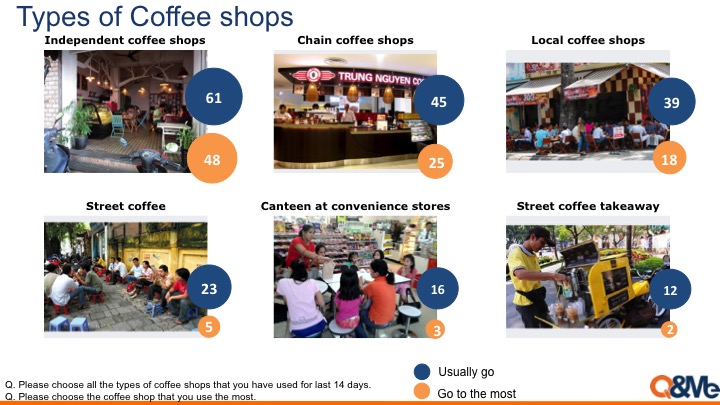
EXERCISE: Where do you drink coffee ?
Plan –
Introduction: one complex sentence.
Where do you go ? Do you go to many different types ? What do you usually order ?
Why do you go there ? What are the good points ? How often do you visit ? With whom do you go ? How long do you spend there ?
Compare the store with another (price, choice, comfort, amenities).
Are there any negative aspects ? Price, location, crowds, parking etc.
Conclusion: one sentence summary of what you have said.
IF you don’t drink coffee, then you can explain why not, and where you like to go to hang out with friends. Even if you never go out, you can talk about that as it will afford you the opportunity to give reasons and build more complex sentences.
Highlands Coffee, a popular chain in Vietnam.
Practice adjectives by describing this photo.
Increase your word power
Match the basic words with others of similar meaning
For example boring = tedious
interesting attain on time fascinating
forgetful miserable live (I live in) jovial
smart (clever) exhausted
unhappy punctual
happy feasible
possible reside
tired intelligent
get (a qualification) environment
place absent-minded
Interviews
What is your favourite beer ?
Well, I like many beers but my favourite is Czech beer. For example, Pilsner, Budweiser or Staropramen. I think the taste is very good as well as being excellent quality.
Along with Czech beer, I also really like Mexican beer such as Corona or Desperado.
Having said that, these beers can be expensive so sometimes I just drink Vietnamese beer, maybe Saigon Red or 333 because they are much cheaper.
1 Answer the question in a proper sentence
2 Give examples
3 Give reasons
4 What else ?
5 An opposite conjunction (but, however, having said that, on the other hand)
6 What instead ?
Remember to use adverbs and adjectives to make your speech more interesting
Well, I like many beers but my favourite is Czech beer.
For example, Pilsner, Budweiser or Staropramen.
I think the taste is very good as well as being excellent quality.
Along with Czech beer, I also really like Mexican beer such as Corona or Desperado.
Having said that, these beers can be expensive
so sometimes I just drink Vietnamese beer, maybe Saigon Red or 333 because they are much cheaper.
Ask each other some of the following questions:
The interviewer must keep asking questions until the speaker has nothing more to say.
Interviewer can ask, ‘Why do you say that?’, ‘What other reasons?’ ‘Why else ?’
Do you think sports are good ?
What do you like about working for your company ? / Attending your school ?
Do you spend, save or invest your money ?
What films do you like best ? Do you go to the cinema or watch at home ?
















/iStock_000075908411_Medium-574b74f35f9b58516548a60b.jpg)











![Fostering Rescue Dogs at R House in Saigon, Vietnam w/ Geneva, Alex, Thien [EN VERSION] | TÂM SHOW - YouTube](https://thaypaulsnotes.com/wp-content/uploads/2020/12/image.jpeg?w=300)







 Thay Paul's Notes