The whole article is quite long, consequently I have been selective and ‘cherry-picked’ information.
Born: 287 BC in Syracuse, Sicily Died: 212 BC in Syracuse, Sicily
Archimedes’ father was Phidias, an astronomer. A friend of Archimedes called Heracleides wrote a biography of him but sadly this work is lost. How our knowledge of Archimedes would be transformed if this lost work were ever found.
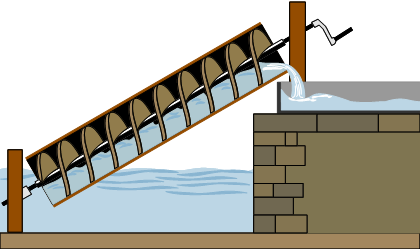
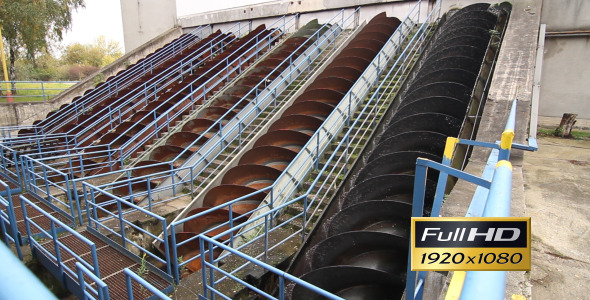
It is reported by some authors that he visited Egypt and there invented a device now known as Archimedes’ screw. This is a pump, still used in many parts of the world.
Yet Archimedes, although he achieved fame by his mechanical inventions, believed that pure mathematics was the only worthy pursuit. He is considered by most historians of mathematics as one of the greatest mathematicians of all time.
The Sandreckoner is a remarkable work in which Archimedes proposes a number system capable of expressing numbers up to 8×10¹⁶ in modern notation. He argues in this work that this number is large enough to count the number of grains of sand which could be fitted into the universe. There are also important historical remarks in this work, for Archimedes has to give the dimensions of the universe to be able to count the number of grains of sand which it could contain. He states that Aristarchus has proposed a system with the sun at the centre and the planets, including the Earth, revolving round it. There are other sources which mention Archimedes’ work on distances to the heavenly bodies. For example in Osborne reconstructs and discusses:-
…a theory of the distances of the heavenly bodies ascribed to Archimedes, but the corrupt state of the numerals in the sole surviving manuscript [due to Hippolytus of Rome, about 220 AD]means that the material is difficult to handle.Ascribed to is similar to ‘attributed to’ – when we don’t have source material to proof positively. Here we have a mixture of science AND history.
Notice all the discourse markers– expressions that don’t add any information, but allow him to think while he keeps talking (examples: all right, yeah,) and expressions (it hit the $300 mark – means the price was $300).
Dialogue
Present perfect, past continuous and questions. Listen for adverbs
Mark: Have you been to Germany ?
Amy: No, not yet. Have you ?
Mary: Yes, twice. I have (I’ve) visited Berlin and Munich.
Amy: Which did you like best ?
Mary:Well, Munich is very clean, elegant and stylish, but quite expensive.
Amy: And Berlin, the capital ?
Mary: I was working there for six months. It was really cool.
They continue after eating a big piece of pie.
Amy: Sounds like you had lots of fun !
Mary: Oh, yes ! The food was cheap and the people were incredibly friendly.
Amy: How about the weather ? I have heard it can be cold.
Mary: It was terrible ! Every day it rained cats and dogs.
Amy: You must have been so glad to get back to Vietnam. (glad = happy)
Mary: Yes, but I miss the German trains and buses; they were so reliable.
How different is England to Germany ?
This is an interesting question because, despite both being Northern European countries with similar climates and a shared language root, both nations have very strong national identities.
Historically, there is an obvious difference; the two World Wars. This originated from economic conflicts to actual conflicts which consequently altered the map of Europe.
There are many cultural differences, the English see the Germans as very efficient, hard-working, punctual albeit lacking any sense of humour.
Putting myself in their shoes, and based on my experiences of Germany, we Brits are seen as aloof and isolated, preferring tea-breaks to solid work.
These factors notwithstanding, the two countries have a lot in common; protestant religion, not Catholic (mostly), a love of both football and beer. Even our Royal Family has German blood.
Now with Brexit, it will be interesting to see what develops over the next generation. We can only speculate whether the nations move closer together or further apart.
After Brasil, Vietnam is the world’s biggest exporter of coffee, and coffee shops are ubiquitous. There are high-end chain stores, with near London prices, down to street coffee which, being honest, is probably more ‘street’ than ‘coffee’.
Here are a few recent caffeine-driven excursions:
OK, this first one is no longer in operation. Can’t think why. Branding is important, even in a Socialist country. This joint is located at the base of an apartment complex in District 2. The lady that stays there is, I believe, an artist and is extremely friendly, not ‘grumpy’ in the least.
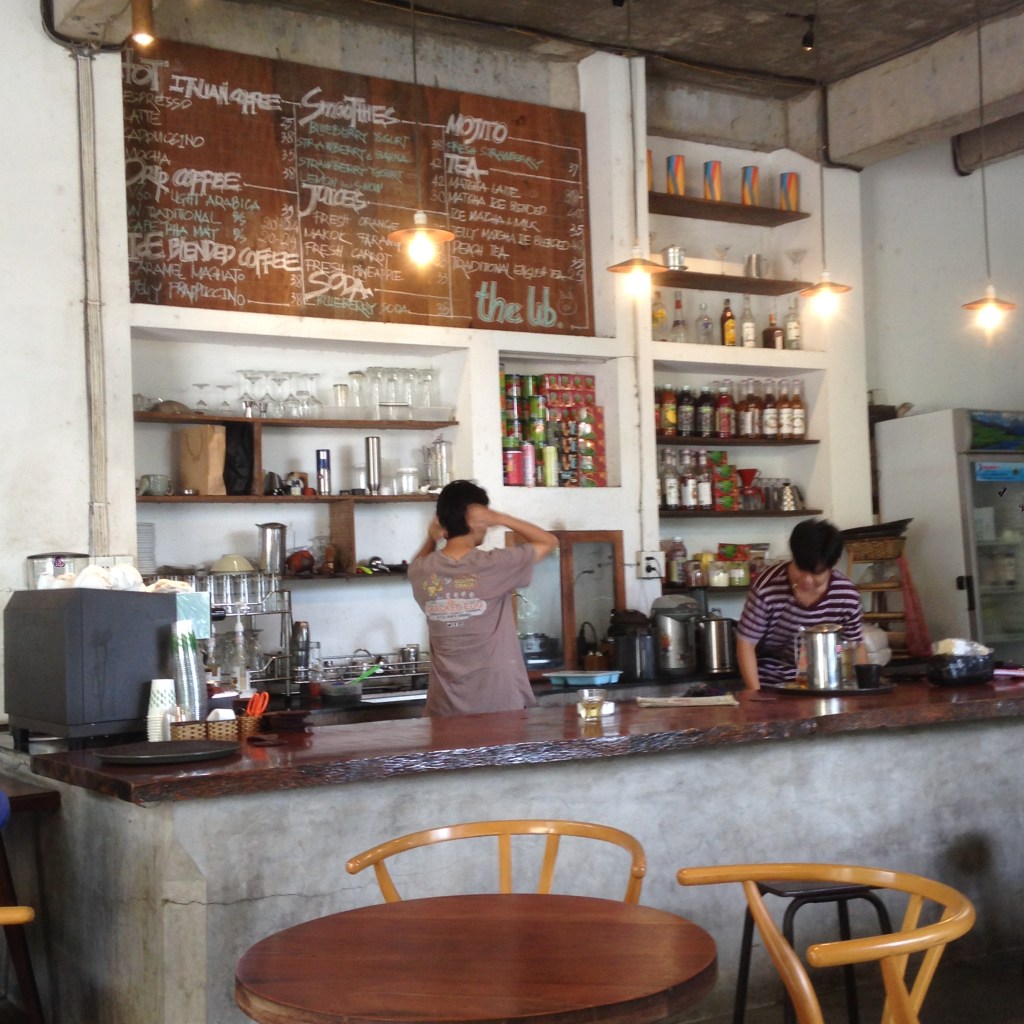
Now, staying in District 2, just a short ride away, is this library cafe:
It looks like it’s based in an old house, with large plants and dusty old books on even dustier shelves.
The coffee, however, was a disappointment, probably due to my ordering the wrong drink. I wanted a hot latte and got an ice version. Perfect for the heat, but not what I was expecting. Oh well, never mind.
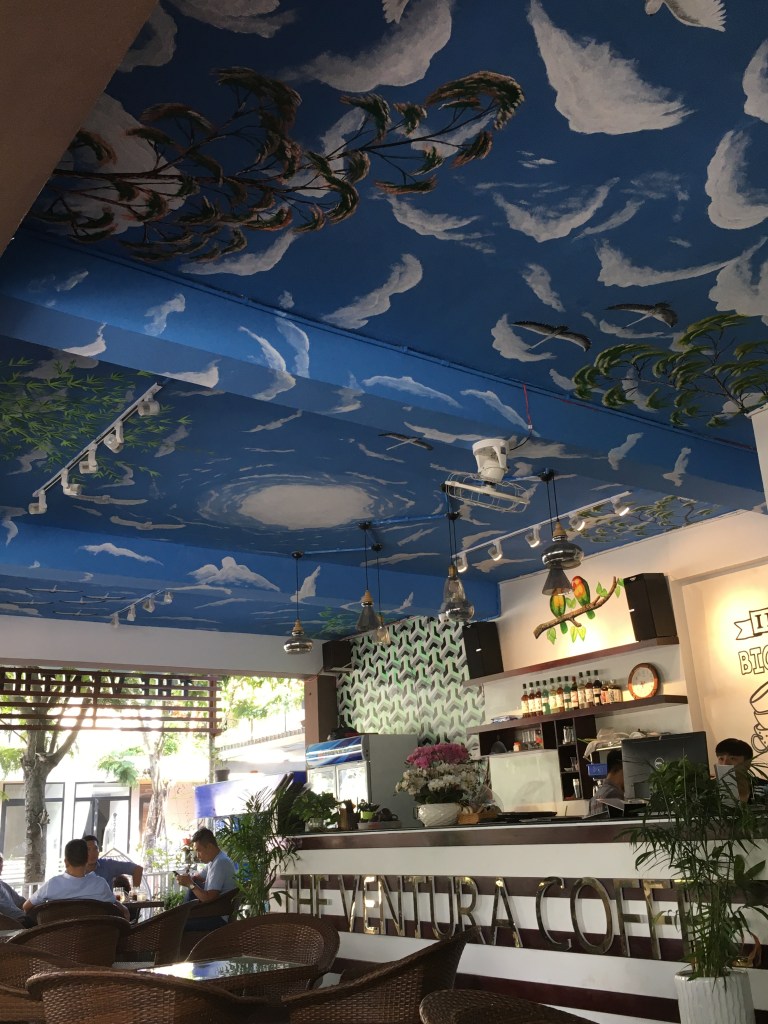
Still in District 2, ‘Ventura Coffee’ was near my old apartment by the port of Cat Lai. This was a great place, and had live football and a beautiful dog:
Damn fine cappuccino, too.
Here are a couple of signs on the wall:
Back to my new manor (are in which I live). ‘Coffee Time’ on Nguyen Duy Trinh. Fine coffees and juices. Nice decoration, and outside seating. Free Wifi, naturally. We had a hot latte and an ice coffee. The cappuccino is also recommended.
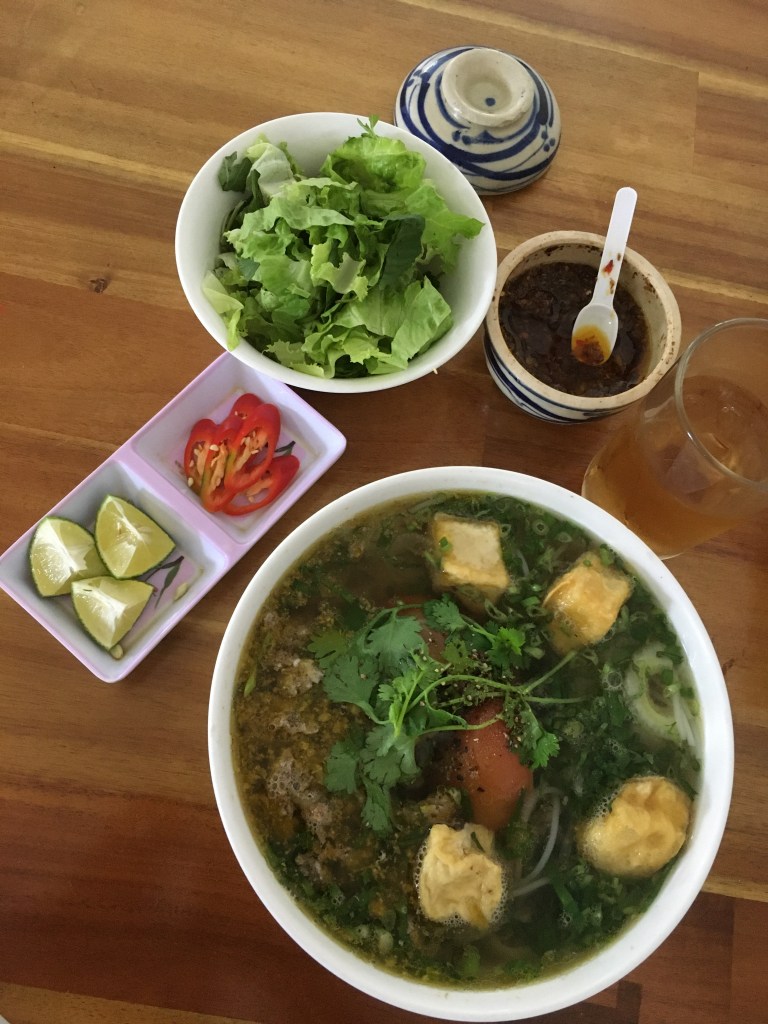
And of course, all this coffee makes a guy hungry. Back at my new apartment, we have a restaurant where they catered to my no-meat diet. Delicious crab-noodle soup. Around 40 000 VND (about £1.35) and worth every penny. Extra chilli sauce !
A major attraction of living in Sai Gon is the cost of living. Teachers are not usually well-paid and as language teachers, we maybe do less than twenty-five hours a week (which is more than enough, depending on the students).
My arrival was not without problems. I will not mention the name of any institution, as I probably have more to be thankful for than otherwise. Having said that … moving across the world to a new culture and a new job is rather nerve-wracking – there will be problems, predictable and marvellously unexpected. One thing that can be counted on is paperwork. It must all be in order … and it will all be expensive.
First, in order to work as a teacher in Vietnam, one needs a BA degree (any subject, though anything involving linguistics would be an advantage), an official teaching certificate, such as CELTA: (this is a Google image)
Then a police background check, a CRC. There is not ONE agency that provides this service, so it is good to look on the internet first to check prices. They do vary considerably. I use Disclosure Scotland.
The teacher should also be a native-speaker but I have worked at centres that employed teachers from the Baltic States, and Spain.
Then there is the visa. One needs a WORK VISA to enter the country and be legally employed.
The ‘DN’ (top right corner) designates this as a business visa, and are issued for varying periods of time. I obtained mine by post from the Vietnamese Embassy in London. Therein, the first ‘issue’. My school had to send me an invitation (to be presented at the Embassy). Unfortunately, I was sent an invitation with the wrong entrance date, then told it would take a week to amend their error. Meanwhile, I’d paid for my (non-refundable) ticket and I had some unnecessary stress hoping I could get the paperwork in time.
“All’s well that ends well,” as the bard said. However, I had to pay for an express service which I believe was £140 ($180), and that was without postage and postal order fees (which brought the cost to over £170).
Furthermore, the three certificates (BA degree, teaching certificate & CRC) have to be notarised, then sent for stamping by the Foreign & Commonwealth Office and then stamped by the Vietnamese Embassy.
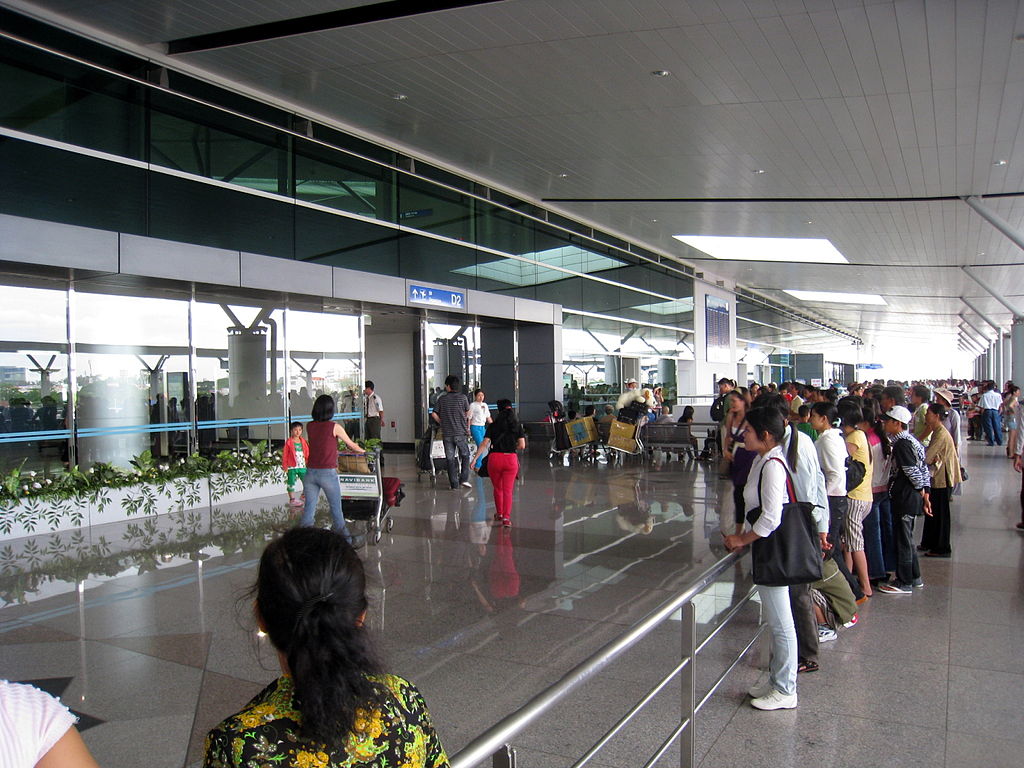
It set me back around £500, and that was without the work permit fee, the flight and money to keep me going until payday. However, one cold (London) morning, I flew, changing once at Bangkok, to Sai Gon and walked out to look for the staff who, I was assured, would be waiting for me. Walking out into the noise, the heat, the chaos that was … and still is … my life.
I had been told I would be driven to a hotel, where I would stay for three days, at the school’s expense.
Just like in the films, a young lady was waiting for me with a board welcoming me to Sai Gon. Yes, she was young. So young I was wondering if they had sent a student instead. Said lady then informed me that we would be taking a taxi and that I would be paying for it, but not to worry; it would be deducted from my first pay check, and because I was travelling with a local, I wouldn’t be ripped off by a tourist taxi.
I was a little taken aback by this news (I had been travelling for around twenty four hours, therefore not at my best), but it was compounded as Ms Information (as I later dubbed her) told me that I was also expected to pay for my complimentary hotel but again, not to worry, it would be deducted later.
I wondered what other joys lie in wait. I didn’t have to wait long. The assigned hotel had a power cut and wasn’t sure if they even had a room for me that day. After waiting with Ms Information in a cafe near the school (damn fine coffee if I remember, and I paid for it without being prompted; couldn’t handle any further deductions from a pay check I’d yet to receive), we returned to the hotel. A room was free but no wifi in the room.
On that note I thought, as I’m paying anyway, I’m going to choose my own hotel (I’d been to Sai Gon several times previously).
Later that evening, I met my manager and all was cleared up; no taxi bill, no hotel bill. I met some of the teachers, including the young lady whom I was replacing. She was young, blonde and beautiful, three things I have never been. Her students are going to hate me … and I wasn’t far wrong.
That weekend I observed some classes. Some teachers were very accommodating and helpful, some clearly didn’t want me in their class. I was left in no doubt that one in particular did not consider it her job to help me at all. And she didn’t. Each to their own.
Now, I was staying in my hotel, and getting the street motorbike to school. Ms Information would phone a street bike to take me home, very kind. I managed to find a room in District 3, which was ideal for me. Lots of shops and markets, lots of things within walking distance (I do not ride a motorbike).
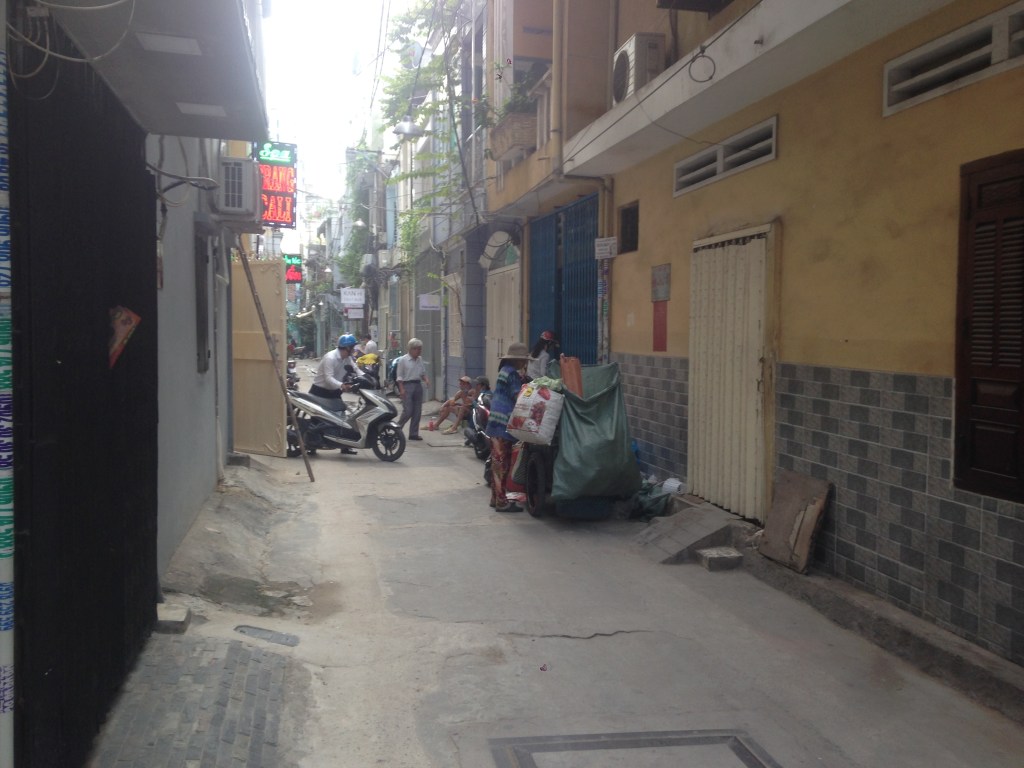
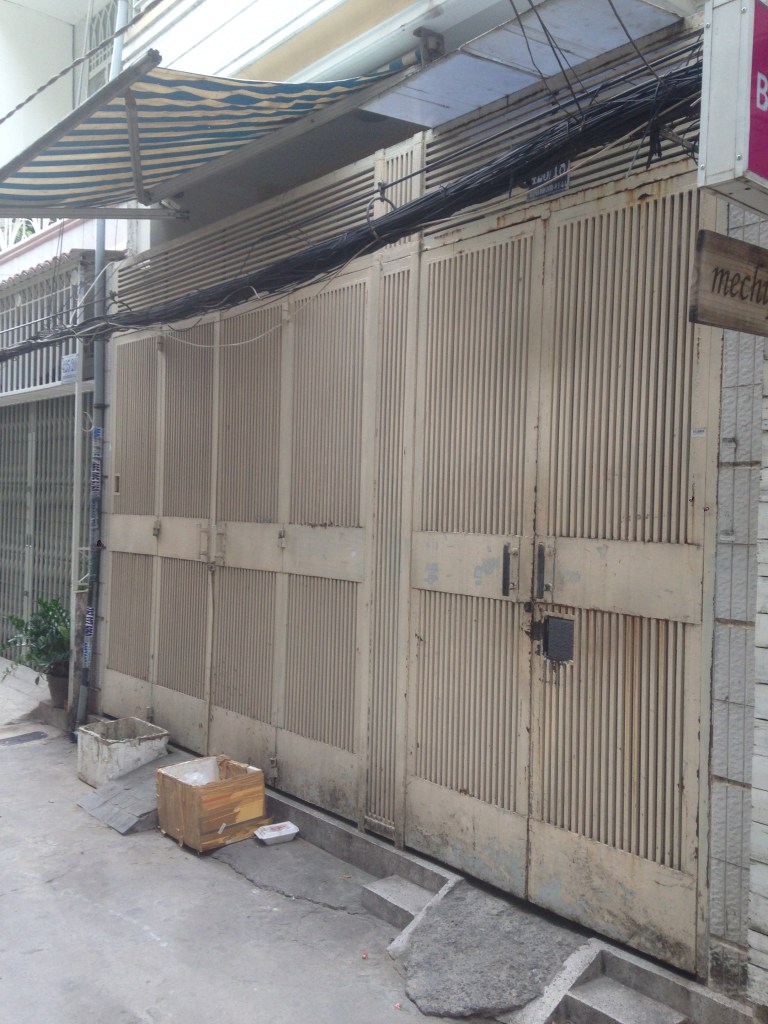
This was situated in a small alley off a main road, Nguyen Dinh Chieu, in between a lingerie shop and a pharmacist. I felt at home.
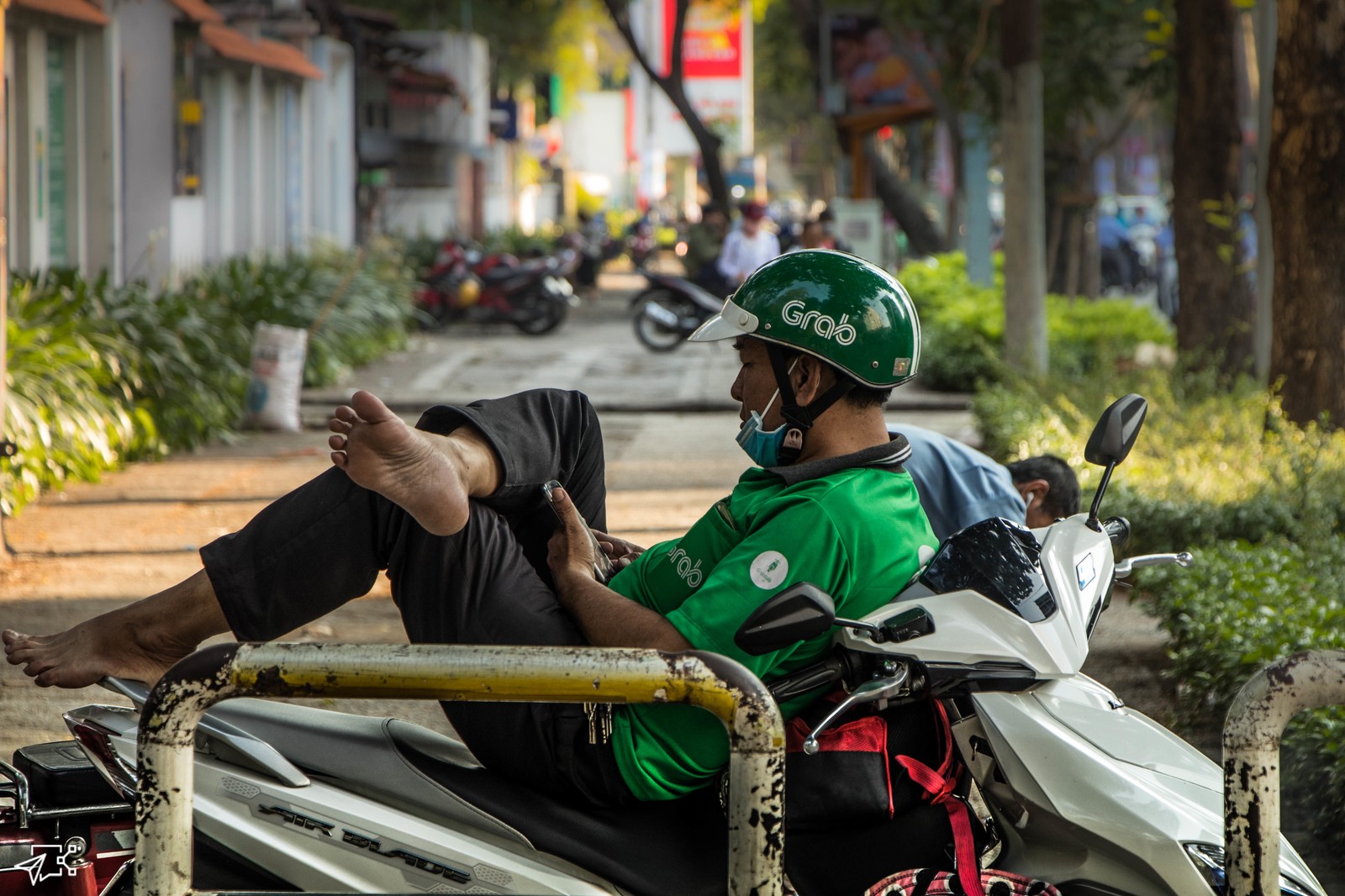
The door was unlocked by inserting one’s hands through the black square and unlocking a padlock. There was no recycling. All rubbish, or trash if you are American, was dumped outside. It was rarely there a few minutes before some neighbour would pounce on it and rip it open looking for … who knows ? But the debris would be scattered outside the door. I took to dumping my rubbish, or garbage if you are American, further down the alley. At this point, I downloaded the Grab Bike app and was able to use their services to get home, easily halving the cost of the street bikes:
Probably not the image the company wants to promote, but more realistic than the twenty-somethings with pearly-white teeth and a perpetual smile. And footwear. I informed Ms Information that she no longer needed to order me a motorbike, I could book myself, with Grab. Maybe you can guess what happened … yes, I jumped on a bike she ordered for me and was on my way to the old hotel. So, back to my digs:
The room was basic, no fridge or cooking facilities, but a shower and private bathroom. Furniture provided. Kindle on bed and bottled-water on standby.
The simple life. I think I paid three million Vietnamese a month plus electric which could be up to another million depending how often I used the air-con. In all, I paid a maximum of four million VN Dong – about £135 / $175 a month, for a six-month contract.
Yet, nothing especially Viet or Asian about it. It evoked more of a Leonard Cohen in Greece feel. Nothing wrong with that of course … “You get used to an empty room.”
However, one Tet, when most of the tenants were away, I think someone broke into my room, as my suitcase which was always padlocked and contained my laptop, Kindle and money, wouldn’t open. It seemed that someone had tried to open it and had broken off their implement.
After that, I changed the door lock and spent a million on new, European-made security locks and bolts. Nothing from Taiwan, sir, give me that impressive and weighty German monstrosity. It’ll do the job.
But … at the end of my six months contract, I wanted out. The next place was just a few streets away, living above a clothes shop. I forget the rent, but it was similar to the first place, perhaps a tad more. Renting can be risky in Vietnam. At short notice, the owner can decide to take back the space, and the tenants have only a short time to find a new place.
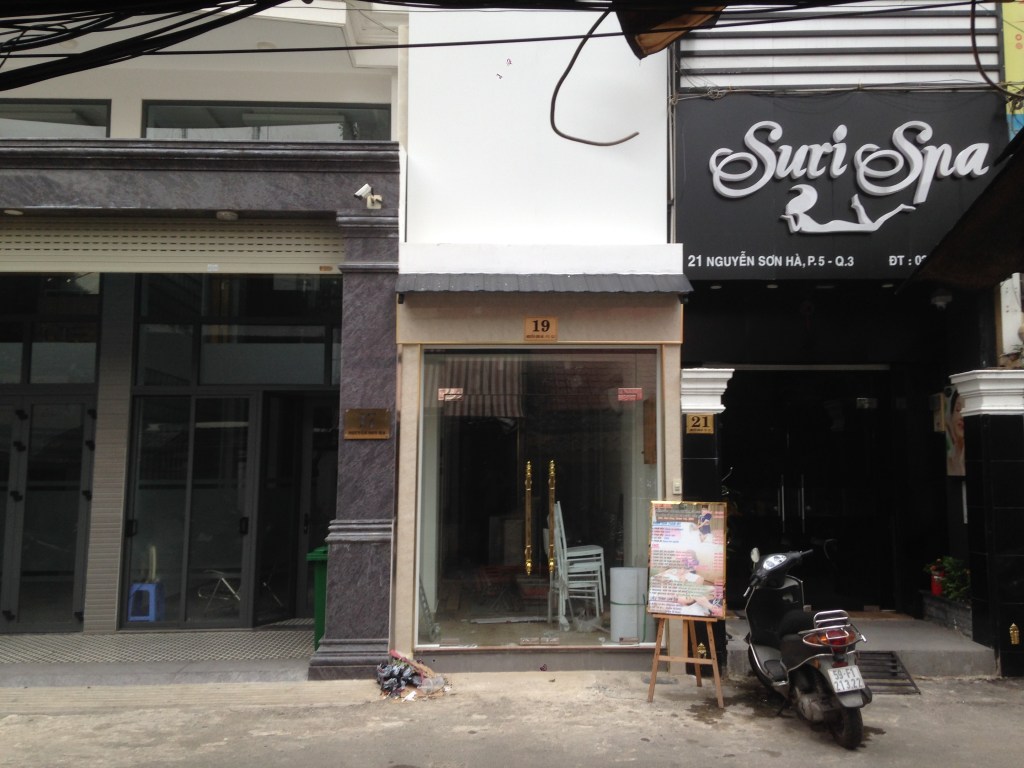
The clothes shop had that exact fate. As you can see, it has gone, but this was the location, number 19. A husband & wife team sold shirts and Tshirts, living behind the store front. I had two floors upstairs, with a little verandah for outdoor cooking, and a shower that was apparently a danger-hazard. I was advised to fill a bucket with hot water and use that as opposed to standing directly under the sprocket. Power cuts were not unknown.
One night there was shouting and screaming – more than is usual in Sai Gon – as a house but three doors away was on fire. Exit flat sharpish and waiting in the street for the all clear before my year’s work-contract was up and I was ready to clear out of Viet Nam and head home.
Which I did. London … in winter. I took care of some paperwork, a new CRC, new work Visa and back on that plane for a lovely thirteen-hour flight. My new place, however, was an apartment. Way out in the sticks, near Cat Lai, the busiest port in S.E. Asia:
The local area was terrible: containers, night and day, honking of horns, trucks stomping over speed bumps, few amenities, few restaurants, not an ATM for miles and karaoke … open-air, all day and most of the night karaoke.
The apartment was great, and the swimming pool was fantastic – even if everyone if the neighbourhood felt it was their right to come and use it.
And then the rainy season began … the jolly old rainy season. Here are some arty (I wish) shots. A little Impressionistic:
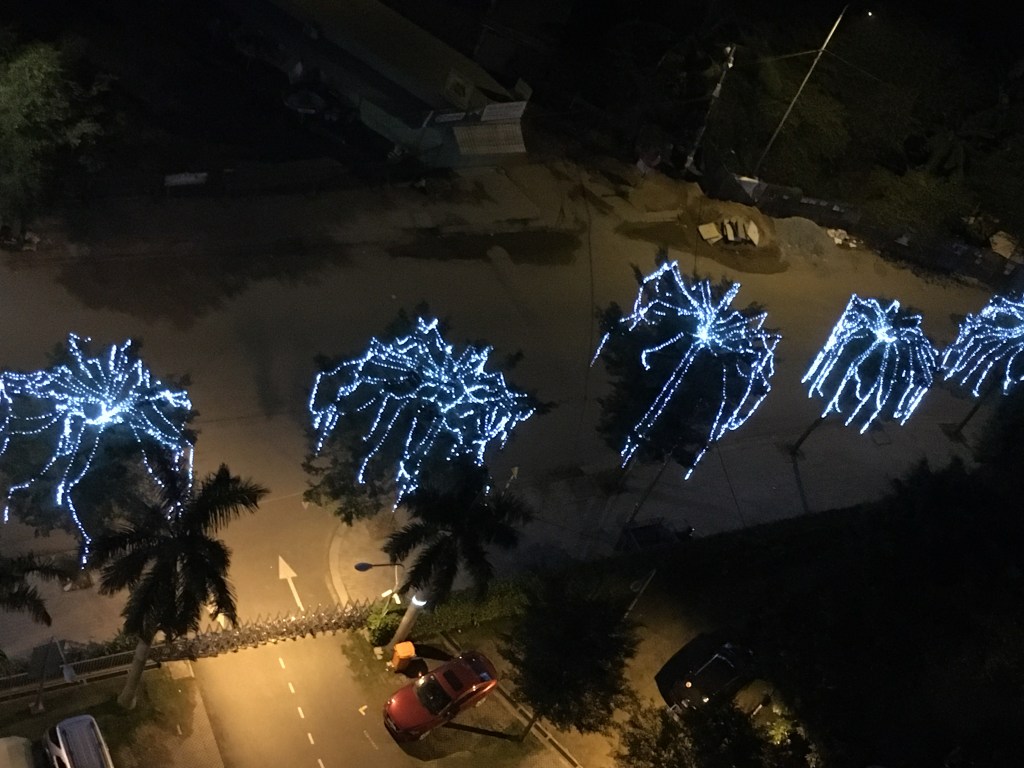
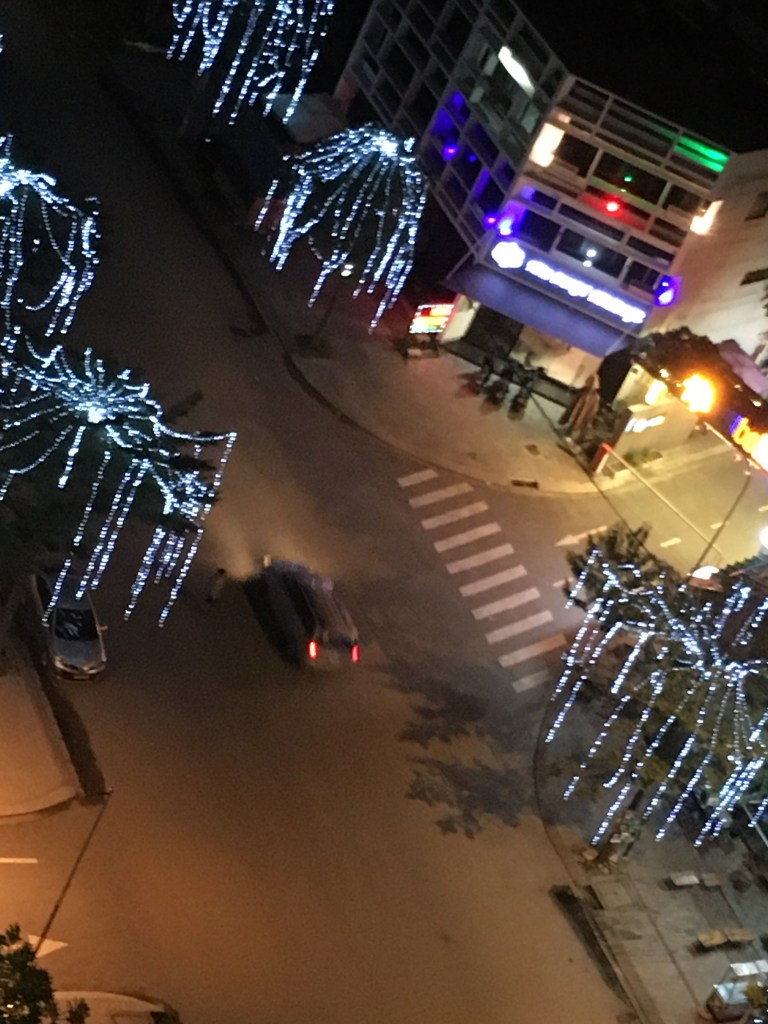
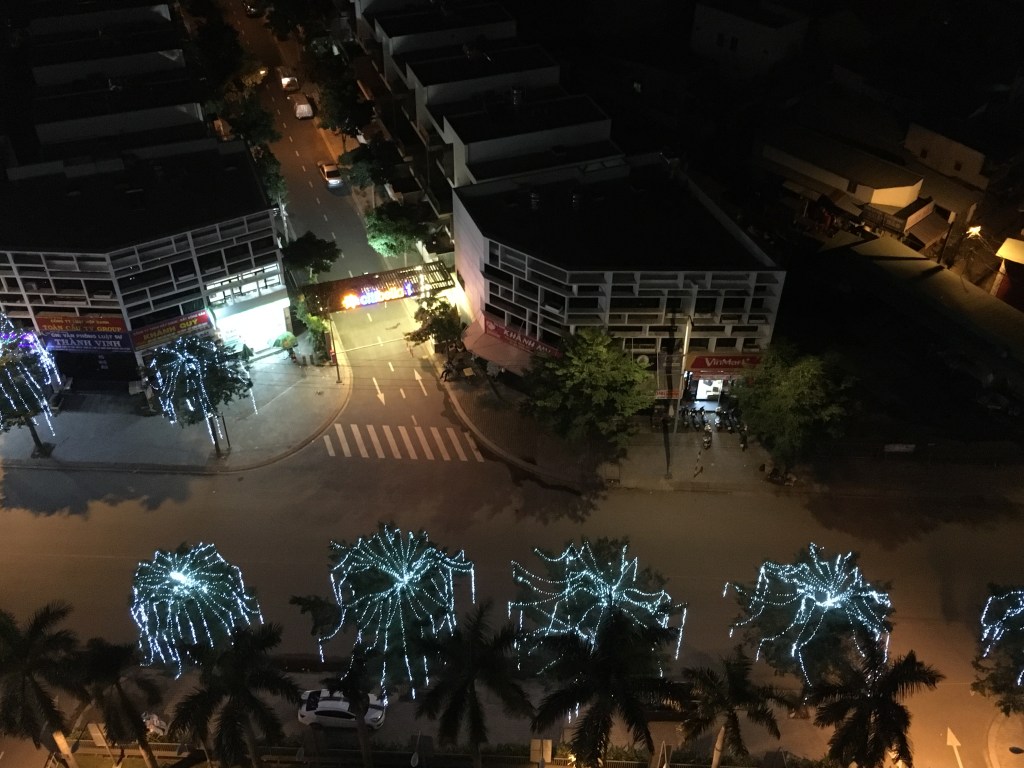
For Christmas, they made this effort, which just looked like giant spiders from my vantage point:
One night, the Moon looked spectacular. Unfortunately, my phone camera couldn’t do it justice but anyway:
I mentioned karaoke. There were some people whose hobby was warbling, screaming, croaking, belching etc into a microphone, turned full whack, and ‘entertaining’ everyone within a two-mile radius. How could it get worse ? Wedding parties.
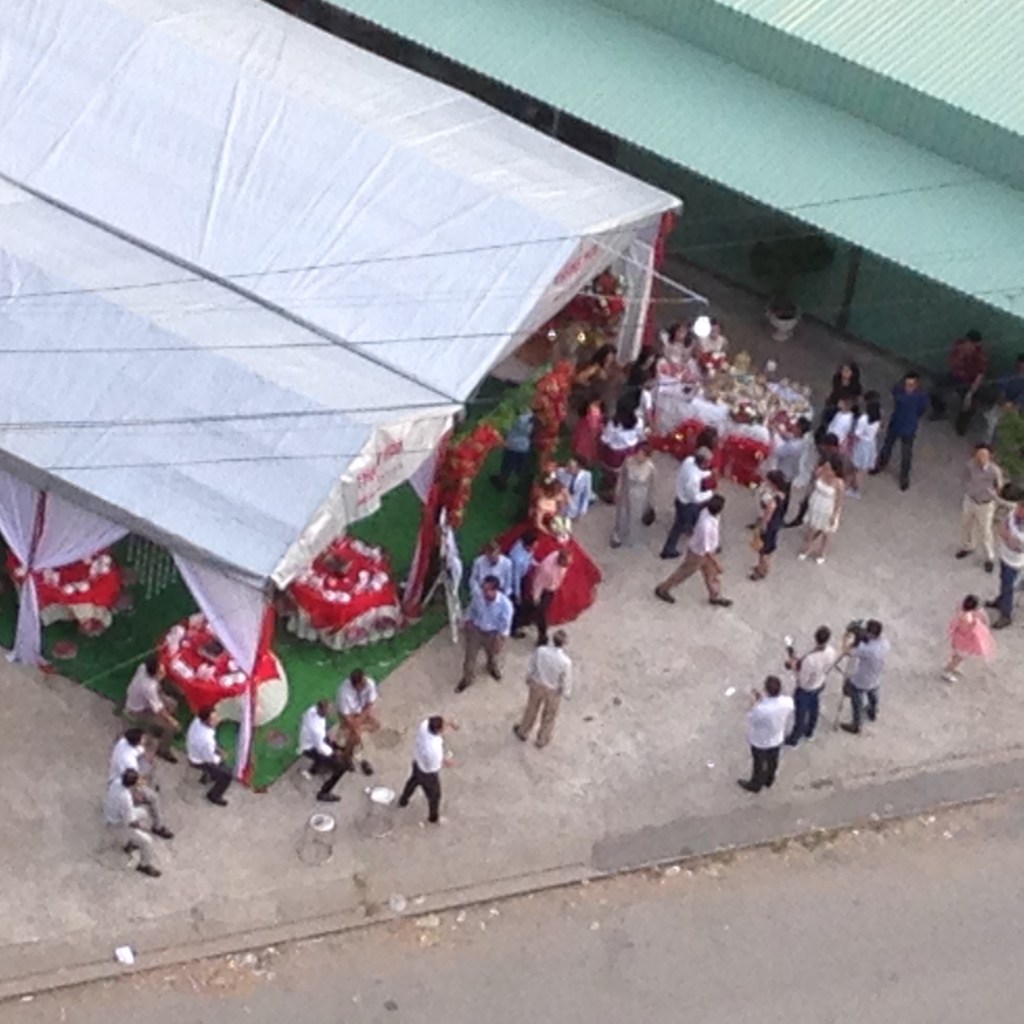
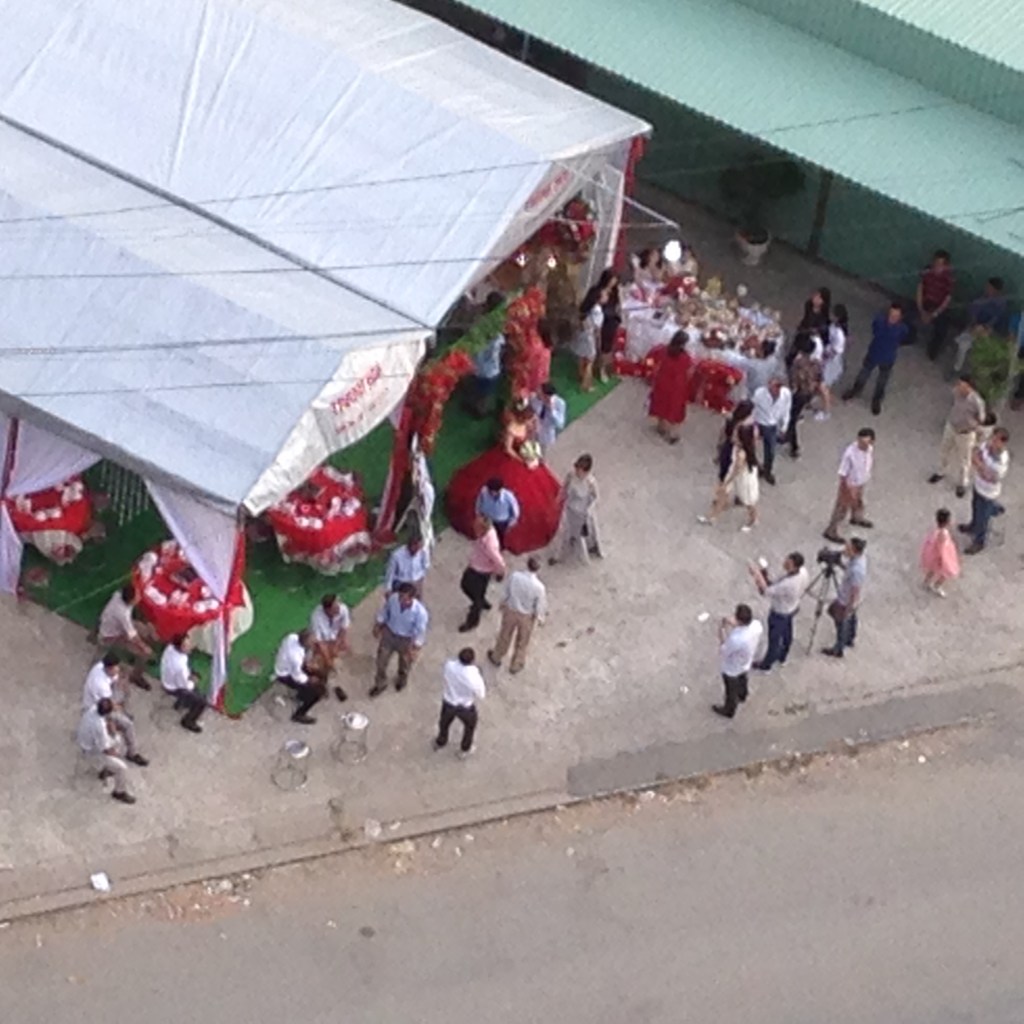
There was a vacant lot opposite my flat. It served as a car wash weekdays, but at weekends was rented out for wedding parties. These are noisy. Really noisy.
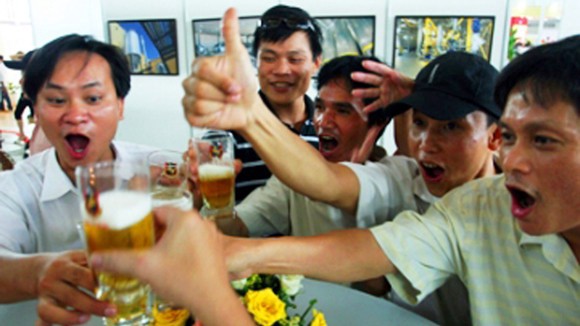
The first two hours usually have a professional singer or band. Most guests start to leave at that point … but not all. Some stay and avail themselves of the free beer, the karaoke and the microphone … for hours.
What starts as a romantic event ends up like this: Imagine these gentlemen screaming and shouting and whooping all day. Welcome to my (old) life.
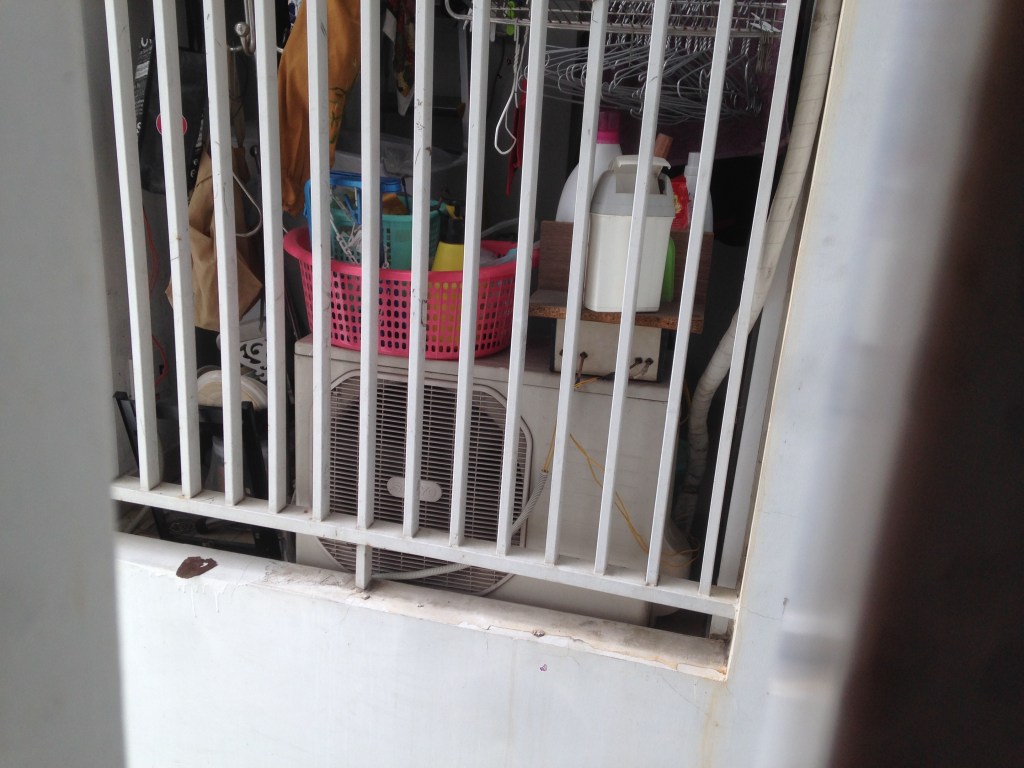
And then we have the neighbours. Lovely people, but they were from Central Viet Nam so couldn’t take the heat. Thus, they installed three air-con units, the third of which blew directly into our balcony, sprinkling us with dust, muck, dirt, goodness only knows what kind of air-bourne viruses … and heat.
Enough, as they say, is enough. Time to move.
So now I’m still in District 2, but near shops, near a main road, near amenities, not a container in sight (or sound) … and we can have pets.
Of course, my very first night there, a local restaurant had … karaoke. However, we have a police office in the next street, so they make sure karaoke is contained and punishable by (I don’t want my English humour landing me in hot water, so add your own comment here) ………………..
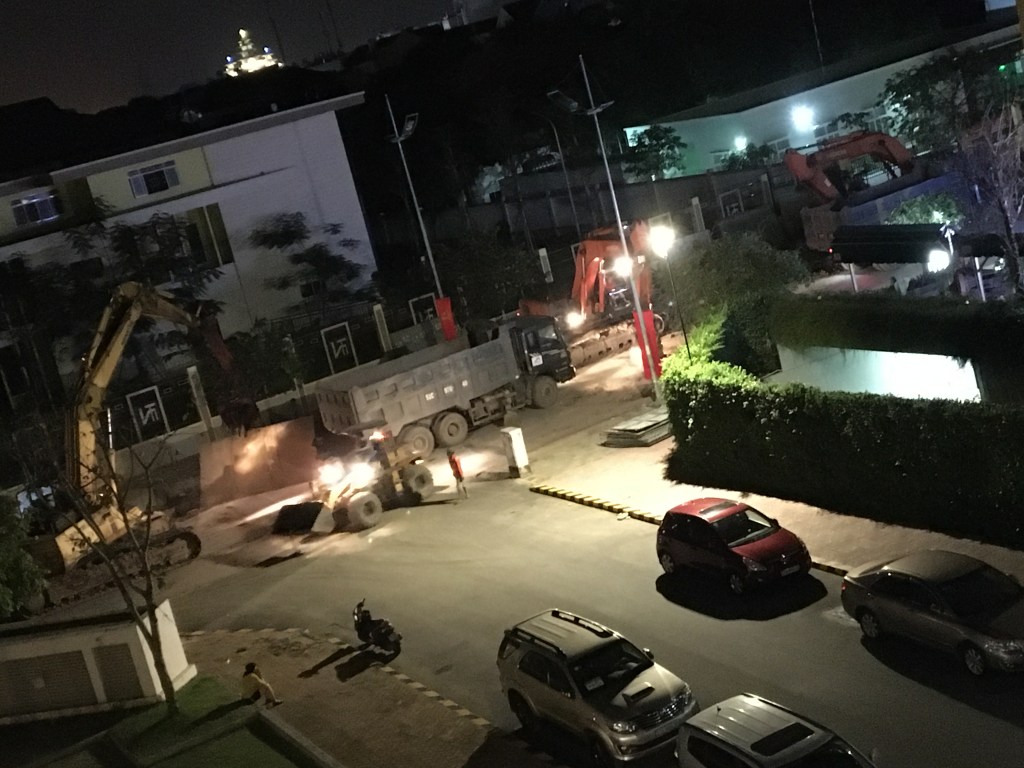
Since then, very little except, around Christmas time all night, and for many nights, they decided to dig up all the roads:
Vietnamese food can be wonderful, albeit a little samey (to a casual eater, it can appear to be no more than bowls of different types of noodles with different types of meat, topped with a forest of fresh-ish vegetation).
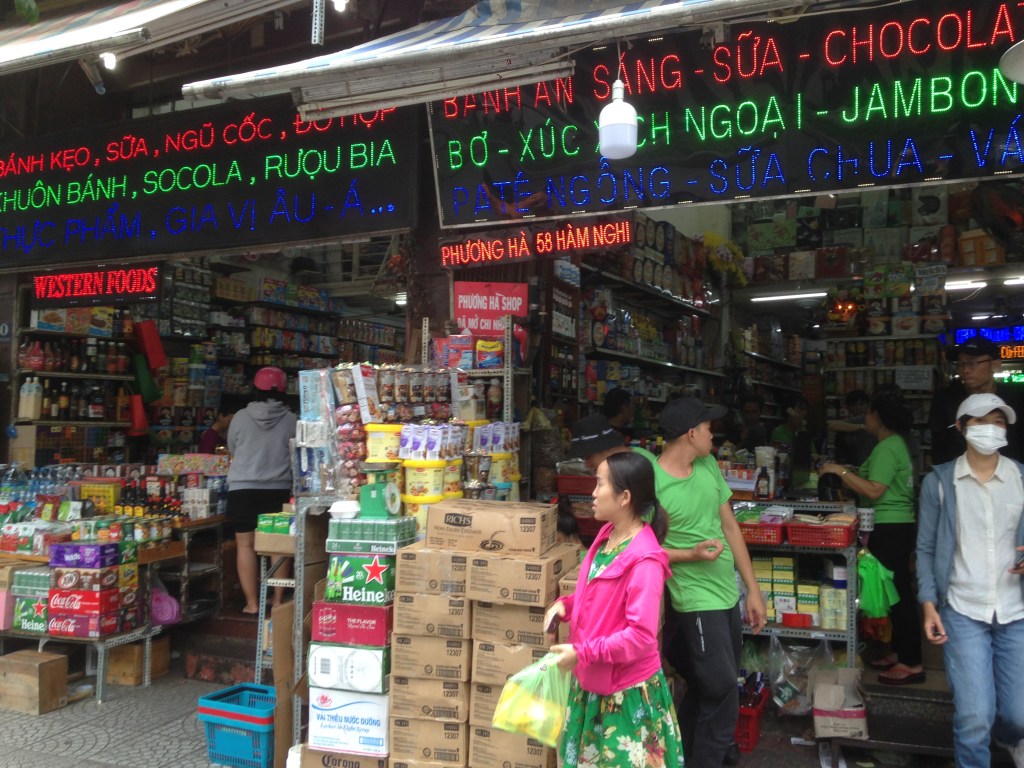
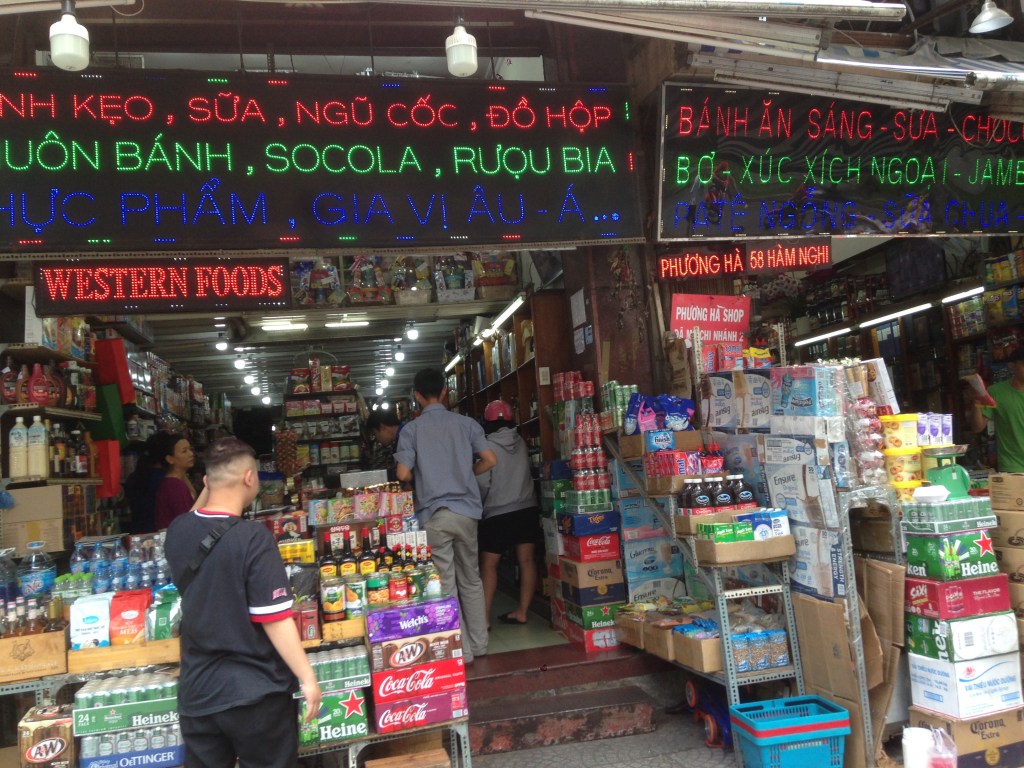
I’m not knocking the local food, I’ve written blogs about my favourite dishes, but sometimes … an ex-pat will miss that little something from home. Never fear, in District 1, in the shadow of Bitexco, we have a number of stores selling, and usually at a very good price, various items from around the world:
58 Ham Nghi Street, District 1
And finally, I mentioned we are allowed pets … allow me to present my puppy, Dali (if you’ve been following my teaching blogs, you’ll no doubt appreciate the moniker):
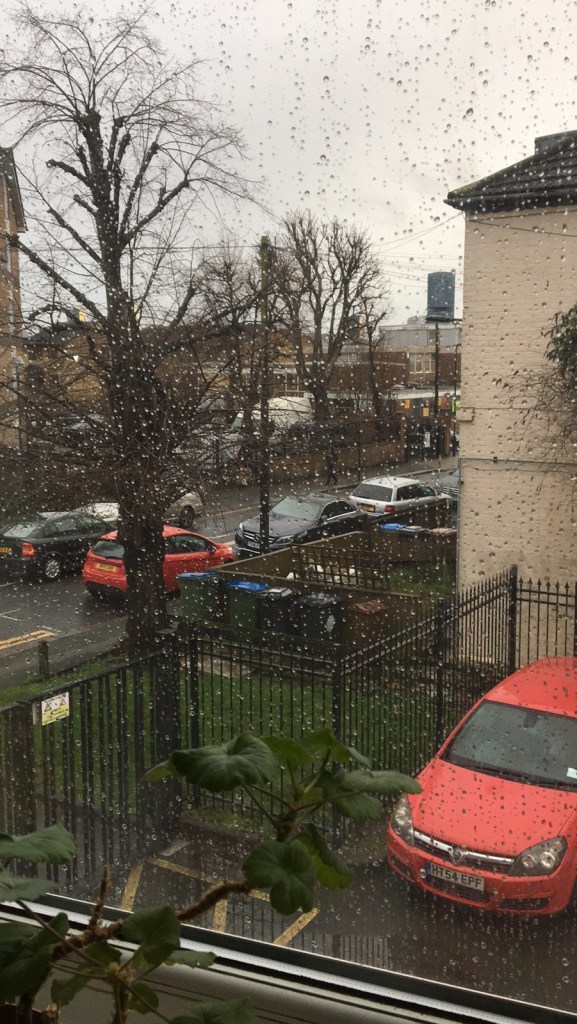
The sky is grey, the prices are astronomical, people are loving Brexit, people are hating Brexit, people are predicting a boom, people are prophesying doom … and it is cold. It is very, very cold.
The view of east London, near the Olympic Stadium:
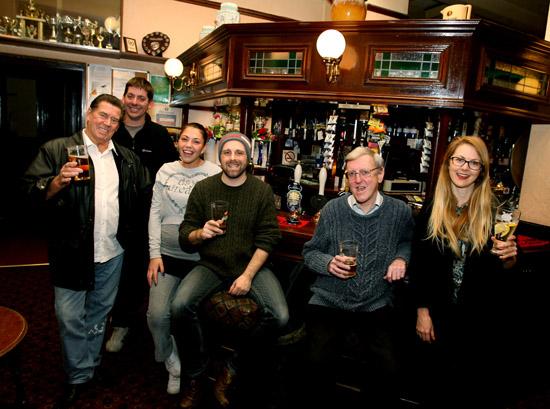
I arrived late Thursday 13th and spent most of the next day meeting my brother’s friend in his local (the nearest pub). At ‘Happy Hour’ a pint of Guinness was £3.50. Otherwise, it is a fiver (£5, that’s $6.50).
Sunday, I took the new express train from Stratford International 75 miles to Canterbury West (£35 single / $44), to meet up with some old friends, Carole and Pete. Carole met me, then we drove to a small cottage on the sea, at a place called Whitstable, famous for its oysters.
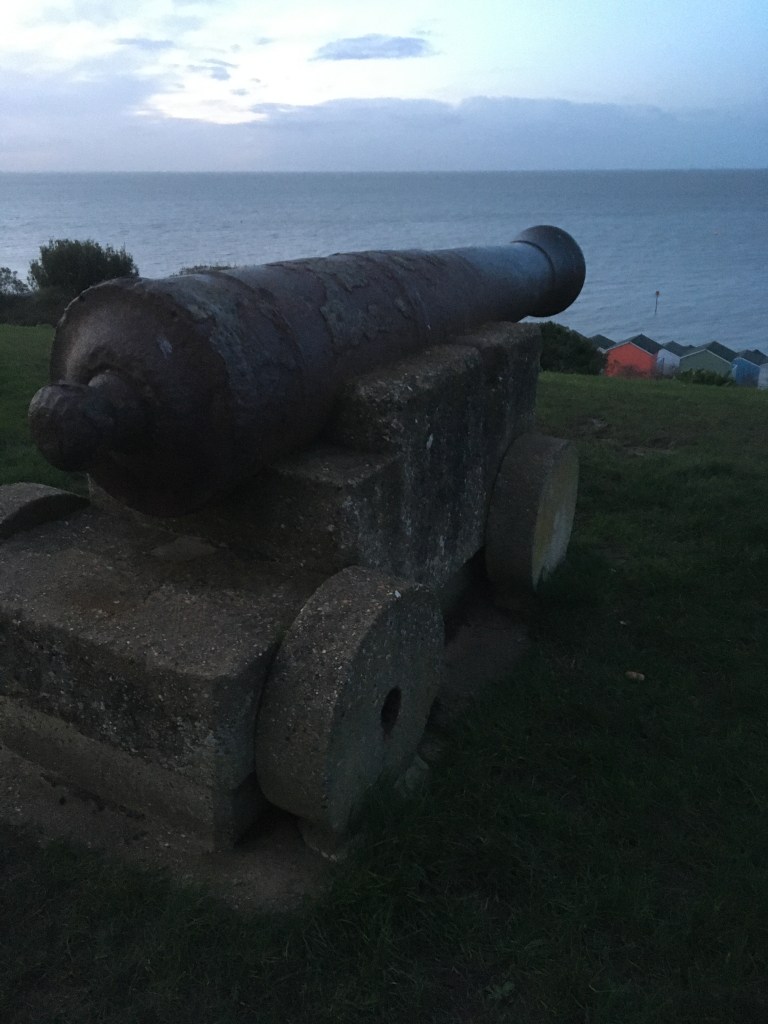
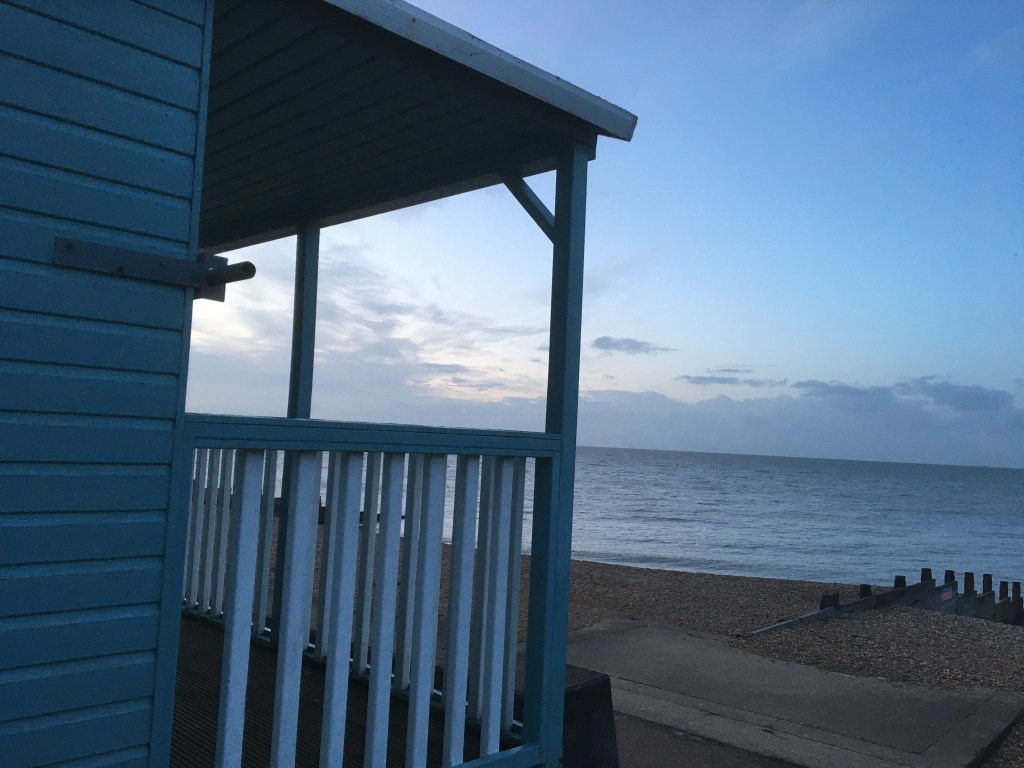
The sun emerging from the clouds at WhitstableBeach bird looking for food Canon overlooking the beach huts Colourful beach hutsTypical quaint houses and curving streets of this sea-town.
Next day, we met Pete at Broadstairs (see next blog), but back in Whitstable, we had the traditional fish and chips:
Clockwise, from top left: cod & chips, skate & chips, and my choice, haddock & chips. Served with tartar sauce.Pete VERY happy with his lunch. Note, also three mugs (large cups) of tea.
For my Vietnamese students, the above (three fish and chips and three mugs of tea) was about one million VND. I told you UK was expensive and this wasn’t even London ! However, in the UK one is never far from an Indian, Chinese or Asian restaurant. For example, in Broadstairs I saw:
Next Wednesday I’ll be back in Bangkok, so I can try the real McCoy (the real thing).
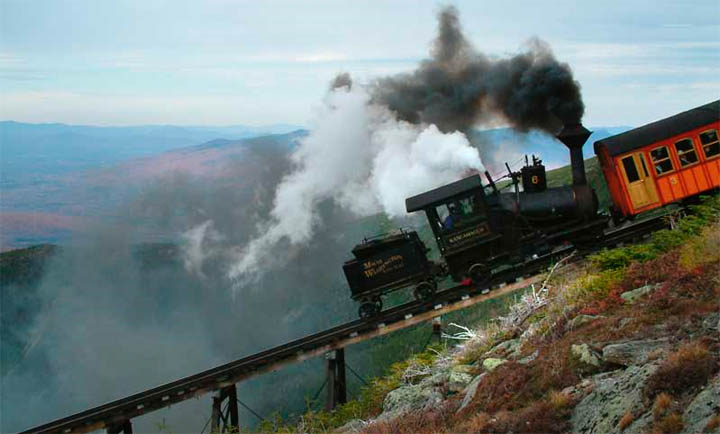
What is the problem with trains and going up gradients ?
What do they struggle to do ?
What are the scientific reasons for this ?
What was the problem with James May speaking ?
James normally speaks quite clearly, but there were problems. This was due, I feel, to the speed and the amount of language. Look at this conversation analysis: (0. 10 – 0.42):
And now, ‘Why can’t trains go uphills ?’ Well, the smarter ones amongst you will have recognised already, especially if you’re a qualified railway engineer, this is a bit of a trick question because of course, train can go uphills … they’re just not very good at it.
If you think about the topography of most of the world, this is clearly a bit of a problem. Human being can … albeit rather sweatily, motivate themselves up a gradient of around eighty degrees, or one in a quarter.
Listen again– hear how James:
links words
uses expressions (bit of a)
adds addition information / commentary in supporting clauses.
Creative use of adverbs – sweatilyshows how many words can be made adverbs
Think – does James need to add the clauses ? What is the purpose ? Consider the medium (TV, internet, blog etc) and the target audience.
James is speaking to a fluent, English-speaking audience, probably native speakers, or people who have lived in the UK for a long time. Therefore, they will be more used to this natural way of speaking.
This is why I recommend student put their text books down and read real English books, watch English-speaking films and TV shows and sing English songs. It really helps.
He does make allowances for non-British audiences by showing two fifty-pence coins, but his language isn’t downgraded.
Intonation – SO important to assist in conveying meaning.
Many interviews have similar questions. Read the following and then role-play with a partner. Feel free to add your own information, or make up something new.
Possible questions:
What experience do you have ? // What do you know about the company ? // Have you ever had to work to a deadline ?
Tell me about yourself
I was born in …. and I graduated from …. University in 2014 with a major in Business Administration. Since then I’ve had two year’s experience in administrative work at ABC and XYZ Corporation.
I’m a very organised person, well-balanced and efficient. I’m hard-working and dedicated.
In my free time, I like to travel and I love to paint. Furthermore, I enjoy going out having coffee with friends.
What do you know about (COMPANY) ?
XXX are an established company with a good reputation. They help …….. and there are over (xx) sites in VN (or your country).
What are your strengths ?
I feel I am easy-going, hard-working, careful and diligent. I think my greatest strength is my positive outlook, even during times of stress. I can work under pressure and I really enjoy a challenge. Lastly, I like working in a team.
What are your weaknesses ?
Well, my English isn’t perfect, so this will be a great chance to improve. Maybe I can be a little quiet sometimes; that’s why working as part of a team will help bring me out.
Can you give an example of when you had to deal with an angry customer ?
One time, a customer didn’t like the price of a visa, and he began shouting and getting angry. I asked him if I could explain the reason. I then told him how it wasn’t our fault, but that I understood his anger and said sorry. Then I told him he could check elsewhere, but we would still be happy to serve him. He calmed down, said sorry to me and bought the visa and was happy.
Where do you see yourself in two years ?
My short-terms goals are to work hard and efficiently, so I can master this job. However, in the long-term, I would be interested in possibly doing more courses so I could be a manager.
What can you bring to the job ?
I’m very friendly and enjoy working with people. I always try to be happy at work and share my positive outlook. I’m very motivated and open to learning. I’m very excited about being a part of this great company.
Do you have any questions ?
May I just ask, what career opportunities are there at XXX ?
It is not a good idea to ask immediately about salary, money and bonuses, although this is an important part of the interview process.
Firstly, this job is an ideal match for my skills and experience.
Secondly, …
Above all, the reason I want this job is …
Key words:
highly motivated
can work on my own initiative
proactive
team-player
ready for a challenge
Speaking Practice:
Now you have some new words and phrases, interview each other again, making sure to really sound like the ideal person for the job.
Working in English. Being a TA (teaching assistant)
How would you handle (answer) these questions ?
How often do you communicate in English ? Have you ever used English in a work environment ?
Two teachers need things at the same time; how would you prioritise ?
How would you deal with a rude teacher ? What would you do if you had a problem with a certain teacher ?
Could you work as a team member ? Could you take orders from a younger person ?
Some students come to you and say they don’t like a certain teacher. What would you tell them ?
Teachers earn much more than Viet staff. How do you feel about that ?
Some parents may be very angry about a grading a teaching gave. If they came and shouted at you, how would you cope ?
Can you give an example of a time when you dealt effectively with an angry customer ?
How do you see this role ? What do you imagine you’ll be doing ?
The work may become routine. Do you think you will get bored ?
Part of the job-description involves keeping a safe environment. What do you think that means ?
A child has a nosebleed; what would you do ?
A child is being noisy and shouting when the teacher speaks. What would you do ?
A child swears in class, but his parents are angry at you when you criticise the student. However, the teacher insists you phone the parents to complain.
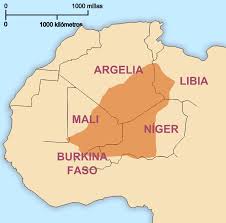
The Tuareg are a large group of Berber people from many different ethnic groups who live in the Sahara region of northern Africa. No one really knows where they first came from …
Conversation practice: New person at work // past-time expressions
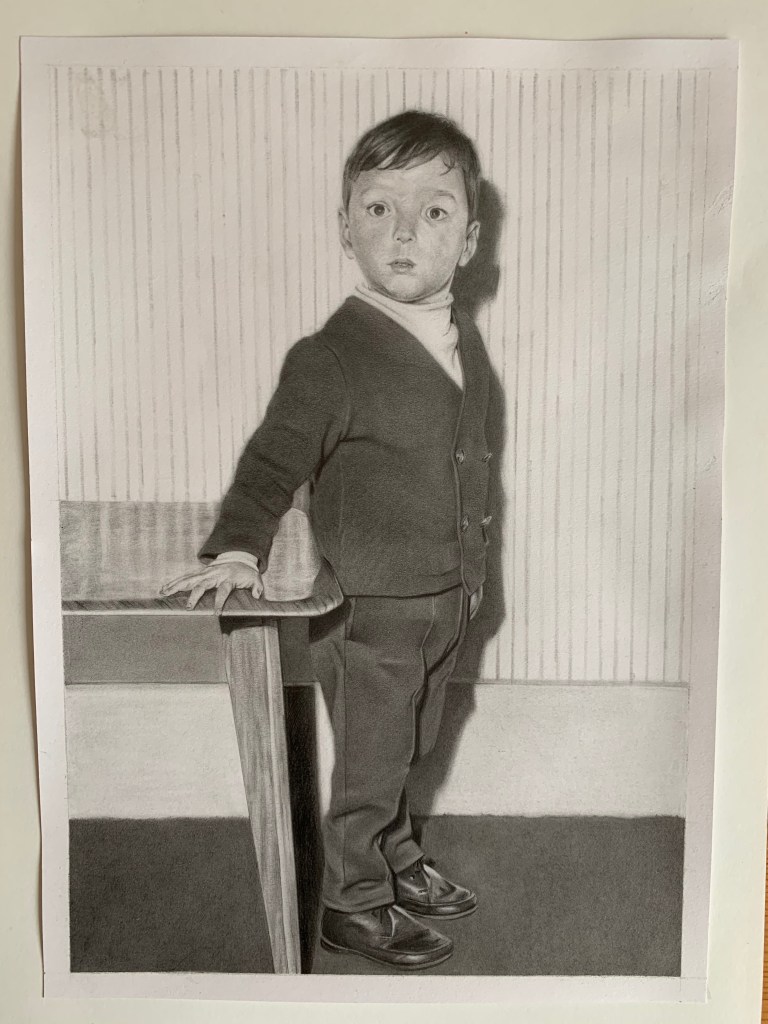
Photo description
What is happening here ?
Never start a story with a pronoun (he, she, they, it). Tell what the subject is, or tell what the people are doing.
NOT ‘They are laughing.”
I can see two ladies (add adjectives – their age, their background), what they are wearing, where they are and what do you think they are doing … how do they know each other … are they close friends ?
Warm up game:
Show these pictures. One student sits facing away from the image, and the others have to describe it. See how accurate the student can be.
Work in pairs. One is new to your company and the other has to show him / her the ropes (show the new staff what to do, how the job works, where things are).
Make conversation:
First – small talk (general questions, where did he work before, where does she live)
Next – explain about the subsidised lunch (lunch is not free but is much cheaper than a normal restaurant).
New staff can ask about the food at local coffee bar or restaurant.
Older staff can offer suggestions to eat somewhere or a great local cafe.
New staff can ask about shopping, coffee shops, watching football in cafes.
Bonding – seeing what you have in common.
What (films, books, music) are you into ?
Would you like a coffee / tea / water ?
Pronunciation Quiz
What words are being said ? Teacher, or a student, reads out these pairs of words. Students must decide which is being said.
Cheese or cheers // Ship or sheep // close (the door) or close (near) //
work or walk // heard or hurt // house or ours // open or a pen
Past time expressions
Not for a long time / not recently / oh, I can’t recall it was so long ago
quite recently / fairly recently / about a month or so ago
last week / last month / last year / yesterday / just this morning
the day before yesterday / a fortnight ago / ages ago / I’ve never done that
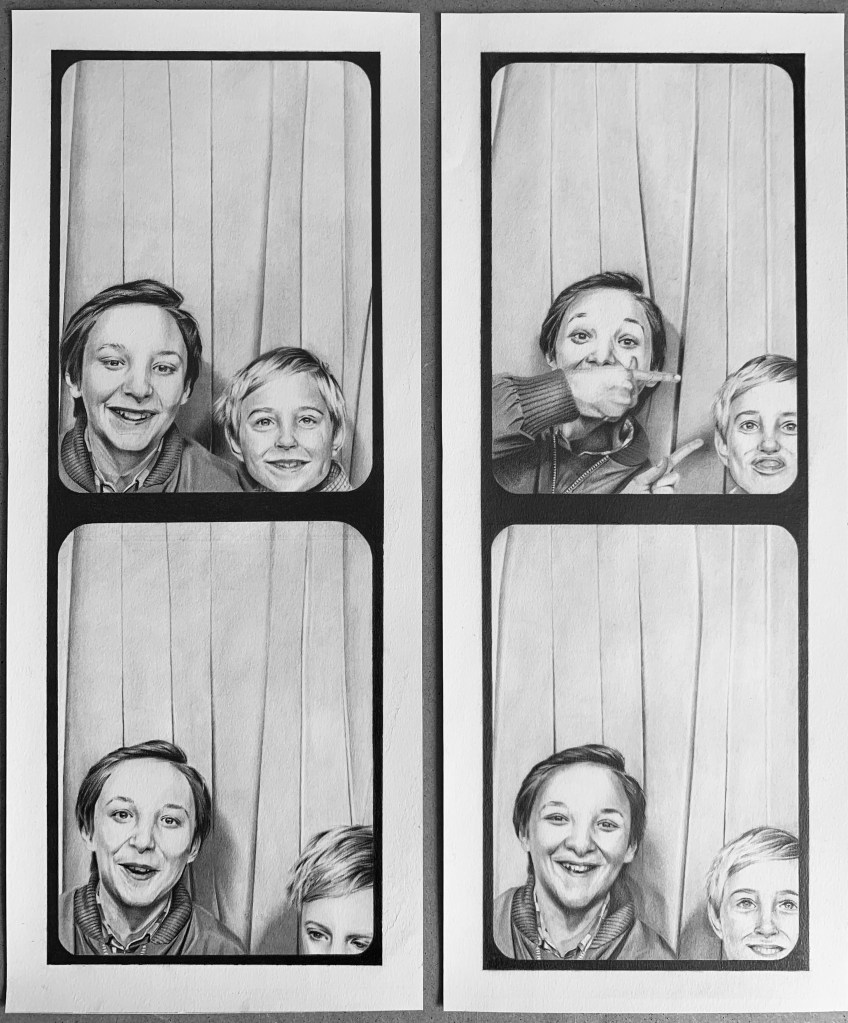
What could these two friends be saying to each other ?
Put class into two teams (or more depending on size). They have to write and then act out a conversation using FIVE of the above time expressions.
Example: Let’s call them Yen and Haamida
Yen: Have you seen Anthony ?
Haamida:Not for a long time. How about you ?
Yen: Yes, I saw him the day before yesterday.
Haamida: Didn’t he go to Scotland last month ?
Yen: No, that was ages ago. Oh, did you finish your essay ?
Haamida: Yes, just this morning.
Do not use any of the examples !
Now try this situation. The two people are not so amicable (friendly).
To help: what is the relationships between the two ? Boyfriend / girlfriend ? Husband & wife ? Brother & sister ? Neighbours ? Actors rehearsing or actors in a play ?































































 Thay Paul's Notes