Adult Class, Level 3 (class 2): She said, she said.

7th October for 8th October 2019. AEF 8A (1, 5 & 6), pp. 74-75, 77

Sentence building – becoming fluent and coherent

Use

  • adverbs
  • adjectives
  • opinion phrases
  • linking words and discourse markers
  • new vocabulary

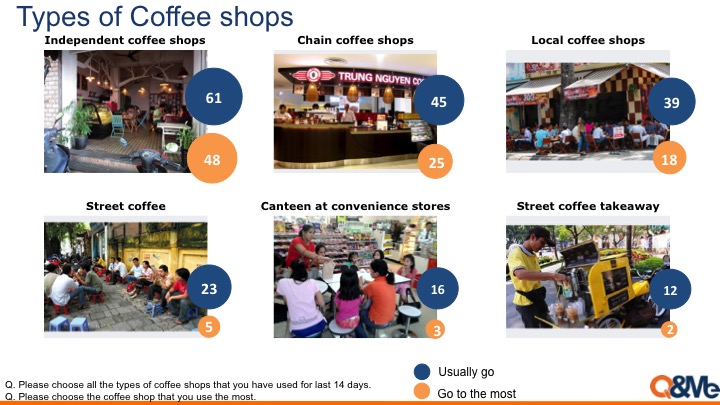
Vietnam is famous for coffee; coffee shops are ubiquitous. In fact, there are so many, it’s hard to see (difficult to understand) how they stay in business let alone turn a profit.

Be that as it may, let’s use this as a learning opportunity. To practice making longer sentences, and as a warm up exercise, the students can ask each other, “Where do you go for coffee ?”
Tips:

Don’t answer the question directly and immediately; Begin with a short introduction:

Sai Gon has so many coffee shops, some are cheap while others can be quite expensive although they have a wide range of delicious coffee. Personally, I like going to …

Then

Ask

  1. How MUCH do you like it (adverbs) ?
  2. What kind of coffee (adjectives) ?
  3. What do you think about this ? (opinions)
  4. WHY do you like it (give reasons)
  5. Interesting words, phrases, idioms

Personally, I like Tap Coffee which is an independent shop where I live. I enjoy going there so much because the owner is very friendly and tries to speak English with me. There isn’t a lot of choice, so I order cappuccino with hot, fresh milk. In my opinion, it is good value and tastes delicious. What I like about the shop is the free wifi, the comfortable chairs and the atmosphere. Furthermore, it is usually very quiet and it therefore a good place to read. I love to put my feet up, kick back and sip my damn fine coffee.
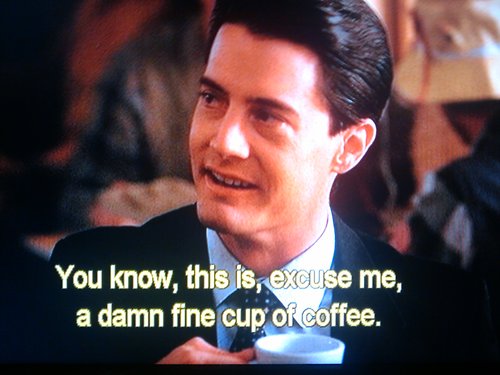
Image result for damn fine coffee

Before the exercise, elicit and board as many relevant words and phrases as required. The students have a discourse marker list, so I could insist that they use certain words (moreover, therefore, consequently etc). Additionally, I’ll need to explain vernacular phrases such as ‘kick back’ and ‘put my feet up’.

IF a student doesn’t like coffee, then they can say where they go and what they drink. IF they don’t go anywhere or like anything (yes, I have had that in a class), then they can explain WHY NOT!

Key vocabulary: ambience // aroma //atmosphere

Now, their turn; after this model, they must tell me about their favourite app on their phone. Give them five minutes to write a short piece.

Image result for iphone apps

After, the students can read to each other, and we can incorporate their answers into tonight’s grammar: reported speech.

For example, Ms Jane is speaking with Mr Tony:

Jane, “I really love the iTunes app.”

Tony, “Oh, for me, I prefer YouTube because I can watch music videos. I will send you a link to The Beatles.”

This is called direct speech. If I want to repeat what they said, I use indirect or reported speech. Look what happens to the subject and the verb:

Jane said that she really loved the iTunes app. (or She said she really loved …)

The subject changes from 1st person (I) to third person (she), while the verb alters from simple present to simple past.

What happens with Tony ? Look for the verb(s) then put them into simple past. Change pronouns to the 3rd person.

Now – changing reported speech back to direct speech.

He said the egg was perfect

(Change the past simple verb to simple present)

Now, here’s the actual quote (around the 2:28 mark):

https://www.youtube.com/watch?v=crPVJ3CXs1g

This is one of my favourite clips about Sai Gon: Mark Weins eating a fairly typical Viet breakfast … but enjoying it SO MUCH !

Image result for mark wiens face

Student Survey

Student must ask three people, what they usually eat for breakfast, and drink, as well as where they eat; do they go out, or cook at home ? Following that, they have to report to the class on their findings, using reported speech e.g.

She said (that) she usually cooked at home, but occasionally ate out when she felt too tired.

Then we have the book work and grammar practice. To end, we can have an eyewitness game. Students work in pairs, one having their backs to the board. On the screen, I show a man or lady. The first student has to describe, in as much detail, what is happening and how the person looks. Give them a minute or two. Then, the second student must report to me what they have learnt. Finally, they are allowed to see the picture, to compare the reported speech with the actuality. Photos could include:

Image result for Hari won singing
Related image
Image result for boy eating chocolate cake
Image result for egyptian lady
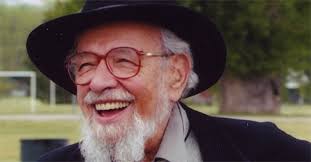
Image result for laughing rabbi
Image result for sir alex screaming

IELTS 5- 6.5: All you need is love … and relative pronouns

25th September 2019

Tonight I want to focus on forming complex sentences in order to boost the speaking prowess of my students. Being able to speak in long sentences, with subordinate clauses and relative pronouns, linked by appropriate discourse markers, will improve their scores in the speaking tests, along with use of stress, intonation, chunking, and a liberal smattering of expressions and vernacular, thereby demonstrating a familiarity with different uses of English.

So, without further ado … complex sentences. Let’s kick off with some basic information about my friend Pete:

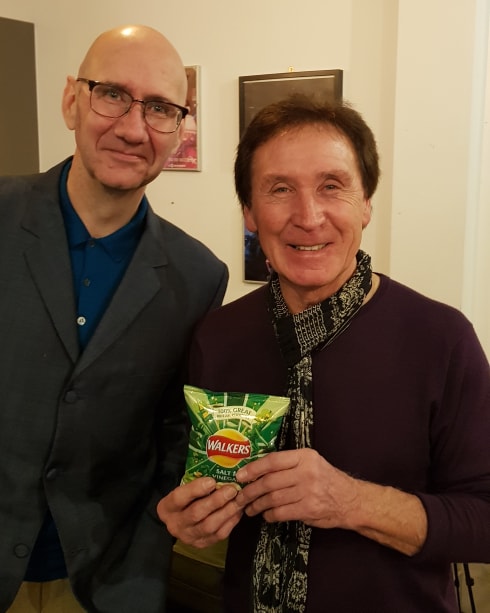
Pete (left) with drummer Kenny Jones of The Small Faces & The Who

Pete’s family are Irish. He was born in Kent, south England. He loves music especially Jazz and he can play saxophone, keyboards, guitar and bass. He is 40 years old. He is bald, and wears glasses. Currently he plays bass in a band called ‘The Deep Six’. They have a video on YouTube. In the photo, Pete is with the famous 60s drummer Kenny Jones. He was in The Small Faces. Later he joined The Who after their original drummer died.

Example:

Pete, who was born in Kent in the south of England, is of Irish heritage. Although he is just forty, Pete looks older, probably due to the fact that he is bald, as well as having to wear glasses. His great passion in life is music, especially Jazz, but his interest is not merely passive; he plays several instruments. In addition to saxophone and keyboards, Pete is proficient on guitar. Having said that, he actually plays bass now in a band named The Deep Six, who have a video on YouTube. Pete is seen here with the legendary drummer Kenny Jones who rose to fame in the 60s as drummer for chart-topping band The Small Faces before joining The Who following the death of their original drummer.

And here is said video:

https://www.youtube.com/watch?v=W-_u-W_3jWk&list=LLfquznE0joCgmA3v1PIQ0CQ&index=6&t=0s

I am sure if you watch the video, give it a ‘thumbs up’ and ‘like’, Pete will be tickled pink.

Now, a quick practice:

This is Wei Minzhi. She was born near Beijing. She was chosen to be in a Chinese film called ‘Not One Less’. She was 13. She played a substitute teacher but had no experience teaching (and no experience acting). The area is very poor. Some of the children have to leave school to work. The film was shown all over Europe, even at special film festivals. She was famous. She did no more acting. She studied in USA. She lives in Hawaii. Wei is married and has two children.

Students have five minutes to reorganise this information into a style more suited to an IELTS student.

Now – a Socratic activity; students are arranged in small groups, selected by choosing a card (Ace, 2 or 3), given a task and have to collate information and present it to the class, utilising the resources available, namely internet for facts, images or videos. Let’s revisit some old friends; first one of my favourite authors, Dr Franz Kafka:

Image result for kafka

Born: 1883 Prague, Czech Republic (at the time, part of the Austro-Hungarian empire) // Died 1924 in Austria. Never married, engaged twice. Had three sisters. Was vegetarian. Difficult relationship with his father. Famous for writing, but only produced three novels, all of which were published after his death. Most famous of these is ‘The Trial’ which has a famous opening line, “Somebody must have made a false accusation against Joseph K., for he was arrested one morning without having done anything wrong.” This book is seen as a warning about totalitarian governments. He lived in Prague which is Czech and Protestant, but he spoke and wrote in German, and he was Jewish. He is one of the most influential writers of the Twentieth Century, and his name has become an adjective, ‘Kafkaesque’ meaning impenetrable, convoluted, mysterious and unsolvable. More information can easily be found online, for example:

https://www.dw.com/en/franz-kafka-the-trial/a-45774582

Now let’s turn to John Lennon, seen here with his Japanese wife, Yoko Ono (also an artist, but more avant-garde).

Image result for john lennon

John was born in Liverpool, during World War II, in 1940. Liverpool was a port, so was a target for German bombers. He grew up very poor. At school he was rebellious, but liked art. When he first heard Rock ‘n’ Roll, he knew he had to be a singer. He formed The Beatles. His guitar playing was enthusiastic but basic. He wrote many songs which have become classics. When The Beatles split up in 1970 he went solo. His most famous solo work is the ‘Imagine’ LP. The title track has the lyric, “Imagine there’s no countries
It isn’t hard to do
Nothing to kill or die for
And no religion, too.” He protested against the war in Vietnam. He was shot in 1980 outside of his New York apartment. He has two sons, Julian by his first wife, and Sean from Yoko.

The third group will get NO help from me – they shouldn’t need it. Their subject is “the father of the Indo-Chinese people, and his name is Ho Chi Minh.”

Image result for Uncle Ho

This task involves the students working together, assigning tasks, then producing and presenting their report. All members of the team have to speak. Furthermore, they should be encouraged to use English during the preparation stage, only resorting to Vietnamese for clarification or translation of new words.

Quick end game: After the book work, which I have to teach, my hands are tied, we can unwind with some speaking practice.

Using discourse markers: I give teams two words which they have to incorporate into a sentence, for example ‘therefore‘ and ‘subsequently‘.

having said that & furthermore

moreover & consequently

initially & eventually

likewise & specifically

meanwhile & notwithstanding

on the whole & instead

What Difference Does It Make ? : I give students a paper with two words or phrases that are related but different. They have to clarify the distinction, for example

teacher / headmaster

educate / bring up

take an exam / retake an exam

do homework / do housework

quite common / ubiquitous

required subject / optional subject

similarity with / disparity between

skim / extrapolate

And to play us out, let’s go back to John Lennon and his iconic song, ‘Imagine’. The music starts around 0:40:

https://www.youtube.com/watch?v=YkgkThdzX-8

Nothing to kill or die for … Peace xx

Adult Class, Level 3 (mixed): You practice what I preach.

17th September for 23rd September. AEF 3 pp. 50 – 51

Last week, we covered past tense – simple, continuous and perfect. However, that is a lot to take in, especially for students who are not so confident. Looking at charts and learning the jargon can be daunting and far too theoretical.

This problem has long been identified and addressed; grammar, as theory, reduced to a minimal. Grammar, used in writing and more importantly speaking, maximised.

Therefore, my policy in this block of lessons (four per block) is to reduce book work, simplify the theory and try to allocate at least half the lesson to student-talking time.

Last night’s lesson seemed to work well; the Socratic approach which makes the students collect information and then collate it into a presentation. This was followed by students reading to each other in small groups, with some useful expressions to use … and repeat and repeat and …yeah, you get the idea.

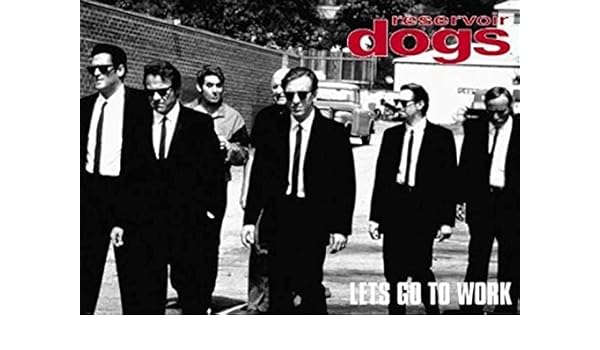
Let’s go to work !

Image result for go to work

But first, back to basics. Some students are not fluent in the three forms of basic verbs:

Grammar – verb practice

Here’s the 15 most common:

infinite \ present // past // past participle (verb 3)

1to bewas werebeen
2to havehadhad
3to dodiddone
4to saysaidsaid
5to gowentgone
6to getgotgot/gotten
7to makemademade
8to knowknewknown
9to thinkthoughtthought
10to taketooktaken
11to seesawseen
12to comecamecome
13to wantwantedwanted
14to useusedused
15to findfoundfound

Regular verbs, just add -‘ed’. However, as you see, in this list only one common verb, ‘want’, is regular.

NOTE: ‘to be’ is different: I am hungry You are hungry She is hungry.

Now, practice: In groups of three or four, they have to ask each other questions in order to feel more natural using the past tense. Lets’s start simply with the simple past:

What did you do today ? PAST SIMPLE

Each student takes turns describing their day. Always give ideas, as some students spent too much time thinking of what to say, whereas the purpose is to speak.

Related image
Related image
Image result for go to school
Image result for easy rider bike
Related image

I will also board: buy / drink / surf the internet / help parents / cook / do homework

To make it more interactive, the students can ask follow-up questions, such as, “What did you eat for lunch ?”, “What time did you start school ?”, “How did you get to work or school ?” etc. Groups can monitor each other to make sure past tense is being used properly.

NEXT: Past Continuous. Subject was doing something in the past ….

Example: Last night I was listening to T-ara:

Image result for T-ar

However, we usually use past continuous to say we were doing something WHEN something new happened.

EXAMPLE: I was listening to T-ara when someone knocked on my door.

The structure is Subject + was or were + verbing, followed by past simple

Try this: dream // alarm clock ring

He was dreaming when the alarm clock rang.

Now – practice: Make a sentence from these pairs of photos:

Image result for reading
Image result for telephone ring
Related image
Image result for rain
Image result for angry teacher
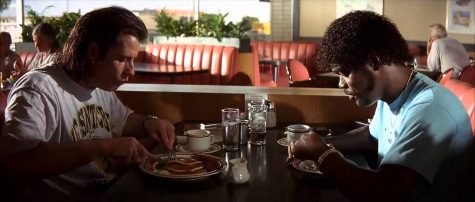
Image result for pulp fiction jules eating
Image result for pulp fiction honey bunny

Finally, the past perfect. Two things happened in the past, one before the other.

Image result for Kafka
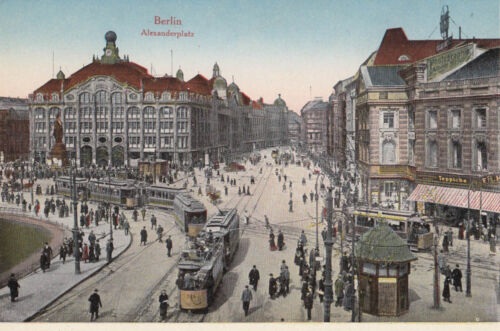
Image result for Berlin 1920

The students ‘met’ Dr Kafka last week.

Dr Franz Kafka had lived all his life in Prague until he moved to Berlin in the 1920s.

Subject + has or had + verb 3 then use past simple.

Try these:

John Lennon – in The Beatles / goes solo in 1970

Image result for john lennon beatles
Image result for john lennon imagine

Dali – paint over 1 500 paintings / dies 1989

Image result for dali
Image result for dali tomb

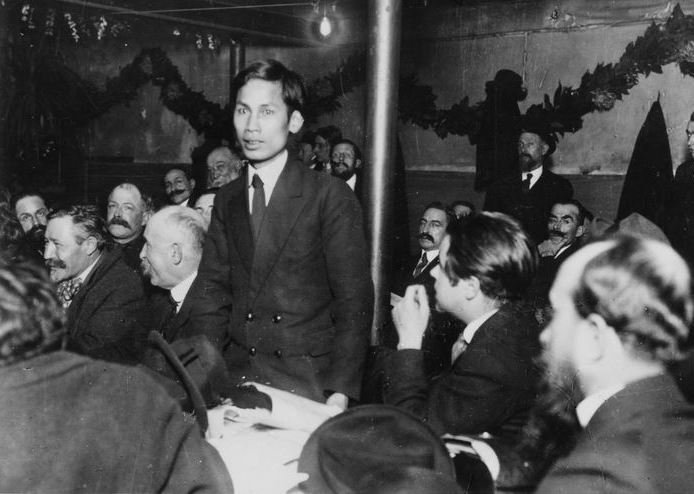
Bringing it closer to home, Bac Ho (Uncle Ho Chi Minh) – work London / meet these young Germans.

Image result for uncle ho in Paris
Image result for uncle ho in russia

Finally, for presentation, the students can be arranged in four groups (draw playing cards so students work with new partners). I will give them ten minutes to work together and make a short presentation, with all members speaking, about the above four historical figures. Those who draw Ho Chi Minh should have an advantage, so I will be expecting more from them.

Presentations should include:

Date and place of birth.

Why there are famous

Give examples of their most famous works or activities

Where they lived

When and how they died.

ALSO – why we should remember them.

Then, I will turn to the books and hand-outs, before returning to some speaking practice before the end.

Young Learners, Level 4: “Can you hear me, Major Tom ?”

6th June 2019. Everybody Up 4. Unit 7, Lesson 4

Today’s lesson is a cross-curicumlum class about space, astronauts and basic science. It is a mighty theme and so, to paraphrase Melville, we need a mighty beginning … for cinema fans, there really is no other choice … the opening of Stanley Kubrick’s ‘2001: A Space Odyssey’.

https://www.youtube.com/watch?v=e-QFj59PON4

So what do the students know about the solar system ? I’ll let them tell me, after boarding some key words:

solar system

planet (Earth, gas giant, rock)

moon (the Moon)

star

asteroid

vacuum

I’ll put a flash card of planet Earth on the board, towards the right-hand side. The students can them fill in the gaps … what planets do they know ? How big is the sun relative to the planets ? What exactly is the sun ? Where does light come from in space ? What exists in space ?

FUN FACTS:

The speed of sound is 343 metres per second (usually given as 330 m p s)

The speed of light is 299 792 458 metres per second or

approximately 300 000 000 metres per second or 300 000 km per second.

Sound cannot travel through a vacuum

To demonstrate the last point, show NOT tell; here’s a good example (start around the 0:24 second mark): An iPhone not making sound in a vacuum.

https://www.youtube.com/watch?v=JrU9LouWY18&list=PL97HViQblvdEM3zsauRxnIg1baFTNmsDM&index=26&t=0s

Group work: Would you like to go to space ?

What would be the pros and cons ? In small groups, discuss the question, trying to use some of the recent vocabulary.

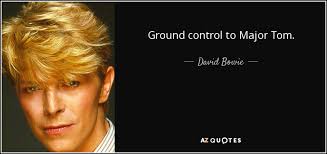
Song time: A British classic, and the first hit for David Bowie, an artist with a deep connection with space. This video has lyrics, but how many words can they recognise ? They can shout them out as they hear them.

‘Space Oddity’. Lyrics start around the 0:30 second mark

https://www.youtube.com/watch?v=9_M3uw29U1U

Board any new words or phrases such as ignition / made the grade / peculiar /

Runaround

This is based on the UK children’s show from the 1970. The class will be split into small groups. One member from each has to stand in front of the board. I will read a question and then give three answers. The students have to run to the correct number. They then have three seconds to change their minds.

Who was the first man on the moon ? Buzz Aldrin / Michael Collins / Neil Armstrong

What is the biggest planet ? Jupiter / Saturn / Mars

The sun is a: planet / star / moon

What is faster ? light / sound / Mr Phuc speaking (just give the name of any talkative students).

In space, people are: heavier / lighter / weigh the same ?

The first animal in space was a: monkey / elephant / dog

(Last one could seem to be a trick question. The answer is Laika, the Russian dog. Monkeys were first put into rockets but they didn’t go high enough to officially enter space).

Bookwork. Today there is a fair amount of reading. I’ll use the passages to show a little grammar, introduce the students to adverbs.

The princess was very beautiful (very = adverb, beautiful is an adjective)

Here, the adverb ‘very‘ goes before the adjective. For concept checking (do the students understand and can use this formula ?) some quick questions:

Correct these sentences:

The very student was clever

Laika, the dog, was scared very

Very David talented is

During the reading, I’ll be asking the students to point out the adjectives and adverbs in the short pieces of text.