An extended scenario that can be used for three speakers, or two, whatever the class needs. Here, a student goes to an expensive private language centre to enquire about course requirement and prices.
You will notice a lot of idiomatic speech as well as expressions. These are designed to show you how to use them in everyday conversation … have fun !
Dialogue Practice
A student comes to the office to get some information about courses
Objective: practice expressions and pronunciation of contractions.
Student Good evening, I’m looking for an English course
PEC 1 You’ve come to the right place !
PEC 2 How may we assist ? What exactly are you looking for ?
Student Well, I’d like to improve my pronunciation, as well as my grammar.
PEC 1 Seems to me that you are already quite good at English.
Student You’ re most kind, but one can always better oneself.
PEC 2 We’ve an interesting class starting soon … it’s upper-intermediate.
Student Yes, I’d prefer to hit the ground running. When does it start ?
PEC 1 Hold on, let me check …..
telephone rings
PEC 2 Hello, PEC … oh, hold the line please, she’s busy. OK, she’ll call back soon.
PEC 1 There’s a class commencing the day after tomorrow .
Student Or maybe a private lesson ?
PEC 2 I can check … bear with me … yes, with teacher John. He’s passionate about teaching.
Student Sounds good. May I ask the fee ?
PEC 2 Certainly …. she writes the price down on paper and hands it to the student.
Student Blimey ! I’ll have to think it over and get back to you. I must work now.
Present perfect I have been to Ha Noi / I’ve been to Ha Noi
Idioms and expressions – bucket list
A: Hello, how’s it going ? Long time no see.
B: Yes, I’ve been in Ha Noi.
A: Amazing ! I want to go. I’ve never been there. It’s on my bucket list.
B: Really ? You must go, the food is great.
A: I’ve heard the people are not nice.
B: They are not the friendliest people in the world, but they are not so bad.
A: What were you doing there ?
B: Knocking on doors ! I had interviews for new companies.
This conversation is more complex and features more idioms and expressions
A: I’m sick of my job ! I need to change.
B: I’ve also been on the lookout for a new job. My job is so tedious !
A: Mine too. Same thing, day in, day out. But … it’s a job. Oh, Tom was fired.
B: No ! Why ? I’ve known him for a long time.
A: He was cooking the books.
B: You’re pulling my leg !
A: Yes ! Really, he went to Boston. He’s got a new job.
B: Good for him ! Now we should go to Boston.
cooking the books = writing false numbers in the accounts – a serious crime
You’re pulling my leg ! = joking with me
Downtown Boston, a very historic US city
A night out in Boston
Now, a quick customer service dialogue:
US restaurants serve LARGE portions
Speaking practice:
Try acting this out in the classroom, encouraging body language and appropriate intonation.
Café worker: Next, please! What would you like? Andi: Can I have a burger, please? Café worker: A cheese burger or double cheese burger? Andi: Double cheese burger, please. Café worker: Anything else? Andi: Yeah, I’d like some banana cake. Café worker: Would you like a drink? Andi: Yes, can I have an apple juice, please? Café worker: OK, so that’s one double cheese burger, one banana cake and an apple juice. What’s your table number? Andi: Table 3. How much is that? Café worker: That’s £8.37, please. Andi: Here you are. Café worker: Thank you … that’s £10.00 … and £1.63 change. Next, please …
As always, I use these exercise to introduce idioms and expressions, as well as demonstrating how adverbs and adjectives can be used in everyday conversation.
Speaking practice:
Pat Well, I’m exhausted. I need a damn fine cup of coffee and a big piece of pie.
Sam There’s a Highlands over the road, or we can go to Coffee Bean or Milano.
Pat I’d prefer Tran Nguyen but it costs an arm and a leg. Highlands is also incredibly expensive.
Sam But great quality and superb cakes. Come on, I’m starving, I need coffee now !
Pat OK, hold your horses hahaha. After we can meet up with Thay Paul.
Sam Sounds good. Now … shall we have chocolate cake or fruit cake … ?
costs an arm and a leg = very expensive
hold your horses = please be patient and wait
Inside Highlands
Highlands Coffee, a Vietnamese coffee chain
Sam Hi, I’ll have a large cappuccino, please. What do you fancy ?
Pat Tough decision. I’m going for the cheesecake and a slice of blueberry pie.
Sam Oh, me too. Big slice, no, only joking, I have to watch my weight.
Pat I think you look great. Lets also get some chocolate cake and we can share.
Sam Brilliant. Oh, did I show you my recent photos ? Here, on my phone.
Pat Let me see … oh, so funny. Who’s that ? The man next to Niall ?
Sam That’s Jimmy, he’s in Niall’s band. He plays drums and drinks like a fish !
Pat And that’s you, a selfie. You look adorable. Butter wouldn’t melt in your mouth !
A very sweet young lady – butter wouldn’t melt in her mouth
drinks like a fish = drinks a lot of alcohol
Butter wouldn’t melt in your mouth ! = looks very sweet and nice … but can be very naughty
Don’t invite him to your party – he drinks like a fish !
For these exercises, refer to the previous blog (‘Holiday of a Lifetime’). Put class into small groups and assign a city to each one. The groups have to make a presentation, using advertising-style language: hyperbolic adjectives, expressions, phrases. Furthermore, they must really ‘sell’ the holiday, so they can practice their intonation and stress skills.
The blurb contains the selling points, while the practicalities has information. The style should change for these two parts – the teacher can demonstrate.
Students are encourages to add their own information and to make use of classroom facilities such as internet, Google images etc to enhance their presentation.
To make it more competitive, the students have to vote on which holiday sounds most impressive.
Today, lots of new words to help you describe the area in which you live (the area you live in). For my classroom-students, I can listen to pronunciation and help them with natural rhythms but online students should use a dictionary with sound … then practice, practice, practice.
Vocabulary booster
Where do you live ? What’s the area like ?
Apartment block in District 2, Sai GonTwo-up, two-down houses in UKTraditional house in Jeonju, South KoreaThe Projects, South Side, ChicagoApartment in Istanbul, TurkeyLagos, Nigeria … a plan for the future ?
Remember to link words together – it’s called ‘chunking’ in IELTS language.
I live in a:
quiet, residential street. Peaceful at night.
lively and busy commercial area, many shops
dirty and dusty industrial part of town. Very noisy.
pop / rock / country and western / punk / classical / jazz / blues
Please Note: All photos are taken from Google Images or free photo sites, and are used for educational purposes only. No copyright infringement or offense is intended. If I have used your photo or image, and you wish me to remove it, just ask. This site is not monetized, I run it on my own dollar. Thank you.
We had a number of blogs devoted to idioms, so now it’s time to practice using them as part of your everyday English. Not only will IELTS students earn points, but every student will feel closer to English, and sound more like a REAL native-speaker. You can only learn so much from text books …
So, without further ado, a range of dialogues for you to practice:
Dialogue 1
Hello, how’s it going ?
Great, thanks. What have you been up to ?
Oh, same old, same old. Nothing new. Are you busy ?
A little.
Do you want a hand ? (Dya wanna hand)
That would be wonderful. Can you take over for a moment ?
Absolutely !
I’ll be right back. I need to print out some documents.
Dialogue 2
What shall I get on with ?
I just need you to finish off the progress reports.
Oh, piece of cake ! (pieceacake)
You’re an angel.
I know…hahaha.
Dialogue 3
Hello, do you have a minute ?
Sure, what do you need ?
Could we have a little chat ?
OK, let’s go to my office. Have a seat. Now, what’s on your mind?
I’d like an increase in our budget. We desperately need a new photocopier.
Unfortunately, those things cost an arm and a leg. What is the exact price ?
I’ll find out and get back to you. We may have some money in our budget.
Dialogue 4
How’s the new girl ? Are you showing her the ropes?
She seems to be OK but I still need to keep an eye on her. Are we having a meeting later ?
No, it’s been called off.
Ok, back to work. I need to finish off some expense sheets.
Yes, time is money.
See you later.
Dialogue5
What were you doing last night ? I tried to call.
I was watching TV. Was it important ?
We were having a party. I wanted you to come.
Your parties are such fun ! What did you do ?
We were all looking online for bargains. Anna bought some great shoes.
She’s always talking about buying shoes.
I was looking at the clothes from London. So stylish.
Dialogue6
Did you see the email from the Manager ?
Oh, that old windbag ! He was talking so much.
Yes, even his emails go on forever hahahah.
Did you bring your raincoat ? It was raining all night.
I know – it was raining cats and dogs.
They were thinking about calling off the meeting because of the rain.
Yes, maybe the traffic will be chockablock.
Dialogue7
Oh, do you know how to use this Zoom program ?
Yes, it’s very easy. It’s a piece of cake! Have you met Jane’s new boyfriend ?
He seems a real loser. As far as I’m concerned, she can do much better.
What does he do ?
Nothing, the work-shy layabout. I believe he wants her money.
In my experience, guys without jobs are hopeless. A waste of space !
How did she meet him ? She’s such a workaholic ! At the gym ?
Well, not at the gym, he’s no hunk ! It’s obvious to me it won’t last.
I’m convinced it’ll soon be over. She needs a good solid as a rock guy.
Tonight’s subject is relationships, and the book work seems well-balanced, with vocabulary, listening and speaking exercises. However, this is quite a strong group and appear motivated. With that in mind, I push them to learn more, in order to prepare them for their next class, which will be the quantum leap into IELTS.
However = discourse marker, better than just saying ‘but.’
With that in mind = expression meaning ‘because of that.’
in order to = to help for the future – I am learning Vietnamese in order to speak to my students.
quantum leap = massive (very, very large) jump forward or progression
Bearing in mind that Vietnamese operate on ‘elastic time’ (a polite way of saying the students turn up in dribs and drabs, ie, ten, twenty or thirty minutes late), so I can’t start any serious teaching until the whole class is present. Therefore, I use some warm up activities.
Egyptian students preparing for their lesson
Warm Up: Call My Bluff.
This is a vocabulary-building exercise. I introduce a new word, then give three possible definitions. Students have to deduce, or just guess, the correct meaning.
1. Ubiquitous
– adj means something that is very common, everywhere
– noun equipment used in scuba diving
-name used towards close friends or family
2. Significant
– noun a small built-in safe in a hotel
– adj something very special, different or important
– verb to paint Chinese or Japanese characters with great care
3. Consequently
– adverb discourse marker meaning because of that, this happened
– noun a person who cheats other people to get more money
– verb a type of pass in football that leads to a goal being scored.
4. Extrapolate
– noun a chair used by a dentist, that can be lowered or raised
– verb to get only important information from a lot of text
– adj something made from different materials or many different colours
Then students have to write four sentences using the new words, as well as trying to repeat them throughout the lesson.
I’m not going to give you the answers – look up the definitions yourself, it will help you to learn.
Warm Up: What is the name, to you, of …
What is the name of your mother’s husband ?
What is the name of your mother’s sister ?
What is the name, to you, of your mother’s brother’s son.
What is the name of your father’s mother ?
What is the name of your father’s mother’s father
Next stage is sentence building:
I am from London. It is an expensive city.
To combine these pieces of information, we use the relative pronoun ‘which‘:
I am from London which is an expensive city.
We replace the pronoun ‘it’ with a relative pronoun ‘which’ and create a longer sentence. This skill is important / vital / imperative to attain a good IELTS score.
Try these:
Kimmy is from Tokyo. It is very crowded.
Tony is from New York. It is a vibrant city.
Scott wants to visit the War Museum. It is in District 1.
Lisa teaches in Beijing. It is the capital of the PROC (People’s Republic of China).
Moving on … My friend
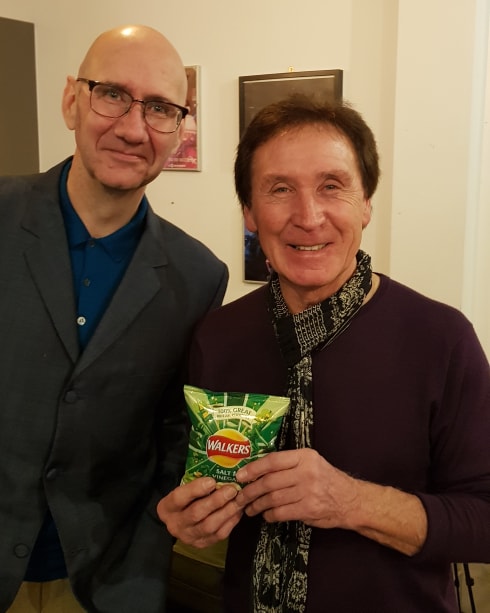
Peter on the left, with famous drummer Kenny Jones
When we link information about a person, the pronoun, ‘he’ or ‘she’ is replaced by the relative pronoun ‘who.’
On the left is my friend Peter. I met him in 2010. I met him in London.
On the left is my friend Peter, who I met in London ten years ago.
On the left is my friend Peter, who I met in 2010 in London.
Try linking these: Remember to replace ‘he’ and use ‘who’ but you have to change the sentence.
Peter is Irish. He was born in Dublin // Peter, who is Irish, was born in Dublin
Peter loves music. He can play saxophone, keyboards, guitar and bass.
Peter is 40 years old. He is bald, and wears glasses.
Peter plays bass. He has a video on YouTube.
Peter is with the drummer Kenny Jones.He played in The Small Faces in the 1960s.
Be careful with the last one. The pronoun ‘he’ is about Kenny Jones.
Be careful with the next two. We only need ONE relative pronoun:
The drummer Kenny Jones.He played in The Small Faces in the 1960s. He is withPeter.
The Manager Mr Smith. He is from Australia. He is going to travel to Mexico.
The manager, Mr Smith who is from Australia, is going to travel to Mexico.
Students, working in pairs or small groups, must come up with a storline for these couples.
Describe these two people. What are they wearing ? What are their personalities ? What do you think they do ?How do they meet ?
Be creative and feel free to use dialogue.
How do they know each other ?
What will happen when they meet ?
Will they get on ?
Will they have a terrible time ?
How about these
How do these two know each other ?
Try to invent an interesting, fascinating story line. Maybe they haven’t met since there were born ?
Now, let’s get creative:
Write a short story using dialogue and adjectives.
MOTIVATION: why do the characters do what they do ?
PLOT: what happens … and why ?
CHARACTERS: make sure each one is an individual and speaks differently.
Ideas:
Where do they meet ?
How do they meet ?
How do they know each other ?
What do they think of each other and how do they express it ?
EXAMPLE:
Boram, a young Korean lady, is at home getting ready to go out. She has put on her favourite white and pink dress and, with her lucky pink bow in her luscious chestnut hair, looks absolutely stunning.
Today she is going to meet her cousin who is coming to Seoul for the first time. Boram needs to practice violin, because she plays in the university orchestra and they have an important concert coming up, however, she is concerned about her cousin getting lost in the big bewildering city. That is typical of Boram, always putting other people first. She is a very sweet and thoughtful caring lady.
[In the first sentence I named the lady – Boram. Therefore, we can use a pronoun – she – because we know the subject]































/iStock_000075908411_Medium-574b74f35f9b58516548a60b.jpg)












 Thay Paul's Notes