Today, we shall learn the story of Theseus and the Minotaur. This story is over 3 000 old, and comes from the country of Greece. Here is the flag of Greece:
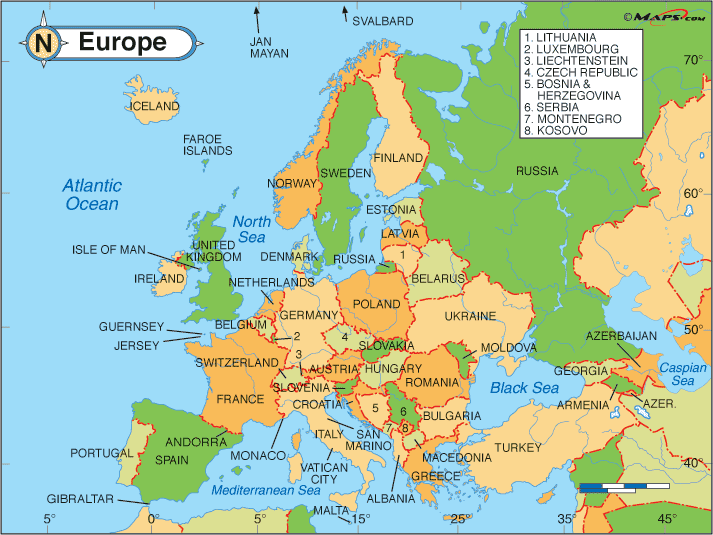
Greece is in Europe. It is a very hot country, and has many stories from history. The capital city is Athens.
Athens, the capital of Greece
Have you ever seen something like this before ?
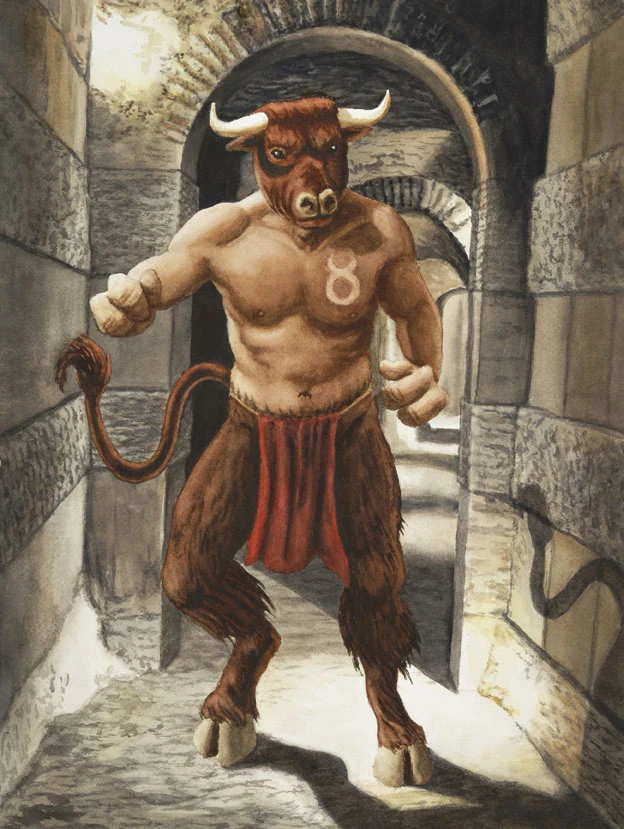
This is the Minotaur, half man, half bull. He was extremely strong, extremely angry and very, very scary. He lived near Greece, on the island of Crete:
The Minotaur lived underground in a big maze called the labyrinth. Every year, the King of Athens had to send 14 children for the Minotaur to eat. This is a labyrinth, a huge maze. It is very easy to get lost inside a labyrinth.
The king had a son called Theseus. He was a hero. He decided to go and kill the Minotaur.
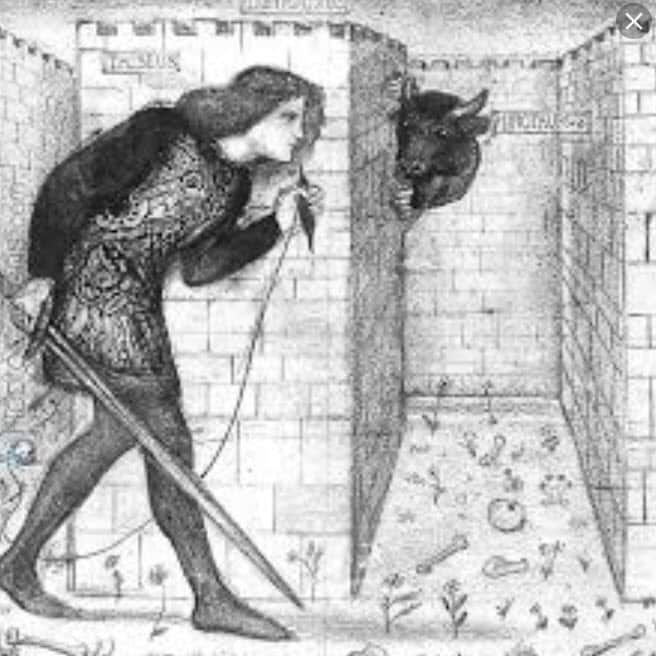
The King of Crete had a daughter called Ariadne. When she saw Theseus, she decided to help him. She gave Theseus a big ball of string. He tied it to the door of the labyrinth, then used it so he wouldn’t get lost:
Theseus found the Minotaur.
They had a long fight because both Theseus and the Minotaur were very strong. Finally, Theseus won and killed the Minotaur.
Then he returned to Athens with Ariadne. The people were so happy, and Theseus became a hero in Greece.
In the UK, we do have a morbid fascination with murder. This man is Alfred Hitchcock who made films from the 1920s to the 1970s, mostly suspense, thriller or murder dramas. ‘Hitch’, who was born where I live in east London, made many famous films but in my opinion ‘Psycho’, which was filmed in black and white in 1960, is his best.
Do you know these British characters ?
What do the book titles mean to you ?
Sentence building:
Do you like to read murder mystery books or to watch murder films ?
Plan – don’t just answer ‘yes’ or ‘no’ ! Make a short introduction, just one or two sentences:
I enjoy all types of films, however I especially like a good mystery ….OR
I don’t really read much because I am so busy studying. However …
Say what film or book you like, tell me about the author and other books.
Tell me about the story and then why you think it’s good
Conclusion – “Maybe this book is not for everybody, but if you enjoy a great mystery story, then I would recommend it.”
Vocabulary building: Some useful words –
thrilling // suspense // gripping // well-written // superbly acted // atmospheric // creepy // scary // a page-turner // I was on the edge of my seat.
However, we must move from the world of fiction to the world of fact. Before we move onto a true story from the USA, let’s keep it closer to home.
What can the students tell me about Lê Hoàng Hùng ?
Students can work in small groups. They have five minutes to make a short presentation. Information can be found on these sites:
Then it’s time to get to tonight’s topic – murder, unsolved crimes and mystery. The lesson focuses on the mysterious death of the actress Natalie Wood. To introduce her, I’ll show a short clip of her acting, then the actual news report on TV on her death:
That clip, which has English captions, is from the film ‘Rebel Without A Cause’, from 1955. Now for the news footage:
Grammar: tag questions
Are you from Korea ? (a normal question, where we don’t know the answer)
You’re (you are) from Korea, aren’t you ? (using the tag ‘aren’t you’ to confirm what we think or know)
Take the pronoun (here it is ‘you’) and then the verb (‘are’). Invert the verb, that is, make it negative then add the pronoun. Hence ‘are’ becomes ‘are not’ = aren’t – aren’t you ?
Try these: First, decide on the appropriate pronoun (he, she, it, we etc).
Bangkok is the capital of Thailand, ……….. ?
Natalie Wood was American, …………….. ?
We still don’t know who killed her, ………….. ? (here the verb is negative, so make it positive)
He’s a brilliant actor, ………….. ?
For the remainder of the lesson, I want the students to talk, talk and talk (and, yes, I mean in ENGLISH !)
Firstly, they can review tonight’s book work and air their views, thus enabling them to review negotiation language (I see your point but …. // I can’t go along with that // you raise an interesting point // I’m not sure I entirely agree … etc).
Questions:
What did they think of the subject ? (interesting, relevant, morbid, inappropriate)
Do they enjoy reading as part of class time ? Do they feel that is a good way to learn ?
How was the listening ? How much could they follow (understand ?)
What is their opinion on the amount of new vocabulary encountered ?
Naturally, I expect other students to play Devil’s advocate – to argue a point even if they personally don’t fully agree with it.
EXAMPLE: “Playing Devil’s advocate, I would say the best way to learn vocabulary is to read new words and see how they are used in a sentence.”
Activities – Just a minute
Here, students work in pairs – there are given a very open subject (work, food, family, their hometown etc) and have to talk for one minute without hesitation, deviation or repetition.
Students can be given new questions and then made to change partners regularly.
Also, encourage peer help – allow the students to correct each other, as well as giving advice and encouragement.
And finally … Mysteries – what do you think ? True or false or … ?
The Loch Ness Monster from Scotland
Area 51 in Nevada, USA. Did an alien spaceship crash here and aliens come to earth ?
Please Note: All photos are taken from Google Images or free photo sites, and are used for educational purposes only. No copyright infringement or offense is intended. If I have used your photo or image, and you wish me to remove it, just ask. This site is not monetized, I run it on my own dollar. Thank you.
This three-hour lesson was totally devoted to planning, preparing and presenting a project about tourism.
Thailand is very close and there, tourism accounts for 9.4% of their economy, a figure which is expected to rise to 12.8 % by 2028 (source: World Travel & Tourism Council).
This affords the teacher an opportunity to add other elements to the lesson; in addition to new vocabulary and collocations, we have, in the first two paragraphs, examples of alliteration and quoting sources to make a report more official; an opinion supported by facts.
Alliteration is a poetic devise, using words that begin with the same letter. Source quoting – stating where information is found – is a vital aspect of academic writing, so to learn it before university will be very beneficial. However, it is important to use books, newspapers or websites that are official and respected, as opposed to Wiki sites or blogs.
Tonight, I would focus on presentation skills, vocabulary used in travel promotion, and fixed expressions. The later is a great addition to the students’ repertoire, allowing them to sound more like a native-speaker. We use fixed expressions all the time. So, without further ado, into the notes.
Firstly, as a warmer, we talked about HCM / Sai Gon; what does it have to offer the tourist ?
“Trash, garbage,”
Thank you, Sir, but I don’t think you’re getting the point of the exercise. Walking around the room, various answers were put forth: history, mystery, great food, cheap (dirt cheap as we would say in the UK), interesting buildings, friendly people.
Conversely, what were the problems or issues that were keeping tourists away ? Traffic was an immediate response, pollution, petty crime, scams. Perhaps the biggest problem is simply lack of knowledge. When most westerners hear about Vietnam, they think about war, boat people, refugees … the unspeakably horrific photo of Kim Phuc, running away from a burning village. So what could be done to encourage tourism ? That was the project.
I wanted to illustrate the difference between a scam and petty crime. The latter includes bag-snatching and pickpocketing, the former is tricking people out of money, for example fake taxis, over-charging, giving people incorrect change etc. We then watched a short video, highlighting some issues, as well as listening to English being spoken by some young Vietnamese. A good way to learn is to check for mistakes. What grammar or pronunciations errors can you find here?
At one stage, the presenter is walking past a group of tourists, some of whom wave to the camera and make various gestures. This allowed me to introduce a neologism, a new word or phrase that has evolved out of modern technology: photo-bombing. Here is a famous example of the British actor Benedict Cumberbatch with the rock group U2:
Now was a chance for some new vocabulary, words and phrases associated with holidays and travel.
Now is the perfect time to visit London, England’s glorious capital. The weather is perfect for walking, so you can enjoy the lush parks, world-famous museums and incredible, unbelievable shops. There is something for everyone … and more ! Like sports ? Go to one of the many Premier League football games. Love shopping ? Everything is here – shop till you drop ! Adore culture – soak up hundreds of years of history.
Flights from TSN airport daily. Seven-day all-inclusive package tour starting from only 50m VND ! All transfers and transport included. Air-conditioned mini bus with Vietnamese-speaking guide.
So what makes a good presentation ?
Volume – not too loud, but not too soft.
Intonation – sound enthusiastic, but again, not overly so. If you sound bored, the listeners will be.
Pace – not too fast, or too slow
Eye contact – look at the audience, engage with them but don’t stare at anyone.
Walk around – this can be energising, but too much will be distracting.
Stick to the point. Avoid repetition or deviating from the subject.
Keep slides simple and basic; too much text and the audience will be too busy reading to listen to you (I got that tip from a former student, a marketing executive).
Gestures, and body language. Look professional and people will take you seriously. Open hand signs indicate honesty. Cross-armed seems hostile.
And then it was time for the teacher to pipe down (stop talking) and let the students work. Most classes have mixed abilities, confidence levels, introverts and extroverts. I wanted each of the four groups to have at least one confident student, so I asked some of the students quietly, explaining my rationale, and they agreed (one deferred, but promised to move next class … right, Ms Uyen ?)
I gave them a set time, after which they had to present. Then came the issue of who would go first; here’s where a pack of playing cards comes in handy. I picked an Ace, 2, 3 & 4 and let the students choose. You can’t argue with the cards !
The work was very impressive, some groups quoted their source material, others had very gifted public speakers. We’ll build on this in the next lesson, when they can practise using fixed expressions and travel adjectives (and the accompanying intonation).
A special thanks must go to my TA, the wonderful Ms Vy, who assisted and co-taught with me. I’ll be writing about my experience with TAs at various schools … but that is for another day.











 Thay Paul's Notes