As I continuously tell my students, being able to form complex sentences, and then say them fluently, is key to passing IELTS.
One way to make longer sentences, as well as introducing subordinate clauses, is to become a master of …
Relative Pronouns
This lady, who wants to work in Australia, is studying hard for her IELTS.
who For people: This is the man who sold me the fake Rolex !
which For things: We tried fish and chips which is delicious.
where For places: Let’s go to the shop where we saw the great bargains.
Whose Possessive: That’s the singer whose record we heard last night.
The Italian car, whose driver was young, won the race.
Exercises
We arrived at a nice beach ______ we could swim and lie in the sun.
A man ______ mobile phone was ringing did not know what to do.
The patient, ______ had a serious disease, was taken to hospital immediately.
Smithsfield is a small village ______ people live a quiet life.
The boy ____ sister is in my class was in the bank at that time.
I know a person ____ can speak seven languages.
We visited the church _____ is in the middle of the square.
It is a protected area of land _____ you can see a lot of interesting wildlife.
This dress is made of silk, _____ is a very expensive and delicate material.
A police officer, _____ car was parked at the next corner, stopped and arrested them.
Go that extra mile – extra practice
IELTS, which can be very challenging, tends to be rather formulaicby which I mean it follows a pattern. Students can pretty much predict, with a fair degree of certainty, the type of subjects they will be expected to encounter.
With that in mind, try making complex sentences about these people:
Name: Ms Chen // Age: 19 // From: China // Lives: London // Studies: Business.
Ms Chen, who is studying Business in London, is 19 and originally from China.
Originally from China, Ms Chen, who is 19, is currently living in London, studying Business.
NOW … YOUR TURN
Name: Adam // Age: 24 // From: Israel // Lives: New York // Job: Writer for a magazine and blogger
Name: Boran // Age: 34 // From: South Korea // Likes: drawing manga // Job: singer, rapper and dancer
Name: David // Age: 28 // From: Leicester, UK // Passion: Music // Plans: To live in LA and record a CD
Yes, keep on Rockin’ in the Free World … but first, you’ve got to get there.
As spoken, we would say:
“First, ya gotta get there.”
So today’s lesson will be in the form of a game, a challenge or quest, if you will, where the students, assigned to one of two teams have to get from:
To …
What a prize ! The dirty filthy insalubrious streets of Ha Noi to the cozy comforts and warm welcome of east London, and my local, the Birkbeck Tavern.
Said task is achieved by earning points, said points are earned by answering questions, and using a wide range of linguistics features namely: adjectives, adverbs, discourse markers, relative pronouns, low-frequency words, expressions, idioms and, naturally, displaying a wide array of para-linguistic attributes, to wit: intonation, stress, eye-contact, body language, gestures, clear pronunciation, turn-taking and rhythm because, contrary to popular belief, when it comes to speaking English, NOT all God’s children got rhythm.
(Yes, the above sentence contained an example of non-standard English, but the vast majority of people do not speak pure standard English all the time).
Now, we have a massive task to undertake … without further ado … let’s go !
First up, a revision and practice. In the last lesson, the class learnt (a-hem!) four new words: ubiquitous, significant, consequently and, it was on my blog, extrapolate. The teams, and let’s name them after famous English explorers, Drake and Cook:
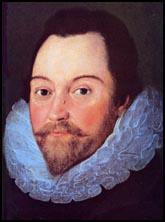
Sir Francis Drake
Captain James Cook
… the teams have to use all four words in sentences. One point for each correct sentence. However; incentive, three points for using two in a grammatically-correct sentence, five for using three words and TEN points for using all words words in one sentence. That should get them some air miles and off the runway.
Next up, the teams challenge each other. They offer points to the other side if they can use these words or expressions correctly:
however / with that in mind / quantum leap / in order to / cats and dogs / kick the bucket / therefore / dribs and drabs
It works like this. Team Drake will say, “We offer 5 points for Team Cook to use the word ‘however’ in a sentence.” If the task is accomplished, Cook gain the 5 points. If the team is unable to use the word, then Drake win the points. The skill is in guessing which words or expressions will be hard to use, and offering high points accordingly.
Moving on, creative writing. My class can use relative pronouns IN THEORY, but not so much in practice. One may even say, NOT AT ALL in practice. Thus, I will give information about our two friends from last week. The teams have to compose a short piece combining all the information, but in the form of complex sentences with relative pronouns and discourse markers.
Example:
Johnny Rotten, Real name John Lydon. Born 1956. Was in the Sex Pistols from 1975 – 1978. Formed band PIL. Changed name back to Lydon. Married Nora Forster in 1979. He was going to be on the Pan Am flight that crashed in Lockerbie, Scotland. He wrote a book, published in 2008.
John Lydon, who performed under the name Johnny Rotten while he was in the Sex Pistols from 1975 – 1978, is married to Nora Forster, and has been married since 1979. After leaving the Sex Pistols, he formed a new band, PIL, and wrote a book which was published in 2008. He escaped death by missing his flight on the Pan Am flight that exploded over Lockerbie in Scotland.
Our young lady is
Sakuri. 21. Born in Tokyo. Studies History at university. Works as waitress. Wants to be a film star. Has two sisters. One sister elder, one younger. Her father is a piano salesman. Mother designs clothes. Sakuri likes reading, films, anime, shopping, going out with friends. Uses Apple iPhone X. Always on Instagram, FB, and Yalo. Is learning English.
Haruto. 23. Born in Okasuka. Left school at 16. Plays keyboards in a band. Likes Beethoven, Jazz and Elton John. Works different jobs. Was TA in a school but was sacked after four hours. Has no siblings. Father left home when Haruto was 4. Mother works 6 days a week in a factory. Uses Samsung Galaxy. Hates social media sites. Listens to music all day.
Points awarded for creativity and relative pronouns and complex sentences.
And now for something completely different: London.
Quick-fire round: I want a list of three. Start a sentence and give THREE examples
In London, you can eat British food …
In London there is public transport …
London has many famous buildings …
There are many famous football clubs in London …
Plan a day for my friends Tina and Michael:
I have two friends arriving in Sai Gon. They want a typical, authentic experience. Plan a day for them. It must include:
Breakfast
A museum
Somewhere for a snack
An interesting building or location
Lunch
Souvenir shopping
Something to do in the evening
Give tips and advice.
How do they travel around ? What are the pros and cons ?
What are their options and estimate the prices.
Try to use as much new vocabulary as possible, words and expressions.
Finally, pronunciation. I will show Drake and Cook a clip from ‘Twin Peaks’. The teams, all members, have to imitate or copy the voice, gestures and intonation. Points out of 50 for this task.
The quote is, “Wait a minute, wait a minute. You know, this is, excuse me, a damn fine cup of coffee.”
And that, as they say, is a wrap. The remainder of the lesson can be devoted to book work, possibly, had-outs, unlikely, or general chit-chat, undoubtedly. Who says English can’t be fun … probably my students !
a quantum leap (which allowed me to introduce the idea of quantum mechanics into an English class). My centre is a business, so needs to generate revenue which is accomplished by getting as many students as possible. This is especially vital after the enforced lockdown.
Stock photo from Google, but it depicts social distancing
However, not all students who enter an IELTS class are IELTS material … but that is another matter. I’ve decided to treat this class, which I really enjoy, as an IELTS class. Therefore, I push them to use language and style employed at that level.
To come to the crux of the matter, I set a relative pronoun test in the aforementioned class. Everyone was able to do the lesson, the theory, linking two or three pieces of information into a longer, single complex sentence. For example:
Mick Jagger is in the Rolling Stones. He was born in London.
Mick Jagger, who was born in London, is in the Rolling Stones.
However, during the free practice session, the students reverted back to simple sentences.
Allow me to elucidate … wherever possible, I avoid working directly from the book, or using handouts (although that would save me about 80% of my dwindling energy). Instead, I look at the book, see what subjects are to be covered, and incorporate them into my blog.
Naturally, this only works with ‘top cat’ students, those who are motivated and willing to work (and I’ve noticed, telling students we will not be using the books boosts moral and energy off the chart).
I’m not allowed to film inside my campus, so here are some top cats 🙂
To return to the case in point; the students can understand the grammar in theory but totally forget it, in practice, and Tuesday’s class afforded ample opportunity to practice. I showed a picture of a young beautiful Asian lady and a young Asian guy … here, see for yourself:
I wanted to the class to be creative, write a backstory for the two characters (the theme of the lesson was relationships), how they know each other, what are their jobs, how they get on together.
The class, which is only small, elected to work together and I was heartened to see Ms X, who normally spends the lesson playing with her phone, taking an active part and volunteering answers.
The upshot was that the beautiful Asian lady was a model, the guy a photographer and both were Japanese. As to be expected, this being a teenage class, someone (you know who you are) said they went to a hotel … but maybe so – in order to do a photo shoot.
From a teaching point of view, I was disappointed that in their speaking, they didn’t apply relative pronouns, enough adjectives or adverbs, all points that will be addressed in the next lesson … and covered in my next blog.
May a say a heartfelt THANK YOU to everyone who visits my site and scrolls through the posts.
A good way to keep a conversation going (to continue speaking) is by asking questions.
Look at this picture, then try to ask questions using:
who / where / when / why / how / what / do \ did / which whose ?
EXAMPLE:
Who are they ?
Where do you think they are ?
How do they know each other ?
Be creative ! Make up a story about them; are any of them boyfriend/girlfriend ? How did they meet ? What do they have in common ?
Relative pronouns:
who = people (Who is the pretty lady ?)
where = places (Where were you born ?)
which = things (Which motorbike is more reliable ?)
whose = possessives (Whose iPhone is this ?)
The Asian lady, whose name is Zhi, is studying Law.
Zhi, who was born in China, has lived in London for one year.
Speaking practice:
Ask each other about their day or their weekend
How was your day ? How was your weekend ?
great
good. On the other hand …
Today was so-so because ……….. However ……….
terrible ! Despite that
horrible / awful / dreadful
boring / tedious
My weekend was …
Example
Today was terrible because I overslept and had no coffee. However in the evening, I have football on TV so I feel very happy.
Notice how the passage mixes past tense (‘was terrible’) with present (‘I have’ …. ‘I feel.’)
How was your day ? (use past tense)
Today, I was very happy at work because I got my salary as well as a bonus (extra money).
When do you get your salary ? When do you get paid ?
Salary = career, professional job – usually once a month
Paid – for a job, can be daily, weekly, monthly – low-income job
Building longer sentences:
Relative pronouns – who (person), which (thing), where (place).
Adverbs – add information
Opinions – I feel, I believe, in my opinion, from my point of view.
Turn and link – but, although, however, having said that
Example:
I teach at public school which can be extremely tiring because there are many students who, I feel, do not want to learn. Having said that, there are also many wonderfully gifted students who make me feel happy.
(I have taught in two different public schools. As in the above Google Images stock photo, we had a blackboard and chalk, fans, not air-con, and windows open onto the street or the quad where students would play sports or keep fit or synchronised shouting. However, my classes were seldom as organised as this, and I often had forty-plus students. )
Make long sentences by answering these questions:
What are you working on at the moment ?
Do you enjoy your latest project ?
Would you like to work abroad ?
Is it good to have a car in a city ?
Can you live without a motorbike in Sai Gon ?
How important is the internet in your life ?
Student presentations
Try to make a short presentation on a subject of your choice.
Include adverbs and adjectives, new vocabulary, idioms, phrasal verbs – parts of English that you have learnt so far.
Examples – family / music / films / motorbikes / your childhood / myths of your home country





















 Thay Paul's Notes