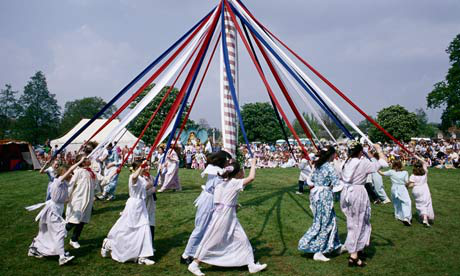
In the UK, it a pagan celebration. In other countries, it is more political.
[pagan = a religion where many gods may be worshipped and dating back before Christianity]
History
The first mention of a May Day celebration dates back to the Roman times, and a celebration of the goddess Flora.
This would be a festival over several days, and included theatre performances.
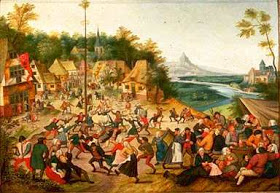
May Day continued to be associated with fertility and the worship of mythological or pagan gods. The celebrations would often involve dancing around a maypole, and crowning a May Day Queen.
A modern may pole, this one from Sweden, where it is now used to celebrate Midsummer, not the traditional 1st May.
Britain has a long tradition of May Day celebrations, from at least the C15th. However, many church leaders objected to the pagan origins (worshipping old gods, not the one Christian God) and celebrations were banned in many places.
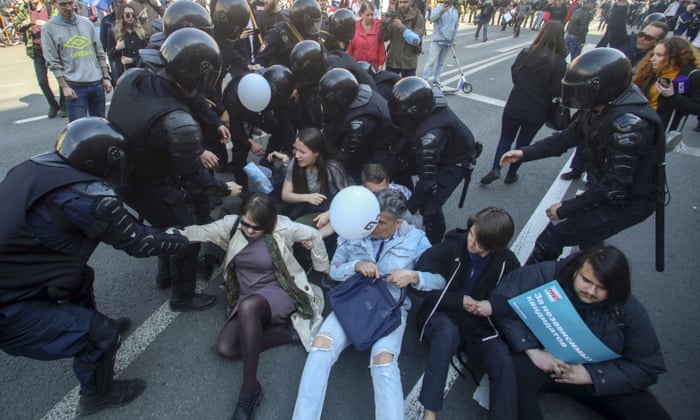
Today, May Day celebrations are not so popular, and in cities, one is more likely to see political demonstrations, than prancing on the village green
In 1889, 1st May was selected as the International workers’ Day
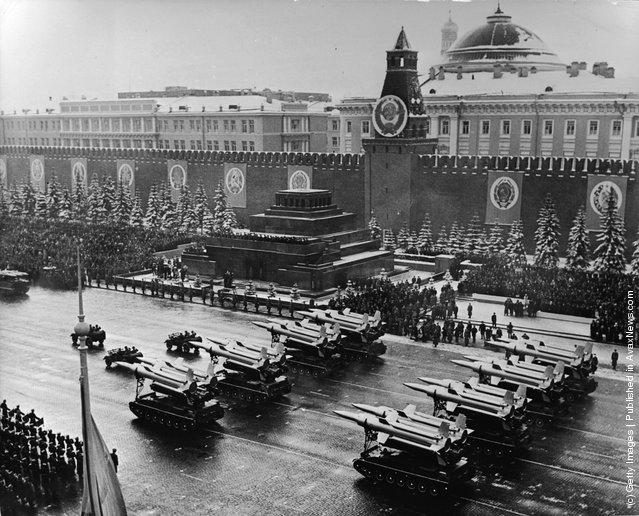
What do you think about these photos ? Political, or cultural ?
How about these photos from Nigeria, UK and Hawaii ?
In Hawaii, May Day is a little different. The flower necklaces, or leis, are given to people as a sign of friendship, celebrating the culture of Hawaii or the ‘aloha spirit.’
The festival is celebrating in school and communities, with many free concerts, dancing, guest speakers and food.
However, it is not all peace and love:
Protesters clash with police in Berlin, Germany.
During the time of the USSR, May Day parades were held, with seemingly endless displays of tanks, soldiers, missiles and weapons of all description.
In Hong Kong in 2019, protesters used May Day to demonstrate about bad working conditions.
In Literature, we have the American writer Nathaniel Hawthorn, ‘The Maypole of Merry Mount’:
This is my most recent film, ảo tưởng, which translates as ‘dreams’ but with a sense of disillusion.
Filming took a number of years, as I had to juggle the availability of my lead actress, not to mention trying to find the time and energy myself after working full-time at various schools and language centres.
Another big challenge was getting around; I don’t have a motorbike and Sai Gon has no subway system. I’ve not even mentioned the heat; I’m used to filming in north Europe, not the tropics.
Additionally, I had a series of camera problems. I intended to use my pocket Samsung camera W200. The first shots were ‘in the can’ ( the university scene) only for me to accidentally delete them. Soon after the camera, which had filmed in London and came with me to Thailand, Cambodia & Viet Nam, died.
Next I borrowed a Samsung Galaxy 5 phone, only to discover it has no ‘steadycam’, so when I played the recordings back, I was shocked at how shaky there were.
After that, I had a great LG phone, with manual options for focus, light, filters etc … but that phone also died. I next used my iPhone 5 but, as related in an earlier blog, that was caught in the monsoon of Sai Gon’s rainy season. I got the dreaded red screen, and that phone died.
Finally, I was able to finish the film on my new iPhone 6S.
I could have shot some more cutaway shots (scenes of the city, without any of the actors) but i thought it was time to finish the film.
In Vietnam, where I’m currently based, I have an Apple Mac Book (though it’s approaching the end of days, I fear), but in London I have a Samsung laptop using Windows, and has Movie Maker. During a recent trip, I cut the film in two days (with a lot of very un-British shouting cursing and cussing; I have NO computer skills or patience to deal with the fact that I have no computer skills).
Finally, I posted it to YouTube … and now it is available for everyone.
I’m not going to explain the film here, I’d much prefer viewer to watch it and make their own decisions or explanations, although I’d be happy to discuss any points people may wish to raise.
Heartfelt thanks to: Ms Quynh, Ms Mi, Ms Hoang, Ms Phuong & Ms Hang and the wonderful music of Mr Richard Lewis and the experimental aural soundscape of Herr Harald Ansorge and the encouragement of Ms Lorna ‘Ace’ Le Bredonchel & Mr Martin O’Shea
Today we’ll concentrate on building longer, more interesting sentences, altering sentence structure, and applying discourse markers and relative pronouns in order to be proficient in meeting the IELTS requirements.
Let’s kick off with some basic sentences, each containing one fact.
Park So-yeon is from South Korea. She performed under the name ‘Soyeon’. She was in the band T-ara from 2009 – 2017.
One possibility is to make a longer, main sentence (an independent clause) then break it up with some extra but not essential information (a dependent clause):
Park So-yeon, who performed under the stage name Soyeon, was a member of the South Korean group T-ara from 2009 until they broke up in 2017.
Here, I employed a relative pronoun (‘who’) to introduce the dependent clause, and altered the sentence slightly, adding some extra words.
Another, more advanced, option, which I recommend experimenting with as it will impress the examiner, is to start with a dependent clause. Allow me to demonstrate:
Performing under the name Soyeon, the South Korean singer Park So-yeon achieved fame as a member of the band T-ara, with whom she played from 2009 until 2017.
You will, no doubt, notice that the grammar may have to change, that is altering the verb form, by which I mean transforming the simple past into present continuous.
Now, you can guess what’s coming, it’s your turn to practise. I realise that not all of you are so enamoured of T-ara and South Korean women as I am, therefore, for that express purpose, I have selected three examples and you merely have to choose the person that most interests or appeals to you:
Daniel Craig is an actor. He is most famous for playing James Bond. His wife is Rachel Weisz. She is also an actor.
Thandie Newton is an English actress. She has three children. She studied at Cambridge University. She was in Mission Impossible II with Tom Cruise.
Tsai Ing-wen is president of Taiwan. The official name of the country is the Republic of China. She has been president since 20th May 2016. She was the first woman to be president of ROC Taiwan.
Next stage is to introduce some information and then offer up an alternate view, that is to say, a critical response which can be achieved by the use of appropriate discourse markers.
Let’s focus on the most recent Noble prize laureate ( Literature):
Peter Handke is an Austrian writer. His first novel was published in 1966. The English title is ‘The Hornets’. Handke was critical of the Noble Prize. In 2014, he called for the award to be abolished. Many people were critical of Hendke winning because he had supported the Serbia cause in the breakup of Yugoslavia.
There is a lot of information here, some purely factual (dates, nationality) some regarding the reaction to the award.
The Austrian writer Peter Hendke, whose first novel ‘The Hornets’ was published in 1966, was awarded the Noble laureate in 2019 despite his previous comments calling for the abolition of the award. Furthermore, there was a lot of criticism surrounded the announcement due to Hendke’s support of the Serbians during the Yugoslavian war.
Alternately:
Although there was a lot of negative critical reaction, Peter Hendke, an Austrian writer whose first book was published in 1966, received the Noble Prize for Literature in 2019 in spite of the fact that he had previously called for the award to be abolished. The writer, whose first book was titled ‘The Hornets’, had additionally expressed views supportive of Serbia which caused a backlash once the winner of the award was announced.
Your Turn:
Either write about somebody famous, somebody you admire or write something about yourself, making sure to include something positive and negative.
Next time, we can work on introductions, how to respond to IELTS questions by leading into the answer as opposed to simply answering directly.
These Business English blogs are aimed at upper-intermediate level students, and will include everyday phrases, expressions and idioms relating to various aspects of conducting business and workplace conversations.
Note down any phrasal verbs or expressions that you don’t know. A great way to improve your English is to add such language elements to your everyday speech, rather than just using text-book, standard English.
Business meetings
One viewabout how to plan a meeting:
Are all meetings cost-effective ? As the seconds tick away, you’ll start to appreciate what a terrible waste of time – and money– most meetings are.
So what can you do?
Firstly, make sure everyone arrives on time. No excuses. If five people at a meeting are sitting around waiting for a sixth person to turn up, just think how much money you are throwing away.
Secondly, get most of the work done before the meeting: send round detailed agendas, telling them what they need to do to prepare for the meeting. That means the meeting itself can focus on problem-solving and decision-making rather than wasting time explaining.
Thirdly, stick to the agenda. Don’t let anyone hijack the meeting by chatting about something irrelevant. Don’t let them take over yours.
Fourthly, set a time limit and stick to it. There’s nothing worse than a meeting that goes round and round in circles with no decisions ever being finalised. A time limit can be a great way to focus everyone’s minds on the purpose of the meeting and the need to achieve something concrete … and then to go back to work and start implementing the decisions.
Of course small talk has its place, but that place is not a meeting.
This is one point of view – do you agree with it ?
To what extent does small talk have a place in meetings ?
Talk about your experiences. Does it vary from person to person and culture to culture ?
This is a contrary (opposite) opinion; how do you evaluate this viewpoint ?
If you’re serious about making your meetings more effective, you need to give the participants plenty of time to ask questions, take the conversation in new directions, say things which may or may not be relevant, and above all, get to know each other. Of course, you need to make sure things don’t get out of control, but that means finding a sensible balance between small talk and getting down to business.
A company which does not tolerate small talk may get things done more quickly, but that doesn’t mean it’ll do things the best way, making full use of the skills and ideas of its employees … and it may well find that it loses its best employees and its customers just as quickly.
Which view do you agree with, and can you explain your reasons. Alternately, you may wish to select elements from both examples and make your own plan.
Asking about current projects:
Complete using present continuous (verb + ing)
What ___ you ___ ( work) on at the moment ? // What are you working on at the moment ?
How ___ it ___ (go) with your new assistant ?
___ you ___ (make) any progress with your big project ?
Asking about recent events: (use past tense)
How ___ your presentation ___ (go) last week?
How ___ (be) your business trip ? When ___ you ___ (get) back?
Asking about news: (uses past perfect)
___ you ___ (hear) back from that potential big customer yet?
What ___ you ___ (be) up to in your department?
Asking about plans and predictions : future tense
When do you think they ___ finally ___ (sign) the contract?
___ you ___ (go) to the conference this weekend?
Now match the questions with some answers from below. Try to practise with a friend or colleague
a) A little, but it’s very slow. We’re still tied up with the financing side of things, so it doesn’t feel like we’re getting anywhere.
b) Absolutely! I’m giving a presentation! I’m really nervous about it, actually.
c) Ah, nothing, really. Nothing ever changes! Busy as usual.
d) It was useful, but really exhausting. I just got back on Tuesday, so I’m still trying to get back on top of my inbox. But I’m glad I went. I made a few potentially useful contacts.
e) Next week, hopefully, but they’re still not happy with our service charges, so it might still all fall through.
f) Not bad, actually. He’s on a steep learning curve, but he’s trying hard, and he’s got a lot of potential.
g) Really well. We had a good turn-out, and some people said nice things about it. Whether anyone actually buys the product as a result is another question!
h) We’re about to start working on the new marketing plan. It’s not due to be launched for another two months, but it takes a really long time to get ready.
i) We’ve been really busy preparing for next week’s quality inspection. We’re nearly ready, but there are still a few big jobs to finish.
j) Yes, they emailed us this morning with an order for 500 units, so it looks like it’s all going ahead. Very exciting.
Lastly, the final point on our agenda – what do you think of this list ?
It indicates what British people say and what they REALLY mean.
always // frequently // usually // sometimes // occasionally // rarely // never
From the blog, we studied agreeing:
To what extent do you agree ?
I agree / I agree 100% / I agree to an extent / There may be some truth there /
I disagree / I totally disagree / That is very unfair / That is offensive /
That’s just a stereotype / I know for a fact that isn’t true !
Now combine to form some stunning, well-constructed responses.
Example: Apple computers never break
Generally speaking, I would tend toagree as I have had a Mac Book for several years without any serious problems, whereas with my Windows laptop, I frequently have issues such as waiting for updates or very slow downloads.
Exercise – How do you react to these contentions:
Men should earn more money than women for the same job.
Everything from Korea is top quality.
All tourists from USA are obese and unhealthy.
All British people are exceptionally polite, helpful and utterly charming.
You will ONLY get a good job IF you speak English.
All Vietnamese students are lazy, disrespectful and only want to sleep.
A typical Vietnamese student … to what extent do you agree ?
Top Gear is a famous British show about cars, motoring, driving and crashing !
Here is an opportunity to hear British English being spoken at a natural pace, and to learn new expressions and colloquialisms (everyday spoken words, not usually found in student text books).
Top Gear Vietnam
The chaps arrive in Vietnam are are given a challenge … to buy a car for 15 million Dong. That sounds a lot of money, but it is nowhere near enough to buy a car, not even an old, second-hand one. Instead they decide they can only afford motorbikes.
Teaching Note: This could be used as a listening exercise. Read out the following information, then elicit answers. A simple test helps to build confidence, especially as IELTS listening can be very demoralising.
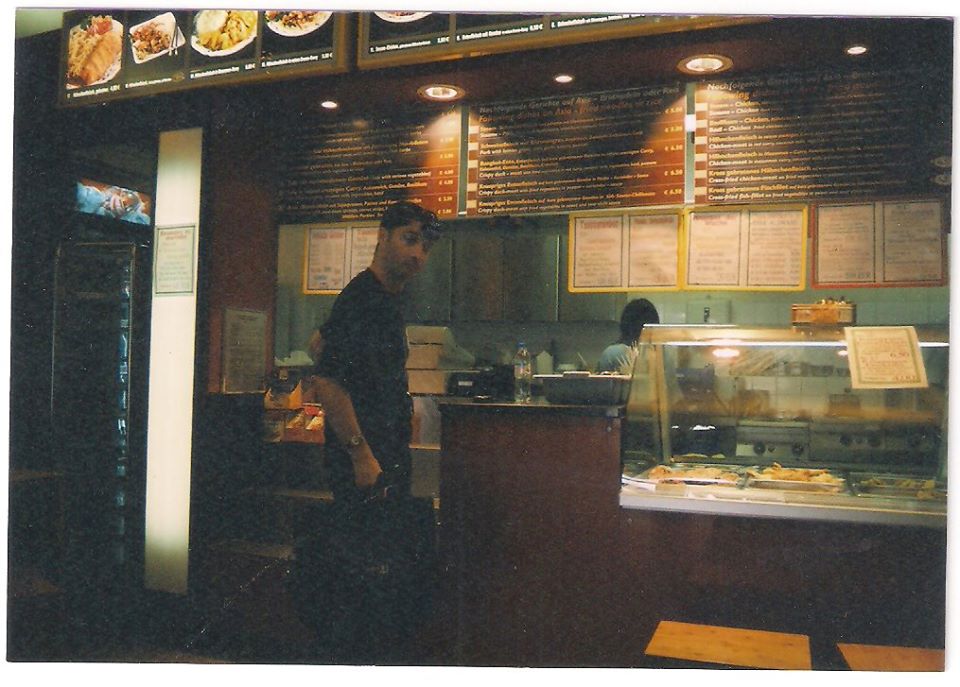
One of my favourite photos is of my friend Peter, who lives in Birmingham, England.
His wife took the photo last March. Peter is playing bass guitar in a studio. It looks like he is having fun. He plays in a band called ‘The Deep Six’.
I keep this photo on my computer in a file called ‘Music in Birmingham’.
What is the name of my friend ?
Where does he live ?
What guitar does he play ?
What is the name of his band ?
Where do I keep this photo ?
Photo 2
Activity 1: The student have to practice forming questions by asking me about the photo.
Activity 2: Read out the following information, then make a contest, who can answer first.
These are two of my friends, Mark and Tony. Mark is on the left, with the curly blonde hair and beard, Tony has short dark hair.
I took this photo last time I was in London, Christmas 2019 at my local pub.
Mark, who has tattoos on his arms, was in the army and now has a security firm (company) in the centre of London. Tony, on the other hand, lives from day to day, he does odd jobs, maybe some painting, maybe some construction, maybe some security work. He likes to gamble on horses, which is a popular activity in the UK.
I shot this on my iPhone and keep it because I live very far from my friends so can’t meet them very often.
As you can see, they are drinking beer, laughing and generally having a very happy time.
Photo 3
Now we progress, giving the information in a different order and with alternate vocabulary.
In this photo, which I was sent by email, we can see my London neighbour Arif and his sister Rita. It made me smile, because the T-shirts are ironic; they just don’t get on at all, in fact they fight like cat and dog.
Arif told me that their mother bought the shirts as a joke, and to make the point that living with them is driving her crazy. All the shouting and arguing, non-stop, 24/7.
Rita’s best friend Suzy was trying out her new camera, a Canon, and asked them to pose for her. The situation is getting complicated because Suzy likes Arif but Rita will be livid if her best friend starts dating her brother. I only received the email last week so I don’t know what is happening now.
I miss both of them, they are so friendly and funny. Arif always helps if I have a computer problem, as he works in IT, while Rita brings me special Indian food, knowing that I love spicy curry. Although she is a marvellous cook, she wants to be a business lady, a ‘mover and a shaker’. I’m sure she will do well, she is very determined and forthright. Maybe too much at times, she hates being contradicted or corrected.
Arif, who sent the email, informed me that after the photo, Rita left the room, changed clothes and threw the T-shirt away. That is so typical of Rita !
1 How did I get this photo ? // 2 Who sent it to me ? // 3 Who took the photo ?
4 Who are they and what is their relationship // 5 What is Arif’s job ?
6 What type of camera was used ? // 7 Describe Rita’s personality
8 If I wanted a physical copy of the photo, I would need to … what ?
Class exercise:
Ask students to bring in a photograph which can be talked about it in class.
We are currently using Zoom for online teaching, so students could share photos from their computer and then get a conversation going. Encourage students to elicit more information and to push each other to speak more.
Obviously, only suggest this, as some students may be shy about sharing personal information
I know that yoga and exercise are popular activities among my students, so let’s use this topic for some sentence building.
IELTS candidates will be expected to speak for two minutes on a given subject, then engage in a dialogue with the examiner.
The candidate will feel more confident with an arsenal of phrases, expressions, idioms, discourse markers, and an impressive array of ‘low-frequency vocabulary‘ (big words).
The candidate, additionally, has to employ complex sentences and well-structured responses in order to boost their score.
As with music, practice is the key:
I set a test for one of my IELTS students, Ms Nguyen. As a warm up, I asked her to tell me about a place she wanted to visit, so this was similar to an IELTS speaking test, Part 1. Following that, I asked her to prepare a Part 2-style answer about a hobby which prompted her to relate her experiences regarding yoga.
To start, we went over some phrases and sentence structure. Ms Nguyen was recovering from a slight injury: how could she phrase this …
I’m not in any pain, but I’m only about 70% recovered.
I’m not in any pain, although I’m only about 70% recovered.
Although I’m not in any pain, I’m only about 70% recovered.
Although I’m only about 70% recovered, I’m not in any pain.
Here, we replaced ‘but’ with ‘although’, and then altered the word order.
Which sentence do you prefer ?
Exercise: Rearrange this basic sentence (sample answers at end of blog)
I’ve been to South Korea but I haven’t been to Japan
Part 1 exercise: tell me about a place you’d like to visit.
{Low-frequency words & expressions: extraordinary, outstanding nature, notwithstanding}
Japan:
I like the culture, by which I mean sophisticated cuisine, outstanding nature and kind-hearted people. Good points notwithstanding, I am not so enamoured on the working culture which seems to be highly stressful especially compared to the norm in Vietnam.
Although I really like Japan, I am currently undecided as to whether to study there or not. On the plus side, the subject, sustainability, fits in with their life ethos. Additionally, the fee is lower for international students and, furthermore we will be supported by extra classes. Despite these benefits, I have some serious concerns over issues such as sexism as well as the constant pressure which leads to a high rate of suicide.
POINTS TO CONSIDER:
Do you see how Ms Nguyen gave three examples in her opening sentence, and used the adjective + noun structure (‘outstanding nature’ etc).
Use of adverbs (‘highly’, ‘currently’).
Low-frequency words (‘enamoured of’, ‘sophisticated’, ‘notwithstanding’).
Moreover, see how Ms Nguyen utilises complex sentences. Keep these in mind as you read her second exercise:
Part 2 exercise: tell me about a hobby or activity you enjoy.
{I gave Ms Nguyen some time to prepare, and allowed her to use a thesaurus to look up better words. Having said that, there are still some little grammar mistakes; can you spot any ? Don’t worry, a few mistakes are to be expected.}
Yoga
Every yoga student has individual needs and abilities therefore the instructor will suggest a method suitable to our needs and requirements. This including advise to prevent us from harming ourselves or pushing our bodies too far.
To be specific, on Tuesday we shall concentrate on stretching our shoulders, neck and spine . We shall do this by adopting positions designed to facilitate this objective. Initially, I felt some soreness because it was an unnatural position. However, there are various levels and when one has mastered the first, they can progress, move on to the next.
If I have a great, productive class, I feel relaxed, calm and refreshed. Some people may overemphasis the benefits of yoga but for me, it isn’t that complicated. I find it a pleasing way to release stress from work and to keep myself active.
Otherwise, I tend to just stay at home socialising with my family, then watching my favourite documentary shows.
Yoga, despite being seen as a very restful and gentle past time, can actually be very dangerous including concussions, injuries and broken bones. Having said that, I know my limits and keep within those parameters.
In conclusion, yoga is my favourite activity as it not only helps my body to reduce stress and keep healthy, but also it is a fun way to occupy my free time and bond socially with my colleagues.
SAMPLE ANSWERS:
Although I’ve been to South Korea, I’ve yet to visit Japan.
I, so far, haven’t been to Japan, although I once travelled to South Korea.
I visited South Korea although I haven’t been to Japan.
Ms Nguyen’s mistake: in the first paragraph, she uses include in the continuous form, not the present simple (“This including advise,” instead of ‘this includes advise.’)
This blog is aimed at IELTS level students, or anyone who wants to learn how to speak or write in longer sentences.
This involves the use of complex sentences and discourse markers. Furthermore, a wide vocabulary is necessary to prevent repetition and to maintain interest as well as, of equal importantance, to make you feel that you are able to express what you really want to say.
One must not forget that when speaking, intonation, stress and body language will all help to make you sound more like a native-speaker.
To recap, a complex sentence uses different clauses (part of a whole sentence) to make a longer, more interesting sentence.
(I will write a blog just about complex sentences, with examples and exercises, in the near future)
Example: Thay Paul plays guitar. Thay Paul is from London. London is the capital of the UK
Thay Paul, who plays guitar, is from London which is the capital of the UK.
The bold text is the main clause, the plain text is a supporting clause. Which and Who are relative pronouns (Paul = who, & which links London to “capital of the UK”). Therefore, we have three pieces of information in one complex sentence.
Discourse markers link ideas together. Look out for ‘although’, ‘therefore’, ‘furthermore’ which should all be part of your everyday vocabulary.
For vocabulary, you can look at your work; could you replace a basic word with a better one ? Make use of a thesaurus, and note down any new words you encounter.
Now, moving on, today’s theme is cultural differences. This doesn’t have to mean travelling to a different country or continent, but even in the same country. For example, one of my neighbours told me about a business trip she took. Ms Phuong is from south Vietnam, but she had to travel to Ha Noi in the north. This is her account of the journey:
I asked Ms Phuong to tell me what happened.
Hanoi old quarter
Last week I went to Hanoi and it was partly business, partly pleasure.
I wanted her to elaborate:
I went to Hanoi, last week, and it was partly business, partly pleasure.Although my expectations were low it turned out to be a greatly rewarding experience.
That was a great introduction, please continue:
I have mixed feelings
I was curious, so I allowed Ms Phuong ten minutes to gather her thoughts, write notes, then tell me:
I have a love-hate relationship, as I believe many south Vietnamese do, with Hanoi. On one hand, I really enjoy the cuisine, the flowers and the colonial architecture. Good points notwithstanding, I have one serious issue with the city and that is the work culture.
Being born in the south, I am used to long working hours, up to ten hours a day and, if need be, working on Saturday mornings. Southern workers tend to be highly focused on work and are always seeking ways to improve their performance. In contrast, workers based in the north seem to lack such a strong work ethic. The working day is limited (is capped) to eight-hours a day and, in my experience, this is a common practice. Furthermore, staff frequently go out for refreshment or leave early.
I noticed this while I was living in Hanoi, and when I return to the city on business. Fortunately, my staff comply with a strict office working policy; I encounter this issue when dealing with suppliers. I have to waste time waiting which makes me feel frustrated as there is nothing I can do to expedite matters.
NOW – what did you make of Ms Phuong’s answer ? I’m speaking in terms of the English, not necessarily the point she makes about Ha Noi.
(make of = think about).
How many complex sentences did you notice ? How about discourse markers ? Were there any words you didn’t know ?
Oh, no … we are not finished, not by a long chalk (not by a long way). Now it’s your turn. Write a short piece based on cultural differences or, if you prefer, write a rebuttal to Ms Phuong’s experience.
Guidance:
A short introduction
First point with reasons to support your view.
A contrary (opposite) view.
Short conclusion.
For those studying for IELTS, read it to yourself, and use a stopwatch … can you speak for two minutes ?