27th October 2019. E Up 5 U 7 L 1 Countries pp. 64 – 65
Today’s theme is travel, and we will focus on six countries from five different continents. As a warm up, the students can be put in teams (this is a large class in a small room so activities have to carefully planned to prevent chaos and injury). Each team is given a small board and has to write:
I want my students to know present and past tense of common verbs, a range of adjectives (both positive and negative) and a good selection of nouns. Additionally, I’d like them to be able to put them together in long sentences, and start to use English contractions.
And so, to kick off (to start), a past tense exercise.
Ask your neighbour, “What did you do today ?”
I will give present tense verbs – students must use the past tense.
Example:
This morning, I go out and drink coffee: This morning I went out and drank coffee.
Later, I meet an old friend and we have lunch together and talk and laugh.
In the afternoon, I sit in the park, play guitar and sing songs.
Adverbs – these make your English more interesting and give more information.
Sai Gon is hot. Sai Gon is so // very // extremely // incredibly hot.
Sai Gon has delicious food – Sai Gon has extremely delicious food and it’s so cheap.
NOW – sentence building:
I love Sai Gon because it’s so hot. Additionally, the food is incredibly delicious and very cheap. However, it can be extremely noisy, dirty and polluted.
Tell me about Nha Trang: Speak about hotels / food / how to get there / things to do
Tell me about these clothes and the people:
Language to use:
beautiful / stunning / eye-catching
cotton / silk / leather / straw / denim (jeans)
short hair / medium-length hair / shoulder-length hair / long hair
teenager / young / in his 20s / middle-aged / elderly / old
Contractions: when we speak quickly, we contract (shorten words) to make a new sound.
Example:
I am = I’m / you are = you’re / he is = he’s / she is = she’s
I am happy =
You are sad
He is angry
She is very eye-catching
I will = I’ll (sounds like ‘eye – all’)
Tomorrow, I will go to work = Tomorrow, I’ll go to work
I’ll send you an email tonight
Call me after 5pm, I’ll be free then.
Conversation Practice:
I want to speak to my sweet lovely student Ms Tram. However, she is at work.
Caller: Hello, may I speak with Ms Tram, please ?
Receiver: Certainly. Who’s calling, please ?
Caller: My name is ……….
Receiver: I’m sorry, could you repeat that ?
Caller: No problem. My name’s ……..
Receiver: Could you spell that, please ?
Caller: Surely (of course) . . . . . . . .
Receiver: Thank you. Hold the line, please. I’ll connect you.
Caller: Absolutely. I’ll hold.
Receiver: I’m afraid Ms Tram has just gone to lunch.
Caller: Again ? She’s always eating hahaha.
Receiver: I’ll transfer you to her office, then you can leave a message.
Caller: Great idea. Thanks a bunch !
Receiver: You’re welcome
Finally, where did Ms Tram go for lunch ?
What did she order ? Did she like the food ?
Adjectives for food:
delicious / bland / spicy / filling / appetising / healthy / unhealthy / vegetarian / traditional
protein / carbohydrates / fat / fibre / vitamins /
fried / deep-fried / baked / boiled
Please Note: All photos are taken from Google Images or free photo sites, and are used for educational purposes only. No copyright infringement or offense is intended. If I have used your photo or image, and you wish me to remove it, just ask. This site is not monetized, I run it on my own dollar. Thank you.
In a previous lesson, the class learnt about basic adjectives to describe appearance. I will therefore choose a student and describe the physical characteristics, e.g. this student has long straight hair, is not very tall, and wears black glasses. The students must guess the student I am describing.
To make it more fun and engaging, it’s a good idea to put the class into teams for a bit of competitive spirit.
This is my friend, Ms Quynh. She has long straight black hair.
We can extend their vocabulary by including clothes: Ms Quynh is wearing a white top and a colourful skirt.
I will choose some students and give them a student to describe, while promoting the value ‘be polite‘. They can describe their hair, whether or not they wear glasses, and if that isn’t enough, they can identify them by their clothes.
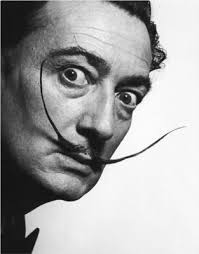
To continue the theme of Art and creativity, I think it’s time they met Dali !
Dali normally gets a reaction (especially when we have fun elongating his name as long as possible). It’s also a chance to learn a few new words:
creative / genius / unusual / surreal
The last word maybe a little advanced, but it’s a good way to introduce new words; inside the word is ‘real’ so surreal has something to do with reality … but what ? Here’s a clue:
This is a mixture of reality and fantasy. The students can say which is which … and why does Dali give the elephants tuba faces … is there a reason or is it just crazy ?
I will then expect the student to form basic sentences using these new words, and not forgetting new vocabulary from previous lessons, for example,
“Dali’s paintings are very unusual.”
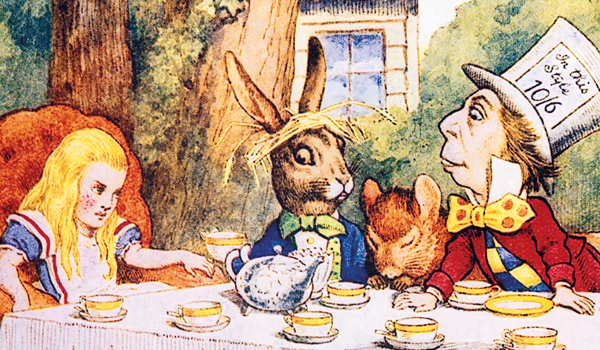
Next up, is a scene from the popular Children’s classic, ‘Alice in Wonderland’.
What is happening ?
Again, a mix of reality and fantasy. How would the students describe this ? It could be turned into a game … students put into small groups and given boards and markers. Points for the best vocabulary.
Key words: tea-party / young girl / bow tie / sleeping / garden
Now, to continue the theme and introduce some listening and reading skills, a video. This is the singer-songwriter Don McLean with ‘Vincent’, about the artist Vincent Van Gogh: This can be played in the background as the students do a writing project today.
This version also has the lyrics, as well as various paintings by the artist.
A useful lesson will be the subjectivity of art – it is a chance for the student to think and to give their views, and to try to develop the English skills to express their thoughts. Clearly, this is a perfect opportunity to introduce some fixed expressions to express opinions:
In my opinion …
I feel that …
For me …
And even an idiom – it’s not my cup of tea !
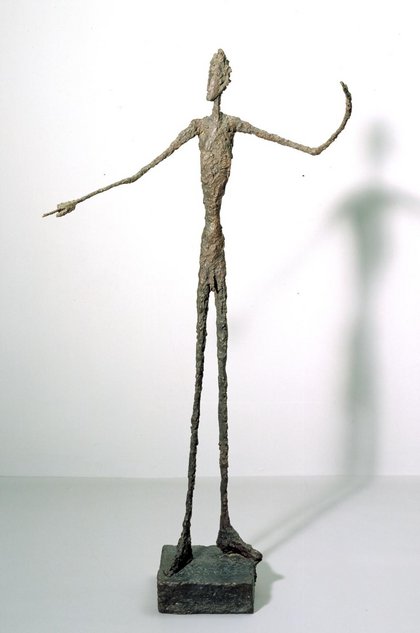
What kind of art are these and what do they think of them ?
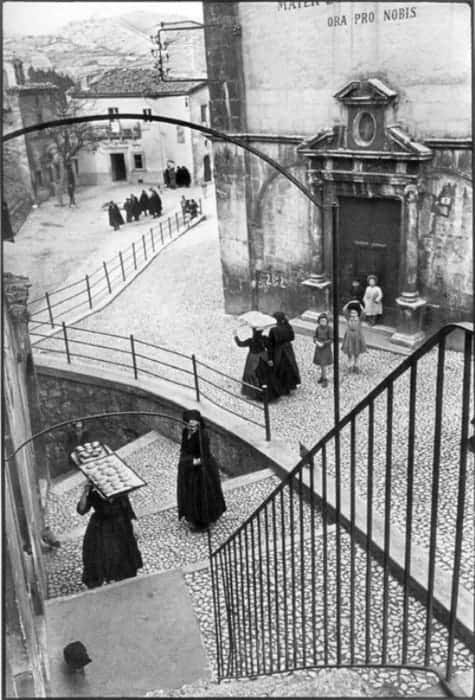
Alberto Giacometti Henri Cartier Bresson – 1908 – 2004Vietnamese silk painting
Then, with time against us, and a lot to get through, we’ll turn to the book work. They will watch a video which also shows sculpture, mosaic and photographs. The book also mentions Van Gogh, and a sculpture based on the Mad Hatter’s Tea Party from ‘Alice’.
Finally, to wrap up after the project, a little bit of fun. Who better than Dali (or at least a great actor playing Dali) ?
21st October for 22nd October 2019. AEF 9A pp 84 – 85
Warm up: Hit the ground running (or at least talking).
As always a model is a good idea; hence my Thai friend is coming to Vietnam:
Ms Namsum is young and energetic. She’s into (really enjoy) clubs, sightseeing and shopping.
I suggest she starts the day with a traditional bowl of pho then goes to Sai Gon centre. She can walk there from her hotel in District 1 or take a taxi (Vinasun or Malin ONLY). She will be out of the heat and has a lot of shopping choices and places to eat or grab a coffee. She could rest at her hotel in the afternoon, then go to Nguyen Hue walking street when it gets cooler in the evening. She has many restaurants in this area. Furthermore, there are many English-language menus. Finally, she can go to Bui Vien street where there are many clubs and bars, as well as many tourists speaking English.
What do they students think ? Is that a good plan ? Have I missed something important ?
Language to use:
I see your point
That’s a good idea but …
If I may make a suggestion …
I’m not sure that’s such a good idea.
For example – That’s a good idea but you haven’t thought about sightseeing.
Or
Bui Vien can be very noisy so I’m not sure that’s such a good idea for a young lady on her own.
Two of my friends are coming to Sai Gon; the students, in two groups, have to arrange a fun day including sightseeing, shopping, eating and transportation. Then they have to compare their itineraries and exchange views and opinions. The students learn how to politely disagree with each and put forward their ideas and support their choices.
Tom and David
PLAN A DAY FOR TOM & DAVID
Where can they eat ?
What could they see or visit ?
How can they travel around ?
What can they buy as souvenirs ?
Where could they go at night ?
What safety advice would you give ?
What you need to know:
Both are 45-years old. They have good jobs and a good income. They like history and culture. They really enjoy good food and wine. Neither speaks any Vietnamese. They are too old for very loud clubs but they don’t mind having a few beers and maybe seeing some live music.
The students can make a presentation, and use the computer for images or maps to illustrate their plan. Then the other team can explain what they have organised, and the reasons why. I will decide which team has made the best choice.
Tonight’s main focus is the third conditional
This means speaking from hindsight.
We talk about something that happened to us in the past and how we would have changed it IF we had known some information.
A basic example: A visit a friend and it is her birthday, but I didn’t know. If I had known it was her birthday, I would have bought her a present.
Yesterday was Woman’s Day but …
Alan didn’t know it was Woman’s Day subsequently his girlfriend, Ms Nhi, was extremely upset !
If he had known it was Woman’s Day, he would have bought her a present, some flowers and taken her out to eat.
However, it is too late NOW ! He’s in the doghouse (in trouble).
Notice all the past tense verbs. Furthermore, would is commonly used in conditional sentences.
Now, this example is based on a true story that my history teacher told me back in London.
My teacher was a somewhat dishevelled gentleman in his mid-30s. Let’s call him Mr Bowditch:
Mr Bowditch, history teacher at an east London school
Mr Bowditch lived in a bedsit, which is basically renting one room in a large house and sharing the kitchen and bathroom with other tenants. His room was not particularly comfortable:
One night, Mr Bowditch was in his room and began to feel a little hungry. He wanted some chocolate so decided to go to the off-license and buy some sweets (an off-licence is a shop that sells basic food and sweets but also alcohol and cigarettes. It used to be open until 11.00pm when most shops would close around 6.00 pm). He decided to buy, among other items, some ‘Fry’s Turkish Delight’ a sort of jelly covered in chocolate:
OK, so far so good. However, Mr Bowditch lived in a rather bad part of London, it wasn’t always safe to walk alone at night. Unfortunately, on the way home, Mr Bowditch meet the following young men:
They called out to Mr Bowditch and stopped him walking. They demanded:
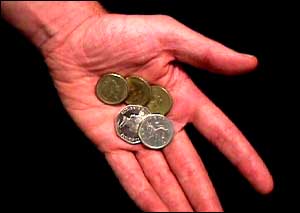
Mr Bowditch had none, as he had just spent his money on sweets (candy). They didn’t believe him and began to search him. He showed them:
That was all he had … a few pounds, about 100 000 VND. The men became very angry and aggressive. Suddenly, they heard a police car siren. The men tried to drag Mr Bowditch into the tunnel, away from the road but he is very tall and stopped them. As the police car got closer, the men ran away. Mr Bowditch has never eaten ‘Fry’s Turkish Delight’ again.
There are several instances of the third conditional in the above story.
If Mr Bowditch had bought sweets on his way home, he wouldn’t have gone out later and been mugged (mugged means being robbed, often with violence or the threat of violence).
If Mr Bowditch had gone to a different shop, he wouldn’t have meet the muggers.
If the police car hadn’t been passing, Mr Bowditch might have been seriously hurt.
If Mr Bowditch hadn’t been so tall, he would have been dragged into the tunnel and maybe beaten or worse.
The structure is the first clause starts with ‘If’ then using a comma before completing the sentence. The first verb can be positive or negative (in the examples, I use ‘had’ and ‘hadn’t’).
We use this to talk about things that DIDN’T happen.
How would you describe this lady ? Where is she ? What is the day like ? How adjectives add information and colour to speech and writing.
Making lemonade out of lemons – this is an expression which means making something good happen out of something bad. Allow me to elaborate – I was taking a Level 1 adult-talking class. The work is all prepared for me, with powerpoint slides and recordings, as well as print-outs. However, the theme was quite advanced for this level. The subject was economics, vocabulary included such gems as ‘manufacturing’ and ‘exports’. All very interesting, but far above the resources of a beginners’ class. And then the students arrived … after a few introductory questions, it became clear that I would have to abandon the lesson and somehow improvise a class at beginner level.
As the class consisted of young ladies, I chose hair and clothes … and how to use adjectives to build up setences.
It is understandable that students focus more on learning nouns and verbs, with just a smattering of common adjectives. However, I think it’s a good idea that students learn and be encouraged to use two or three adjectives from an early stage, so it becomes a natural part of their English (as well as boosting their scores in oral tests).
So, back to my class; three young ladies with very limited English but, fortuitously, also with three different hairstyles.
Let’s start very simply; Ms Kim (this is a Google image, not my real student) has long hair. OK, but we can add more … what colour is it … is it straight or wavy ? Finally, let’s be polite and complimentary … Ms Kim has beautiful long wavy brown hair.
The students may have to learn hairstyles or shapes (wavy, pony-tail, bangs, pleated), and students should learn a small number of new words every lesson. It helps if they can see them in the class and then use them in controlled speaking.
So, without much effort, their sentence length had doubled. Next to Ms Kim was Ms My
Once the students had a word bank and some practice, they were able to describe Ms My as having a beautiful long black ponytail, or beautiful long black straight hair, tied into a ponytail. Fortunately Ms Anh has a different style.
But now, it was clear my students were comfortable with ‘beautiful’ so time for some synonyms – stunning, gorgeous, eye-catching. Ms Anh has medium-length hair or, as I insist on a full sentence:
Ms Anh has gorgeous medium-length brown hair. But we can go further – let’s compare Ms Anh’s hair with Ms Kim – both have brown hair, yet different shades. Thus we introduce dark and light:
Ms Anh has eye-catching medium-length dark-brown hair.
It’s also very rewarding to hear students start building sentences after struggling to say three or four words just five minutes earlier. And so, we continue … let’s turn to jewellery using the students themselves as examples; someone will have earrings (studs or long), another will have a neckless, a bracelet, rings etc. I ask Ms Anh to show her ring … it is gold, while Ms My has a silver one. Or, at least silver-coloured !
Then we turn to clothes, and first elicit different types of material and patterns:
silk // cotton // denim // leather //
plain // floral // striped // checked
So now, when they see a picture like this, the students will be able to describe the lady’s hair, jewellery and clothes and by extension, the room in which she is situated.
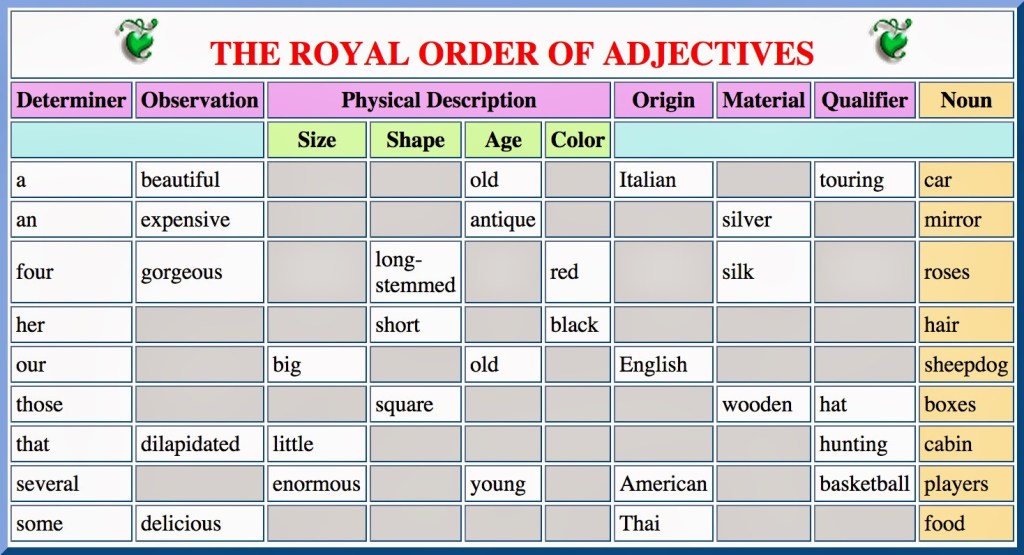
In terms of grammar, there is an order of adjectives, though I would not introduce this too early on. Instead, I would stress the opinion word is first, while size is before colour (eye-catching short light-blue skirt).
Now, let’s return to the first picture, a young friend of mine whom we shall call Ms Ngoc. Students can work together and give me as much information as they can. This includes her hair, clothes but also what she looks like, where she is and what time of day. Furthermore, how does the weather look ? How does she look ?
Finally, a good activity is to board some common adjectives and have the students give the opposites or antonyms:
This is continued in subsequent lessons, so students become used to incorporating two or maybe three adjectives in sentences. And them or course … we have adverbs … but that is another story !
7th October for 8th October 2019. AEF 8A (1, 5 & 6), pp. 74-75, 77
Sentence building – becoming fluent and coherent
Use
adverbs
adjectives
opinion phrases
linking words and discourse markers
new vocabulary
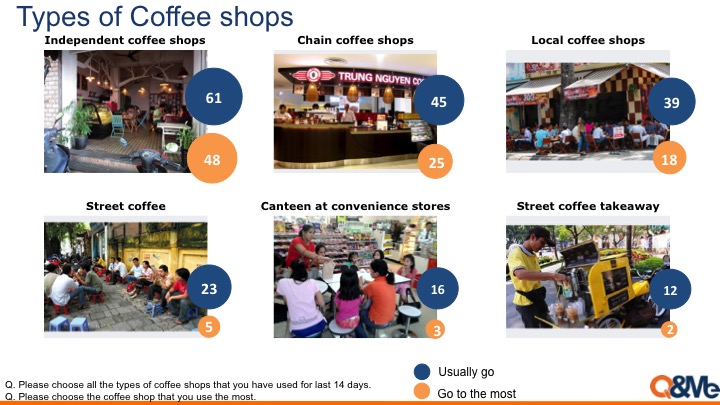
Vietnam is famous for coffee; coffee shops are ubiquitous. In fact, there are so many, it’s hard to see (difficult to understand) how they stay in business let alone turn a profit.
Be that as it may, let’s use this as a learning opportunity. To practice making longer sentences, and as a warm up exercise, the students can ask each other, “Where do you go for coffee ?”
Tips:
Don’t answer the question directly and immediately; Begin with a short introduction:
Sai Gon has so many coffee shops, some are cheap while others can be quite expensive although they have a wide range of delicious coffee. Personally, I like going to …
Then
Ask
How MUCH do you like it (adverbs) ?
What kind of coffee (adjectives) ?
What do you think about this ? (opinions)
WHY do you like it (give reasons)
Interesting words, phrases, idioms
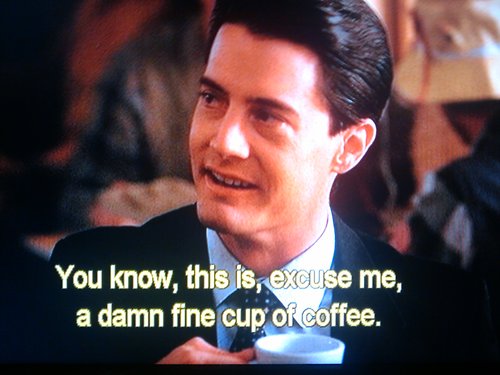
Personally, I like Tap Coffee which is an independent shop where I live. I enjoy going there so much because the owner is very friendly and tries to speak English with me. There isn’t a lot of choice, so I order cappuccino with hot, fresh milk. In my opinion, it is good value and tastes delicious. What I like about the shop is the free wifi, the comfortable chairs and the atmosphere. Furthermore, it is usually very quiet and it therefore a good place to read. I love to put my feet up, kick back and sip my damn fine coffee.
Before the exercise, elicit and board as many relevant words and phrases as required. The students have a discourse marker list, so I could insist that they use certain words (moreover, therefore, consequently etc). Additionally, I’ll need to explain vernacular phrases such as ‘kick back’ and ‘put my feet up’.
IF a student doesn’t like coffee, then they can say where they go and what they drink. IF they don’t go anywhere or like anything (yes, I have had that in a class), then they can explain WHY NOT!
Key vocabulary: ambience // aroma //atmosphere
Now, their turn; after this model, they must tell me about their favourite app on their phone. Give them five minutes to write a short piece.
After, the students can read to each other, and we can incorporate their answers into tonight’s grammar: reported speech.
For example, Ms Jane is speaking with Mr Tony:
Jane, “I really love the iTunes app.”
Tony, “Oh, for me, I prefer YouTube because I can watch music videos. I will send you a link to The Beatles.”
This is called direct speech. If I want to repeat what they said, I use indirect or reported speech. Look what happens to the subject and the verb:
Jane said that she really loved the iTunes app. (or She said she really loved …)
The subject changes from 1st person (I) to third person (she), while the verb alters from simple present to simple past.
What happens with Tony ? Look for the verb(s) then put them into simple past. Change pronouns to the 3rd person.
Now – changing reported speech back to direct speech.
He said the egg was perfect
(Change the past simple verb to simple present)
Now, here’s the actual quote (around the 2:28 mark):
This is one of my favourite clips about Sai Gon: Mark Weins eating a fairly typical Viet breakfast … but enjoying it SO MUCH !
Student Survey
Student must ask three people, what they usually eat for breakfast, and drink, as well as where they eat; do they go out, or cook at home ? Following that, they have to report to the class on their findings, using reported speech e.g.
She said (that) she usually cooked at home, but occasionally ate out when she felt too tired.
Then we have the book work and grammar practice. To end, we can have an eyewitness game. Students work in pairs, one having their backs to the board. On the screen, I show a man or lady. The first student has to describe, in as much detail, what is happening and how the person looks. Give them a minute or two. Then, the second student must report to me what they have learnt. Finally, they are allowed to see the picture, to compare the reported speech with the actuality. Photos could include:
An Introduction to Greece: location, history, lifestyle.
The flag of Greece
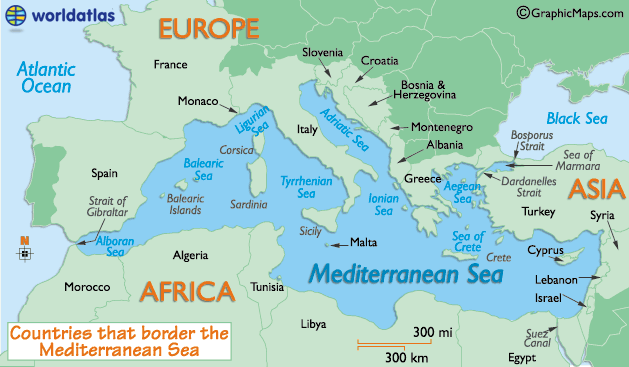
I shall also bring a globe to the class, as this is more visceral than internet images. The students, in small groups (or else the globe will be destroyed) have to find Greece. Now, to review recent vocabulary, what do the students think of these lifestyles ?
First, the food: Does it look healthy ? What other adjectives can the students add ?
Some typical Greek food: olives, cheese,vegetables, fish, meat and bread. Also, we have some sweet food:
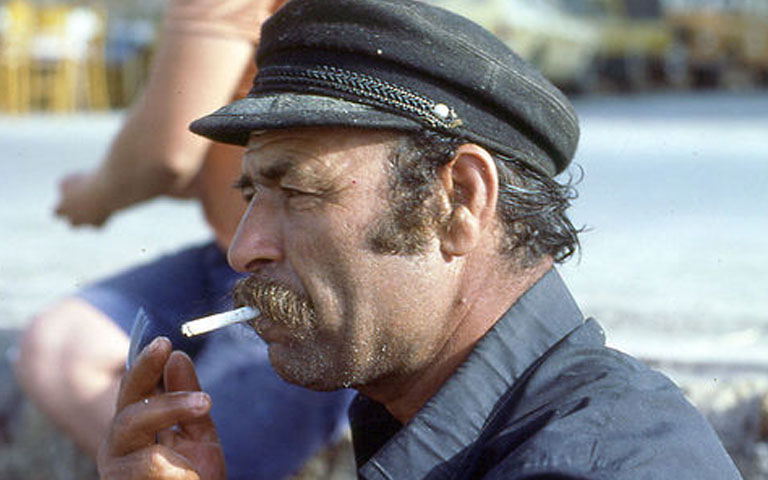
Next, lifestyles – what about these photos:
How about this Greek dance ? Maybe some of the more active students would like to try !
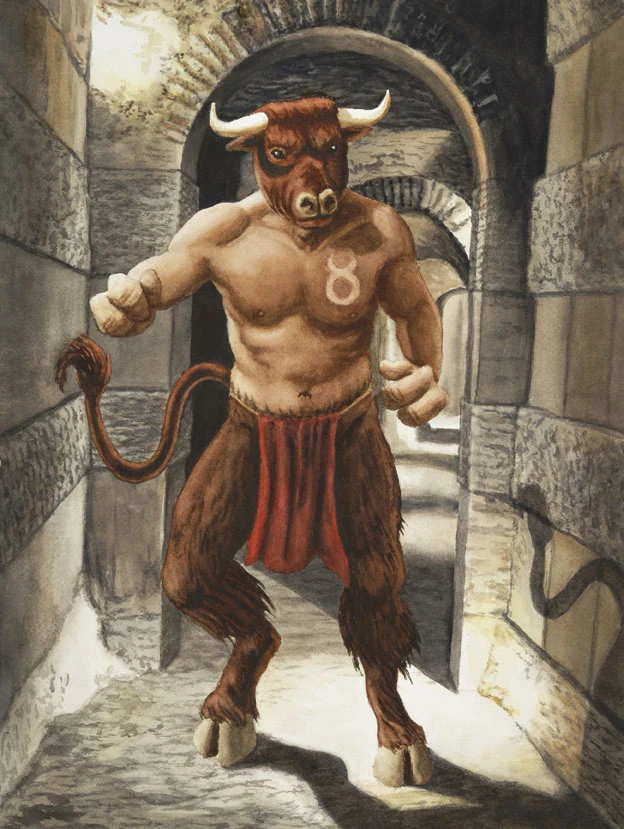
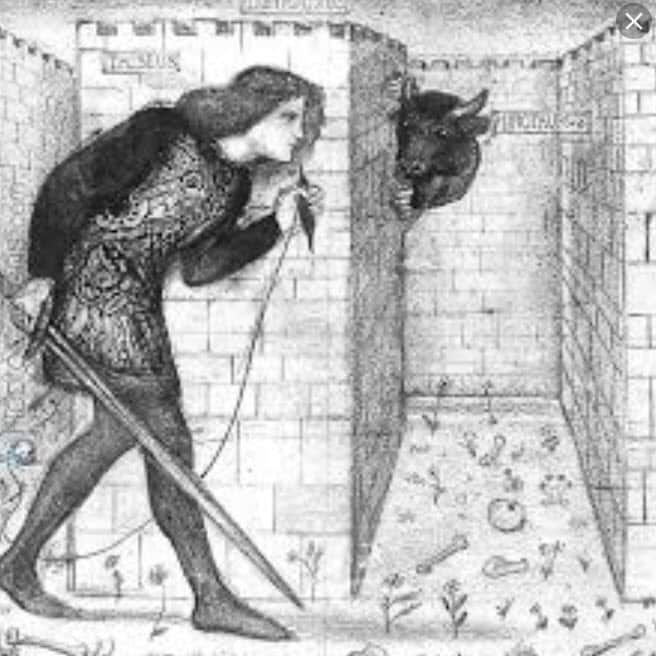
Now, Greek history and myth. On the island of Crete, there lived the Minotaur, half-man, half-bull. He lived underground in a big maze called the labyrinth. Every year, the King of Athens had to send 14 children for the Minotaur to eat.
The king had a son called Theseus. He was a hero. He decided to go and kill the Minotaur.
The King of Crete had a daughter called Ariadne. When she saw Theseus, she decided to help him. She gave Theseus a big ball of string. He tied it to the door of the labyrinth, then used it so he wouldn’t get lost (it would be a good idea to get some string and tie it to the door handle, or at least act out the motion).
Theseus found the Minotaur and killed him. Then he sailed back to Athens with Ariadne (I’m being economical with the legend here; the students are aged ten and eleven).
The students will be learning about the Parthenon in the next lessons, so this is a way of introducing them to Greece and its history. I’ll board words such as ‘bull’, ‘labyrinth’, ‘sailed’, ‘hero’ and ‘decided’. Then, after the students have written them down, they can watch this Lego version and tell me what is happening- start at 0:23.
Many children will know superheroes such as Spiderman, Iron Man etc. How does Theseus compare ? Whom do they like best ?
Then, onto the lesson. Today it’s about measurements, so although its important, it will not be as exciting as Theseus and the Minotaur.
The class is rather large, (twenty-one students) the room is rather small, which limits the scope for kinetic activities. Remember, these are still young children, some of whom will not really want to be in class on a weekend, so anything to vary the lesson and maintain their interest is worth trying.
I often put the class into small groups and then hand out a board and marker. The teams race to be first to write a sentence or key words from the lesson.
Another activity is to put two sets of flash cards on the floor and choose two students. They have to walk or hop from card to card, saying the phrase on the card. To make it more challenging, they have to hop with both hands on their heads (or some such variation). Quickly, two more students
Finally, to make the lesson more inter-active, one student per team can ask another student from another team to say what is on a flash-card and the answer has to be within five seconds. Points should be awarded to encourage the competition.
And what better way to end the lesson than with the theme from the film ‘Zorba the Greek’.













![Image result for all blacks haka]](https://i.ytimg.com/vi/PptTeyYShdw/maxresdefault.jpg)





























 Thay Paul's Notes