General Notes about my English lessons and life in Viet Nam.
Author: Thay Paul's notes
London-born English teacher, now living and working in Sai Gon, Viet Nam.
I want to use this site to post lesson notes, extra work, helpful links as well as general notes about my time in SE Asia and Viet Nam. I also want to give real classroom experiences and how to deal with real classes of noisy, unmotivated and resistant students. Additionally, I'll be posting links to films, publishing plays and stories, and introducing friends who work in the arts.
A compilation of games and exercises to increase your word power
Match the words with the meanings
Give the students some new vocabulary, teach them pronunciation and see if they can match the word to the definition. After, give them a chance to use the new words.
describe planned, in order, not a mess
imagine having to do too many things
typical feeling you have too much work
pressure normal, usual
organised to tell what something looks or like
community to think about something
stressed the place or area where you live
Practice:
The student was under ______ to finish the project on time.
All the neighbours are friendly. It’s a nice ________ to live.
A compilation of games and exercises to increase your word power
Match the words with the meanings
Give the students some new vocabulary, teach them pronunciation and see if they can match the word to the definition. After, give them a chance to use the new words.
describe planned, in order, not a mess
imagine having to do too many things
typical feeling you have too much work
pressure normal, usual
organised to tell what something looks or like
community to think about something
stressed the place or area where you live
Practice:
The student was under ______ to finish the project on time.
All the neighbours are friendly. It’s a nice ________ to live.
Can you __________ what the man looked like ?
After teaching 20 young children, I felt very _________.
The German workers all knew what to do, they were so _______
Close your eyes and _______ you are relaxing on a beach.
On a _________ day, I drink coffee, go to work, come home and watch TV.
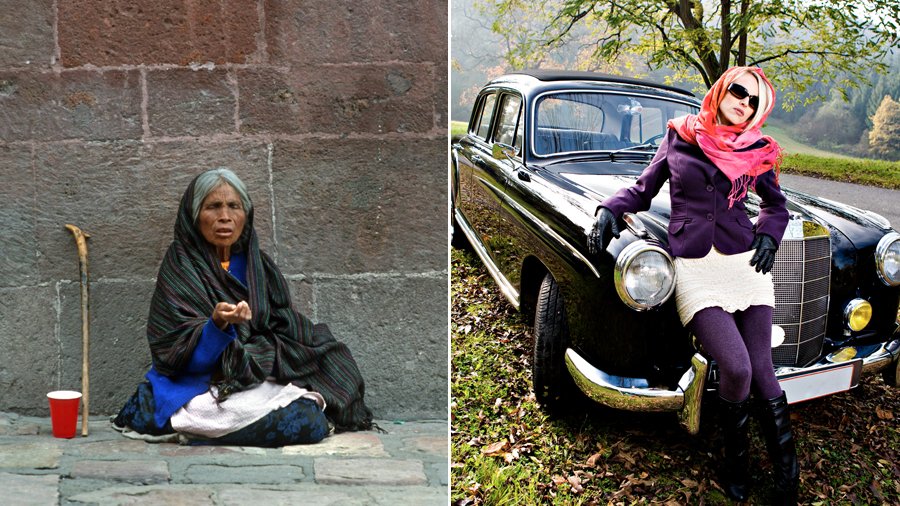
I think he could be a … / She seems to be …/ I get the impression that she is … / From his build, I’d say he was a … / Because of her appearance, I feel she must be a …
Personality adjectives (negative – arrogant). These are strong adjectives:
arrogant // self-obsessed // pretentious // obnoxious // full of themselves
Relative Pronouns
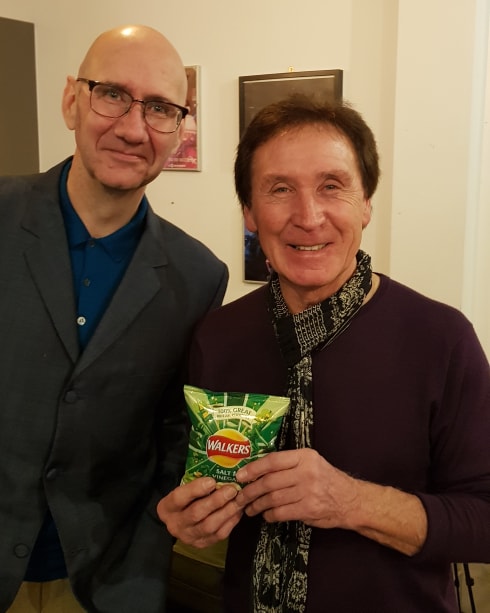
Let’s kick off with some basic information about my friend Pete:
Pete (left) with drummer Kenny Jones of The Small Faces & The Who
Pete’s family are Irish. He was born in Kent, south England. He loves music especially Jazz and he can play saxophone, keyboards, guitar and bass. He is 40 years old. He is bald, and wears glasses. Currently he plays bass in a band called ‘The Deep Six’. They have a video on YouTube. In the photo, Pete is with the famous 60s drummer Kenny Jones. He was in The Small Faces. Later he joined The Who after their original drummer died.
Example:
Pete, who was born in Kent in the south of England, is of Irish heritage. Although he is just forty, Pete looks older, probably due to the fact that he is bald, as well as having to wear glasses. His great passion in life is music, especially Jazz, but his interest is not merely passive; he plays several instruments. In addition to saxophone and keyboards, Pete is proficient on guitar. Having said that, he actually plays bass now in a band named The Deep Six, who have a video on YouTube. Pete is seen here with the legendary drummer Kenny Jones whorose to fame in the 60s as drummer for chart-topping band The Small Faces before joining The Who following the death of their original drummer.
Now, a quick practice:
This is Wei Minzhi. She was born near Beijing. She was chosen to be in a Chinese film called ‘Not One Less’. She was 13. She played a substitute teacher but had no experience teaching (and no experience acting). The area is very poor. Some of the children have to leave school to work. The film was shown all over Europe, even at special film festivals. She was famous. She did no more acting. She studied in USA. She lives in Hawaii. Wei is married and has two children.
Small talk responses
A great way to increase conversation and use more natural language is to practise keeping conversations going for as long as possible. Think of it as verbal tennis – keep ‘hitting’ questions and responses at each other.
Example:
What do you do ?
I’m a student ?
Really ? Where do you study ?
Engineering.
That’s interesting. What branch (what area) of engineering ? Mechanical, electrical ?
And this be continued – where does the person study, does the student like the course, the university, the teachers, the fellow students etc.
Really ? // I see // Are you ? // Right // That’s interesting // That’s a good point // Where is that exactly ? // Oh, me too // Do you enjoy it ? // Do you like it there ?
Tourism
Now was a chance for some new vocabulary, words and phrases associated with holidays and travel.
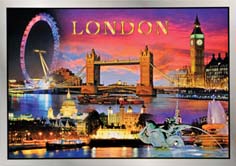
Now is the perfect time to visit London, England’s glorious capital. The weather is perfect for walking, so you can enjoy the lush parks, world-famous museums and incredible, unbelievable shops. There is something for everyone … and more ! Like sports ? Go to one of the many Premier League football games. Love shopping ? Everything is here – shop till you drop ! Adore culture – soak up hundreds of years of history.
NOTE – the use of adjectives to really bring the presentation alive and make it exciting.
Flights from TSN airport daily. Seven-day all-inclusive package tour starting from only 50m VND ! All transfers and transport included. Air-conditioned mini bus with Vietnamese-speaking guide.
Travel
Students are put into small groups and take turns speaking. The topic shall be travel, and the students have to use the following:
amazing / attachment / incredibly / predict / first impressions / you’ve come to the right place
With all speaking exercises, it helps if the teacher or a top student models first, so that all the students understand what they have to do. I shall use the same words but my theme shall be food:
On Saturday, I was out shopping and I felt very hungry. I went into a restaurant and my first impression was not encouraging. It looked a bit dirty and I predicted that the food wouldn’t be very exciting. However, they had an interesting menu with vegetarian options, which was amazing ! I ordered some pho and salad and it was incredibly delicious. I thought to myself I’ve come to the right place. I took some photos so I’ll send them to you by attachment on my next email.
Travel – hotel recommendation
I’m planning a trip to Nha Trang (a beach town in South Vietnam, about an hour’s flight from Ho Chi Minh City). I have two hotels in mind, but I need advise from some Vietnamese. They also have to use as many of these words as possible:
visually stunning / mouth-watering / you get what you pay for / spectacular / a waste of money / significantly / somewhat / according to / how can I put it ?
Students must tell me about the hotels, the area, the food and which one they would choose for me:
Victory Hotel 2* Rooms not very clean, no view. No complimentary breakfast.
Sandy Bay Hotel 4* Much more expensive, although it has breakfast buffet, and room has a balcony with view of the sea.
Trip Advisor recommends Sandy Bay, but they said Victory was dirty and very over-priced.
Local food is great
WILF (What I’m looking for): can the students describe the scenery and food ? Can they compare price and quality difference ? Can they use expressions appropriately ?
With the adjectives, I’ll be listening out for intonation – ‘spectacular !’
To quote another source of information, ‘according to’ and for the prices, the 4* is ‘significantly more’ expensive than … Then, in conclusion, can they make a judgement – ‘a waste of money’ or accepting that high quality means high prices, ‘you get what you pay for.’
Travel: Life in Sai Gon
ubiquitous everywhere, very common
naïve innocent, inexperienced
stroll a gentle walk, for exercise (collocation: take a stroll)
a bazaar (noun) a permanent, covered market
bizarre (adjective) very strange, unusual
absent-minded extremely forgetful
sky-high, astronomical very expensive, maybe too expensive
messy untidy
laundry / laundromat dirty clothes / a place to wash clothes (collocation: do laundry)
predictable it is possible to guess the answer, people doing the same thing
hawkers
Street _______ are common in Vietnam, and they are _________ in District 1. It is nearly impossible for a westerner to take a ________ without being approached. Some claim to sell Ray Bans or designer sunglasses, but you would have to be extremely ________ to believe they are genuine ! They are all fake, probably made in China. Many people try to _____(collocation) money by selling to tourists especially around Ben Thanh Market, a kind of _______, though this is strictly for tourists as the prices are ____________ !
What Difference Does It Make ?
I give students a paper with two words or phrases that are related but different. They have to clarify the distinction, for example
5th December for 7th December 2019 Super Safari 1 U 6, L 3 & 4 (pp. 50 – 51)
Today’s objective is to impose stronger classroom management and to introduce some new activities. The class has some new students, and it’s their first time in a classroom. Last week one of the new students was hard to control, running around the room, then drawing over the walls. Naturally, bad behaviour becomes contagious so it needs to be stopped … immediately.
From experience, I have seen that rewards work better than punishments; I shall make a chart and each week assign colour stars to each student based on their behaviour. Each week, the students will be able to see how they have performed.
Furthermore, I’d like to introduce a story section. At this age (mostly around 4), a very short story using basic vocabulary is sufficient. After I tell the story, I will repeat and the students can help me retell it.
Another change will be the games. I’ve tried ‘musical statues’ or ‘freeze’ but that hasn’t worked out so well. While some students stay still, others, mostly the boys, start doing an Irish jig or windmill impressions or forming fists and moving closer and closer to me. Hitting the teacher will be an instant BLACK MARK.
It can be frustrating getting a lesson started as students (or rather their parents) arrive up to fifteen minutes late and each new arrival diverts the attention of the class. Therefore, it’s good to start with a song, and YouTube has a vast selection of suitable material. Naturally, a song featuring ‘Hello’ is appropriate.
This can be played twice and the students can act out the emotions (I’m good, great, wonderful).
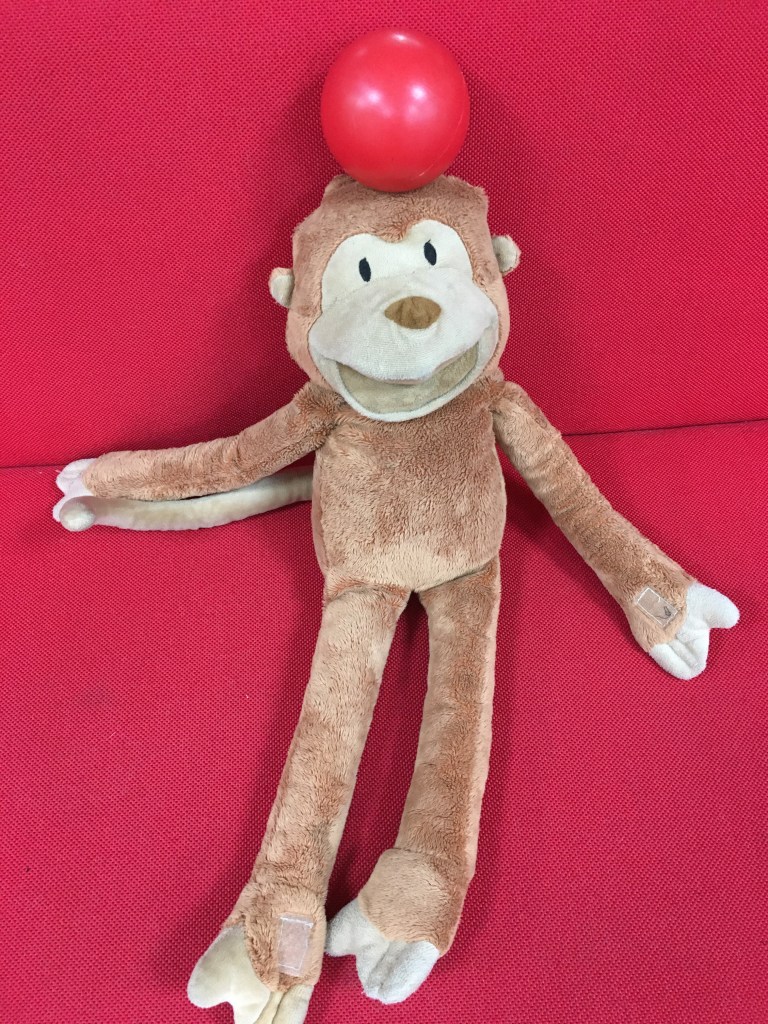
Next – a physical activity. Here we can use Teacher Says or Mike (the monkey) says:
Stand up // sit down // jump // hop // put your hands on your head // wave hello
Next – a review of last lesson’s new vocabulary (bird, rabbit, fish, cat). I’ll put the flashcards around the room. After, I’ll ask for two students to find a certain card (while making sure no other students jumps up and joins in). The student that finds it will hold it up and ask the class, “What is it ?”. I drill for “It’s a …” form of answer.
The students that haven’t participated yet can take part in the next activity. I will show them a card and they have to act or mime that animal, while the other students must shout out the name.
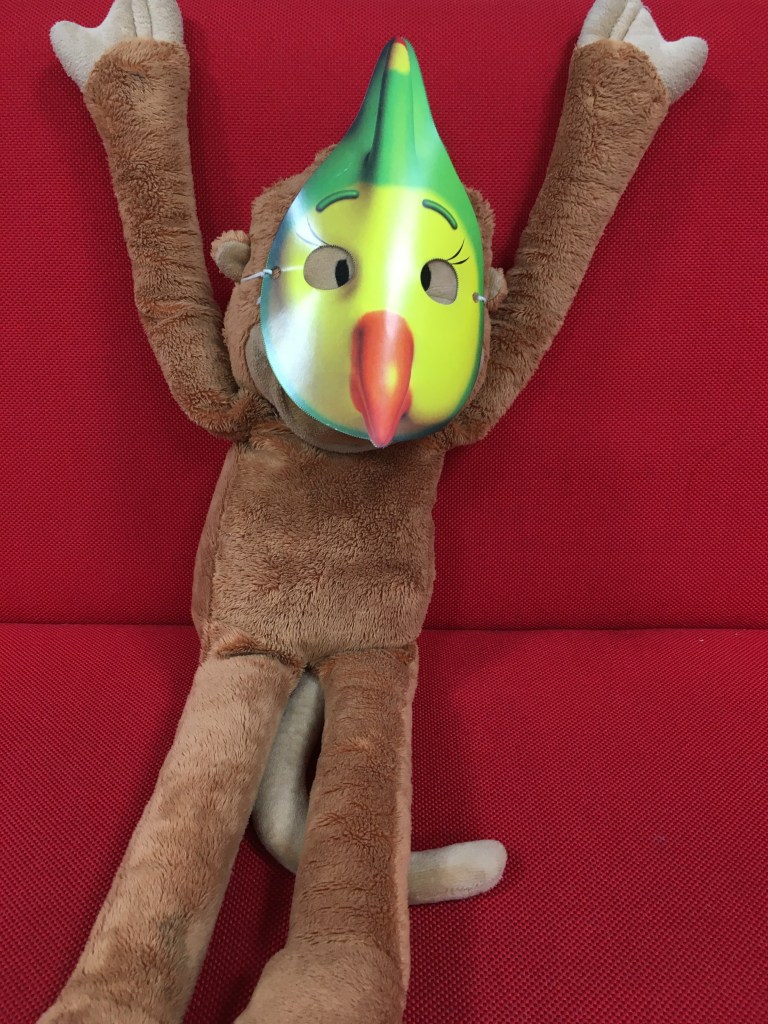
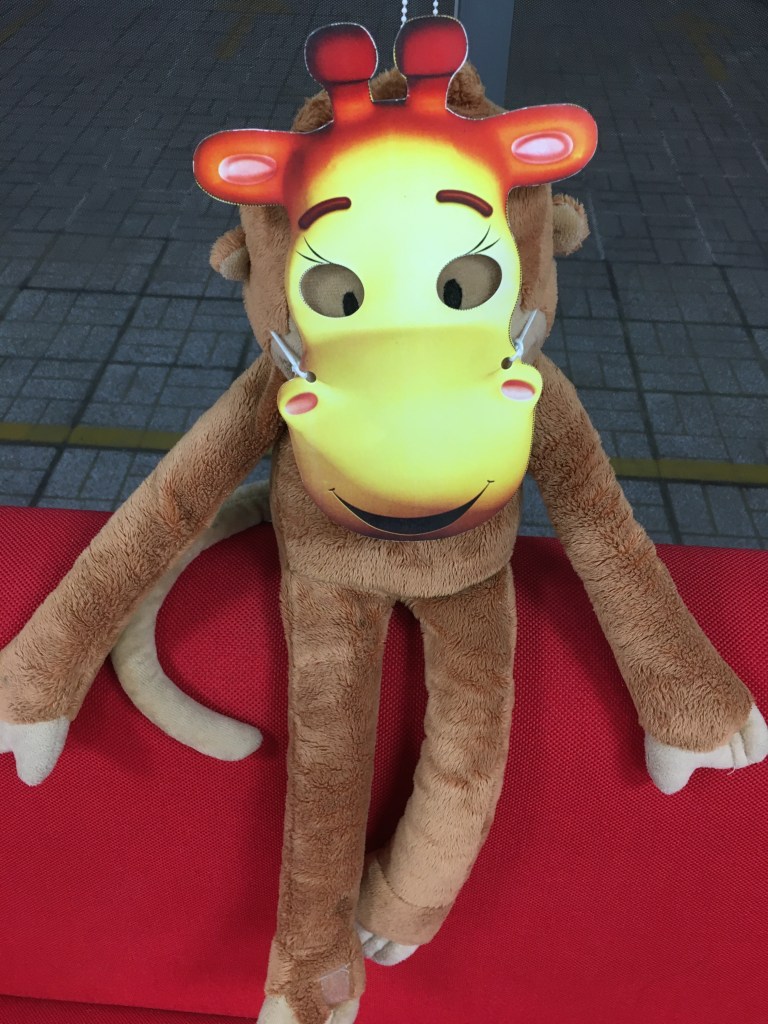
Next – story time. Our class puppet is Mike the monkey. Student can sit of front of the whiteboard.
They must ask, “Hello, Mike, how are you ?”
(the TAs’ help is invaluable here, as it is for the entire lesson. In fact, the TAs make the lesson work much more than I could ever do).
Mike says, “Today I am sad.”
Students ask, “Why are you sad, Mike ?”
Mike, “I don’t want to be a monkey.”
Students, “Why not, Mike ?”
Mike, “I want to fly like Polly.”
Yes, Polly can fly (mime flying).
Mike, “I want to be big and strong like Leo.”
Yes, Leo is big and strong.
Mike, “I am small. I want to be big like Gina.”
Yes, Gina is big. VERY big.
But Mike … you are very funny. Class … where is the ball ?
Mike is funny
Repeat story but give out masks to four of the students, so they can act Polly, Leo, Gina & Mike. Possibly most students will want to take part, so it can be re-enacted as required. Make sure students copy the actions and repeat key words.
Mike is now teacher …
Thay Mike. “Is the ball big or small ? What colour is it ? It’s a small red ball.“
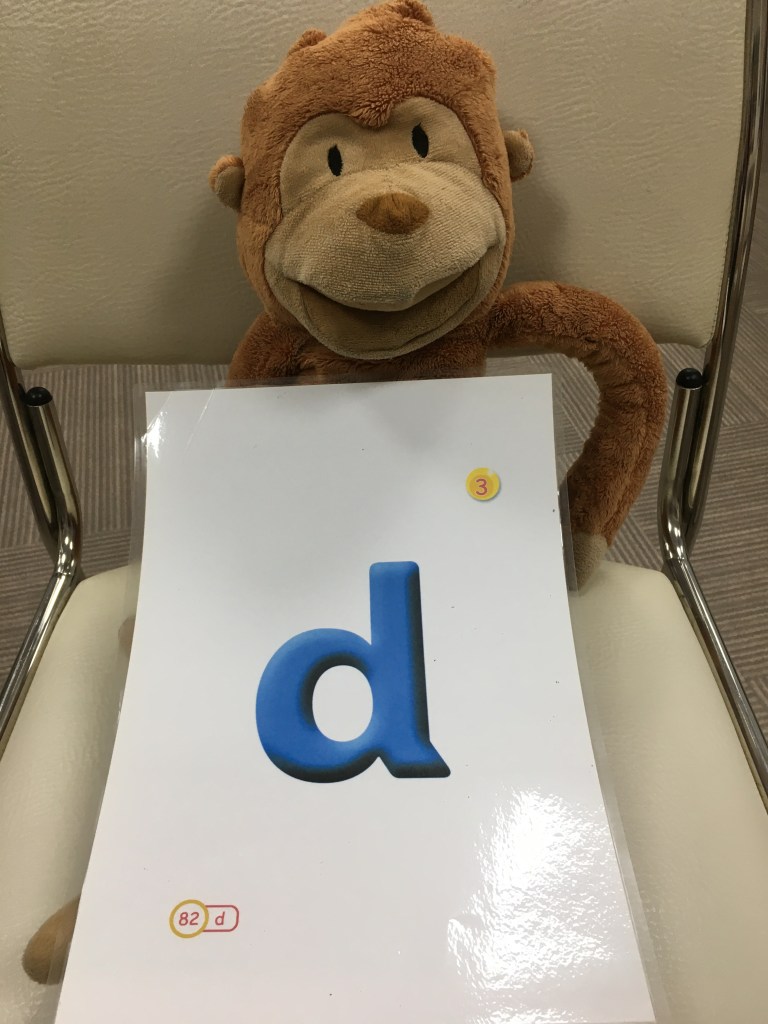
“Excellent ! Now, what letter is this ?”
Excellent ! Letter ‘d’ … ‘d’ is for dog.
Hand out as many markers as possible and see how many students can write ‘dog’. Some students still write ‘d’ as a ‘b’. By the end of the block, I would like the students to be able to write some basic words.
Next – Thay Student: Choose a student and they will tell the class what to do, for example ‘sit down’, ‘stand up’, ‘jump’, ‘be Polly’, ‘be Leo.’
This should easily take us into, if not over break time (always good to have more planned) after which is book work and activity books.
Today’s new verbs are: fly, swim, jump and walk. Once the students have learnt the pronunciation, they can practice. Which of these animals can fly … swim .. ?
Finally, at the end of the two-hour lesson (which is challenging for both students and staff), we can unwind with some colouring, but even here, the teaching continues. The TAs and I go around the class and ask them informal questions about their drawing and the colours they use. Meanwhile, we play a song that features some key vocabulary and show an image that could inspire our budding artists and allows them to develop their innocent imagination.
4th December for 7th December 2019 E Up 4 pp. 80 – 81
This is my final lesson with this relatively ‘easy’ class. There are only 13 students, and the class is well-behaved compared to many others. Today, there is a final checkup and a creative project. To keep the festivities going, I’m going to prepare an activity list, covering various subject. These can be done in small teams, maybe pairs or threes.
Name three things we can have for lunch
2. What did this man eat and drink ?
I need the whole sentence using the past tense for ‘eat’ & ‘drink’ and a linking word.
3. Make a sentence: Jane – models 😡 cloths 😀
Jane likes to design clothes but she doesn’t like to make models
Peter – songs 😡 movies 😀 // Tina – pictures 😡 stories 😀
4. Draw a picture of Dali !
5. Tell me four types of art.
6. What are you going to do this afternoon ?
7. Tell me three things we can make.
8. What does Teacher Paul like ? Two thing …
9. Someone who plays guitar is a … // someone who tells the news is a …
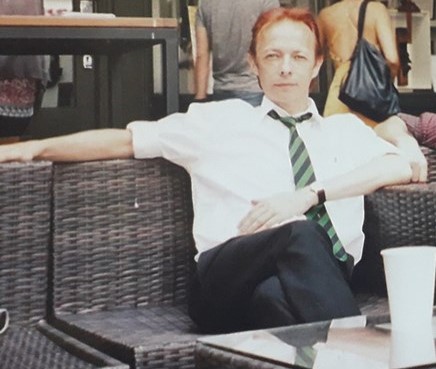
10. This is my friend Mark:
He works in films and in plays. What is his job ?
11. Where does he live ?
12. How does Mark go home ?
13. If I go to Nha Trang, what do I need to take with me ? Three things …
14. Space – What is the biggest planet ? // What is the sun ? // Can we hear in space ?
15. Watch Mr Mark. What did he eat for breakfast ? What words did Mr Mark use ? Can you smile like him ?
3rd December for 4th December 2019 AEF 7B pp. 70 – 71
Tonight we focus on a reading, extrapolating information from a chunk of text, and listening. Additionally, there is a test which may occupy thirty minutes so we’ll need to hit the ground running (not so easy when students arrive at various times but it’s Viet Nam … what ya gonna do ?) … so let’s test their knowledge of Mother Russia:
Word Bomb: Russia – Famous people / cities / famous for / history / food / language / artists /
2nd December for 3rd December 2019 AEF Listening p. 72 & Review p. 103
This block of lessons is something of a mixed bag; there’s a long listening piece, a review with a chunk of text, and a printed scenario for speaking practice. Listening is perhaps the hardest. Consequently, the students can be less than engaged with the lesson, faces fall and participation plummets. Although my hands are tied – I have to teach this assigned lesson – I can endeavour to bring it alive, take it off the page and into context.
To kick off – let’s go over the highlighted text and focus on ‘less than’.
In plain English, I would say, “The students will be bored.” This is rather hard and sets a negative tone so, using British politeness, I soften the language. We practised a similar technique in a previous lesson. To recap, how would you describe this gentleman:
We can all see that the gentleman could benefit from going to the gym and maybe reducing his intake of unhealthy food, but we want to be polite and not blunt (or indeed, rude). Consequently, we would say:
“He’s not the thinnest man in the world.”
Here’s how it works – we take the negative adjective (here, and excuse the impolite word, it would be ‘fat’, maybe even ‘obese‘), then apply the opposite (‘thin’) and use it in the superlative form (thin, thinner, thinnest). We simply form the sentence by saying that the subject IS NOT the opposite superlative form – he IS NOT the thinnest man … Try these two for practice – there may be more than one negative adjective you could use:
Now, today’s expression (and expressions are vital for boosting students’ English up to the next level) – ‘less than’ – what sentences could you make here ? The subject could be the man, the film or, more generally, cinema today.
Examples: The man is less than excited by the film // The man is less than engrossed with the movie // The film is less than thrilling // Films today are less than intelligent.
This item comes from China:
Products from China are less than perfect // less than top quality // less than well-made. Finally:
Movin’ on; Tonight’s listening is about a ‘boys’ night out’. What do you think that means ? If they had a friend visit Sai Gon and he asks for a ‘boys’ night out’, where would they take him ?
Shopping in a supermarket ?Bui Vien backpacker street ?Sai Gon Opera House ?Visting elderly people in hospital ?Going to a club and meeting new people ?Late night at the library ?
How do you think this man spent his boys’ night out ?
And now for something completely different; what do you think of this man ?
What’s My Line. I will pretend to be this man answering questions truthfully, and the class have to guess what this man does.
Firstly, are the following true or false ?
This man is said to be worth $180 million.
He is married to the Queen’s grand-daughter
He was arrested in 2009 because the police thought he was a homeless person.
He travels a lot for work, around the world.
In 2016, he tried to become President of the USA
He has a Noble Prize for Literature in 2017 although he has only published two books.
Class must now ask open questions and from my responses, have to guess why I am famous.
He is, of course, a singer-songwriter, an icon of the 1960s, and still releasing music to this day.
Now the students chance. In small groups, they can select a famous person and the other team(s) have to guess who they are. We can limit the guessing to a certain number of questions, or fix a time limit.
A variation on this game is to have a student sit in front of the board and write a name behind them. The student has to ask question and the rest of the class can only answer ‘Yes,’ or ‘No.’ For example, I could write HARI WON and the student could ask:
Am I a man ? // Am I alive // Am I famous ? // Am I old ? // Am I on TV ? // Do I play sports professionally ? // Do I act ? // Am I in the news a lot ? // etc
Tonight I’m covering a new class so I don’t know the ability of the class, their motivation, nor their willingness to talk English. There is a lot of book work but, to cover myself, I’ve prepared a list of activities to help get the students involved and producing English.
Hence, a compilation of adult activities:
First up – Family Fortunes
This seems to be a small class, maybe just seven students. Rather than ask them for introductions, we’ll jump straight into a game. Class divided into smaller groups and given a writing board and marker. I ask a question and then want four answers. Points for each answer that matches mine. Questions can include:
Not counting Sai Gon, I have been to four places in Viet Nam … which four ?
My four favourite things to eat in VN // Four things I LOVE about VN // Four things I HATE ! // Four instruments I can play (it’s a game, not the actual truth) // Four types of film that I like // Name four cities in Europe // Which four languages can I speak //
Moving on …
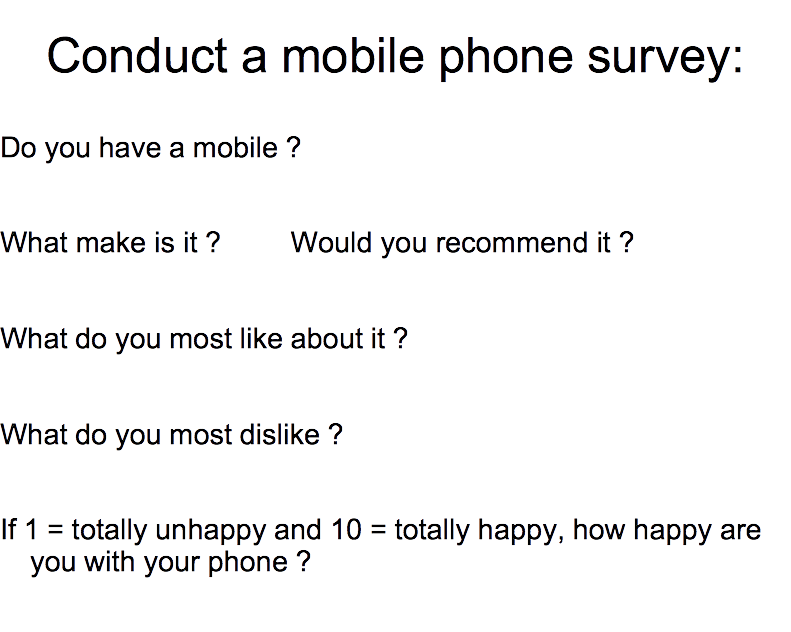
Mobile phone survey:
One of many online review posts
The students will be arranged in small groups. One member will be responsible for gathering the information, then reporting back to me.
Next up – a new persona.
Students are put into two or three groups, with each member given a card with some information about their new identity. They read the information to the group, who have to try to understand and write down details such as email addresses, phone numbers or Facebook accounts. Example:
Hello, my name is Tony
I’m 23 and I love shopping for shirts and ties.
I’m not into reading or books. I find them boring.
My mobile number is 0943 552 8207
It’s highly probable the other students will need to hear some of the information again, so they can use the following:
I’m sorry, I didn’t catch your phone number (email address etc)
Could you repeat that, please ?
Could you spell that, please ?
Would you mind speaking slower, please.
Putting students into small groups helps to take the pressure off the students, as they speak to a limited number of classmates, not alone and in front of the whole class. this is highly effective in motivating shy and quiet class.
No rest for the wicked … Call My Bluff
Class divided into small teams. Each team reads out a low-frequency word, followed by three definitions (hopefully, they will be able to embellish and add some of their own ideas). The opposing team has to review the three definitions, maybe ask for examples in a sentence, and then decide which definition is correct. Example:
jeopardy
In danger, in danger of losing or failing (noun)
A small car used by the army (noun)
A bird in Australia that can speak fluent English (noun)
contestants
People who order food in a restaurant but run away without paying (noun)
A large vehicle for carrying heavy things (noun)
People who enter (take part in) a competition (noun)
Others words include: maximum // in the form of //reduce // actual // smart // except the last one // obnoxious // broadsheet // charismatic // convinced // stain
Just a Minute
Students are put in pairs. They have to speak for one minute on a subject without hesitating, repeating or deviating (speaking about a different subject). This will test the students’ ability to speak fluently, as well as giving opportunities for using discourse markers and new vocabulary learnt so far. Subject are deliberately open, for example:
food // travel // work or study // life in Sai Gon // their family // their house.
Viet Nam presentation – where should I go on holiday ?
Three teams, representing Ha Noi, Hue and Nha Trang.
This exercise encourages team work and, furthermore, allows the students to develop their intonation skills; they will have to sound excited and optimistic.
To assist, here are some words and phrases to embellish their speech:
cultural centre // historical importance // breathe-taking scenery // tranquil // relaxing // hustle and bustle // mouth-watering food // never to be forgotten //unforgettable // once in a lifetime experience.
To give some help, I can perform a quick example:
COME TO LONDON, UK’s magnificent capital city and one of the world’s GREAT cities.
SEE such iconic, historical sights such as:
Buckingham Palace, home of our Queen, Tower Bridge over the Thames river.
Visit the world-famous British Museum to see the wonders of the world, or watch a football match at Wembley Stadium, in the country that invented the sport.
There is something for everyone:
Shops; you can buy everything here, to suit all budgets, from street markets to high-end department stores. To relax, London has so many tranquil parks, right in the centre of the city. Maybe see famous movie stars at one of London’s many, beautiful theatres, or dine out at restaurants cooking traditional British food or anything from anywhere.
A plane crashes in the desert. No one is hurt, but they cannot stay by the plane. They need to be rescued and to stay alive. The plane has a lot of items but they can only select FIVE:
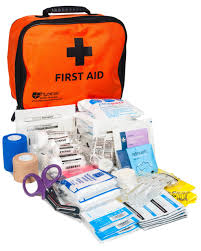
first aid kit // matches // rope // knife // compass // cigarettes // blankets // barrel of water // flare gun // torch (flashlight) // magnifying glass // Beatles CD // dried food // make-up set // Angry Birds game // air rifle // sun cream (sun block) // English grammar book
Factors to consider: food, drink, heat, cold, attracting attention, wildlife
Class put into teams and each team must choose their five items. After, they must compare their selection with the other team(s) and argue their reasons. Here we can practice negotiation language:
I see your point, however I disagree because …
That’s interesting, however …
I respectfully disagree
I’m not sure about that
I don’t feel that is entirely right …
Class interact and practice agreeing, disagreeing and making convincing arguments.
Friends
Here I show five pictures of men or women. Students, just by appearance, have to guess the personality and occupation of my friends.
This is a good way to teach new adjectives and jobs … and, in case you’re wondering, their jobs are: unemployed (looking for a job so is sending out CVs) // DJ // Actor // self-employed plumber and … doctor (photo taken on holiday).
26th November 2019. AEF 3 Listening Part 2 & Units 5 & 6 review (p.63)
Tonight, the lesson is heavy on listening and review. I try to get as much student-talking time as possible, so I’m got some ideas up my sleeve to, hopefully, lighten and brighten the class.
The topic is celebrity interviews, especially interviewing famous people who may be:
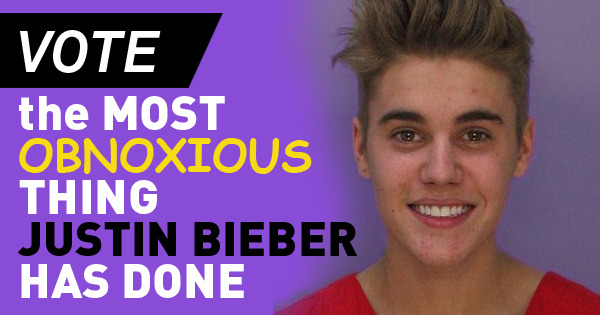
arrogant // self-obsessed // pretentious // obnoxious // full of themselves
Which of those words would, in your opinion, apply to these people:
Use opinion phrases (In my opinion, For me, He seems to be, I get the impression she is …)
a lawyerRonaldo celebrates a goal … but is this too much ?
A celebrity is anyone famous, but most often it’s an actor, musician, TV personality or just a regular person who has made the news (had a story about them in the newspaper, online media etc). Sometimes they can be arrogant or full of themselves in interviews. However, occasionally the interviewer may upset the star. What do you think is happening here [start at 04:23] in this Robert Downey Jr interview:
I have an assortment of activities for the speaking.
First up – small talk
I’ll hand out some papers with a short dialogue of small talk. This is basically learning how to keep a conversation going by using appropriate responses.
Students can use the following:
Really ? // I see // Are you ? // Right // That’s interesting // That’s a good point // Where is that exactly ? // Oh, me too // Do you enjoy it ? // Do you like it there ?
Then the students can pair up and ask each other questions such as:
Why are you studying English ?
Where do you live ?
Where would you like to visit ?
What do you do in your free time ?
What do you want to do in the future.
Students can change partners for each question.
Next up – Call My Bluff
Class put into two or three teams. Each team has a sheet with four words or phrases, followed by three definitions. A different member of the teams reads out a definition, embellishing the wording to make it more convincing. The opposing team have to guess the correct definition.
Finally, for a fun ending, the students can interview each other, but one pretends to be a difficult celebrity. They can use language from tonight’s lesson, or preferably, invent their own.
Please Note: All photos are taken from Google Images or free photo sites, and are used for educational purposes only. No copyright infringement or offense is intended. If I have used your photo or image, and you wish me to remove it, just ask. This site is not monetized, I run it on my own dollar. Thank you.
Class put into groups of three or four. Each team given a name of a European city, such as London, Venice, Barcelona and Paris.
First question – in which countries are your cities ?
Next ‘Screen Test’: The students watch the opening song then have to answer multiple choice questions.
1) What was the road sign at the beginning of the clip ?
London // Berlin // Paris ?
2) What was the number of the bus ?
9 // 19 // 28 ?
3) What colour was the first car behind the bus ?
red // white // blue ?
4) How many children wore a hat ?
1 // 2 // no children
5) How many men were riding bicycles ?
3 // 4 // 6 ?
6) How many women were in the car ?
3 // 4 // 5 ?
BONUS POINTS – Can anyone sing the song – just two lines
“We’re all going on a summer holiday // we’re all going for a week or two.”
Last lesson the subject was future tense and activities. Therefore, I shall board some times – this afternoon / tomorrow / next Monday / next Thursday / next weekend / next month
Under these, I shall write some scrambled nonsense, e.g. ‘who as ees’. The students, placed in teams, have to elect one person to find the corresponding flash card somewhere in the room (‘see a show’) and then say a third-person sentence e.g. “He’s going to see a show this afternoon.’
Information gathering: Class into three or four groups. One member will be going away and the others in the team have to get information from him or her, then present to the class.
Team 1: Going to Phu Quoc island / is going next month / will be staying in a hotel near the beach / will be going swimming / is going with family
Team 2: Going to London / is going next week / is going to see a show / is staying with family / is going with older sister.
Team 3 : Going to Ha Noi / is going next Tuesday / is going on a bus tour / is going to stay in a big hotel / is going with school
Team 4: Going to Dak Lak Province / is going tomorrow / is going to ride an elephant / will stay in a tent / is going with VUS TAs
The selected member will stand at the front of the class with the information sheet. One teammate must run up, ask one question then tell the rest of the team, who will write the information down. Then a different teammate will run up and ask.
Planning a day out
I have a niece and nephew coming to Saigon. The teams have to plan a day for them including what to see and do, how to travel and what to eat. Of course, they need to but some souvenirs, so where are the best places ?
My ‘niece & nephew’.
We shall probably have to board many ideas first. Where do tourists go in HCM ? What is traditional food ? How can they travel ? Do the girls want to take the niece and the boys take the nephew only ?
Hopefully, this will encourage a lot of speaking and ideas and I can show a map of HCM to help.
And if the students are still drawing a blank (or being too lazy to think), this could inspire them: It’s spoken in English, with text, but with Viet accent (can start at 0:20 seconds)
As with all ‘real-world’ videos, the film should be stopped and new words or expressions boarded. The students are later made to write the words down (the majority will simply NOT do any kind of writing unless pressured), and then encouraged to use them where appropriate.
That should easily cover the first hour. After the break, we hit the books, do the workbooks and fast-finishers get an activity sheet, while I can spend at least some time checking the pronunciation and grammar.
Tonight’s lesson will focus on listening, which is always a challenge for the students so, to lighten the load, not to mention the mood, I’ll organise a lot of speaking activities.
First up, a mobile phone survey:
One of many online review posts
The students will be arranged in small groups. One member will be responsible for gathering the information, then reporting back to me.
Next up – a new persona.
Students are put into two or three groups, with about four in a group. Each member is given a card with some information about their new identity. They read the information to the group who have to try to understand and write down details such as email addresses, phone numbers or Facebook accounts. Example:
Hello, my name is Tony
I’m 23 and I love shopping for shirts and ties.
I’m not into reading or books. I find them boring.
My mobile number is 0943 552 8207
It’s highly probable the other students will need to hear some of the information again, so they can use the following:
I’m sorry, I didn’t catch your phone number (email address etc)
Could you repeat that, please ?
Could you spell that, please ?
Would you mind speaking slower, please.
And then, to book work and listening exercises.
Grammar: Past perfect (for and since)
Why is this young lady so upset ?
Maybe this is the reason …
Her neighbour has been renovating his house the whole day !
He has been making a lot of noise since 8 o’clock in the morning.
He has been drilling for six hours, non-stop !
First, the past perfect formulae
Subject + have or has + been + verbing
Since used for a given time or date
For used to tell how much time.
Example – John joined his company, LPR Productions in November 2018.
He has been working for LPR since 2018
OR
He has been working for LPR for one year.
Students than have a chance to practise by asking each other a variety of questions, on subjects ranging from work or school, to friends, holidays, sports, interests etc.
Just a Minute
Students are put in pairs. They have to speak for one minute on a subject without hesitating, repeating or deviating (speaking about a different subject). This will test the students’ ability to speak fluently, as well as giving opportunities for using discourse markers and new vocabulary learnt so far. Subject are deliberately open, for example:
food // travel // work or study // life in Sai Gon // their family // their house.
Viet Nam presentation – where should I go on holiday ?
Three teams, representing Ha Noi, Hue and Nha Trang.
This exercise encourages team work and, furthermore, allows the students to develop their intonation skills; they will have to sound excited and optimistic.
To assist, here are some words and phrases to embellish their speech:
cultural centre // historical importance // breathe-taking scenery // tranquil // relaxing // hustle and bustle // mouth-watering food // never to be forgotten //unforgettable // once in a lifetime experience.
To give some help, I can perform a quick example:
COME TO LONDON, UK’s magnificent capital city and one of the world’s GREAT cities.
SEE such iconic, historical sights such as:
Buckingham Palace, home of our Queen, Tower Bridge over the Thames river.
Visit the world-famous British Museum to see the wonders of the world, or watch a football match at Wembley Stadium, in the country that invented the sport.
There is something for everyone:
Shops; you can buy everything here, to suit all budgets, from street markets to high-end department stores. To relax, London has so many tranquil parks, right in the centre of the city. Maybe see famous movie stars at one of London’s many, beautiful theatres, or dine out at restaurants cooking traditional British food or anything from anywhere.
Please Note: All photos are taken from Google Images or free photo sites, and are used for educational purposes only. No copyright infringement or offense is intended. If I have used your photo or image, and you wish me to remove it, just ask. This site is not monetized, I run it on my own dollar. Thank you.
















/ho_chi_minh_stilt_house-5832e2b43df78c6f6a4578a5.jpg)