This blog is especially for my internet friend Silk Chatters, as she mentioned this idioms in a note. She has lots of interesting blogs, so have a gander at her page. Here’s a link to one of her blogs:
Following on from yesterday’s blog, I’ve included some more everyday idioms, this time related to work. See how many you’ve come across. To kick off, many of my students are accountants. For that occupation we have:
number-cruncher = a slang term for an accountant
cooking the books = writing false information in accountants – a serious crime
What kind of work is accounting ?
Exciting and adventurous … not really. My students complain that their work is uninteresting, boring and tedious. Idiomatically, we could say:
It’s like watching paint dry
same thing, day in, day out
same old, same old
How do you cope with pressure or cope with stress ?
I will getaway from everything = Do something completely different
I take a breather. I take five (a short break from work)
I like to let off steam by …
Ask each other: what do you do to let off steam ?
Play table tennis
Sing Karaoke
Go Shopping
Watch moviesRead a book … or many booksYoyoka, aged 8, playing drums
Idioms
Keep an eye on (watch something carefully)
under the table = to give money to someone unofficially
kick the bucket = to die (informal) Did you hear ? Old Tom kicked the bucket.
A spanner in the works = a serious problem
In the right ball park (US) = not correct but close
On the right track (UK) not correct but close
Now, practice:
That’s not right but you’re …
I had to pay … to get the paperwork stamped
Can you … on the food while I answer the phone ?
Oh, poor Mr Jones, he … last week
That’s a real problem. It puts a …
Throwing a spanner in the works. The young lady is holding a spanner
Idioms / expressions (money)
money doesn’t grow on trees
time is money
on the money = exactly right
costs an arm and a leg = very expensive.
Don’t stop working ! _________________________________
I can’t stay in a 5 star hotel, it ____________________
Be careful with your clothes, I can’t keep buying new ones _______________________ Yes, she’s always right, always _________________
New idioms / collocations
to get hold of someone = to speak to or meet someone
Hell breaks loose = will be a lot of trouble
to be into something = to like something very much
more or less = not 100% but almost.
I beg to differ = polite way to disagree
In the next blog, we’ll look at how these idioms can be used in everyday conversations
Remember: don’t get caught cooking the books – or you’ll get a massive fine.
a quantum leap (which allowed me to introduce the idea of quantum mechanics into an English class). My centre is a business, so needs to generate revenue which is accomplished by getting as many students as possible. This is especially vital after the enforced lockdown.
Stock photo from Google, but it depicts social distancing
However, not all students who enter an IELTS class are IELTS material … but that is another matter. I’ve decided to treat this class, which I really enjoy, as an IELTS class. Therefore, I push them to use language and style employed at that level.
To come to the crux of the matter, I set a relative pronoun test in the aforementioned class. Everyone was able to do the lesson, the theory, linking two or three pieces of information into a longer, single complex sentence. For example:
Mick Jagger is in the Rolling Stones. He was born in London.
Mick Jagger, who was born in London, is in the Rolling Stones.
However, during the free practice session, the students reverted back to simple sentences.
Allow me to elucidate … wherever possible, I avoid working directly from the book, or using handouts (although that would save me about 80% of my dwindling energy). Instead, I look at the book, see what subjects are to be covered, and incorporate them into my blog.
Naturally, this only works with ‘top cat’ students, those who are motivated and willing to work (and I’ve noticed, telling students we will not be using the books boosts moral and energy off the chart).
I’m not allowed to film inside my campus, so here are some top cats 🙂
To return to the case in point; the students can understand the grammar in theory but totally forget it, in practice, and Tuesday’s class afforded ample opportunity to practice. I showed a picture of a young beautiful Asian lady and a young Asian guy … here, see for yourself:
I wanted to the class to be creative, write a backstory for the two characters (the theme of the lesson was relationships), how they know each other, what are their jobs, how they get on together.
The class, which is only small, elected to work together and I was heartened to see Ms X, who normally spends the lesson playing with her phone, taking an active part and volunteering answers.
The upshot was that the beautiful Asian lady was a model, the guy a photographer and both were Japanese. As to be expected, this being a teenage class, someone (you know who you are) said they went to a hotel … but maybe so – in order to do a photo shoot.
From a teaching point of view, I was disappointed that in their speaking, they didn’t apply relative pronouns, enough adjectives or adverbs, all points that will be addressed in the next lesson … and covered in my next blog.
May a say a heartfelt THANK YOU to everyone who visits my site and scrolls through the posts.
This blogsite, aimed mainly at English-language students, contains lesson plans, listening exercises, video clips and suggestions for improving skills and ability.
With nearly two hundred blogs, the site may be a little hard to use, so I hope this page will explain.
When you click on this site, you will see the most recent post. Scroll down to see other posts. However, the blogs will appear by date, not by level or category.
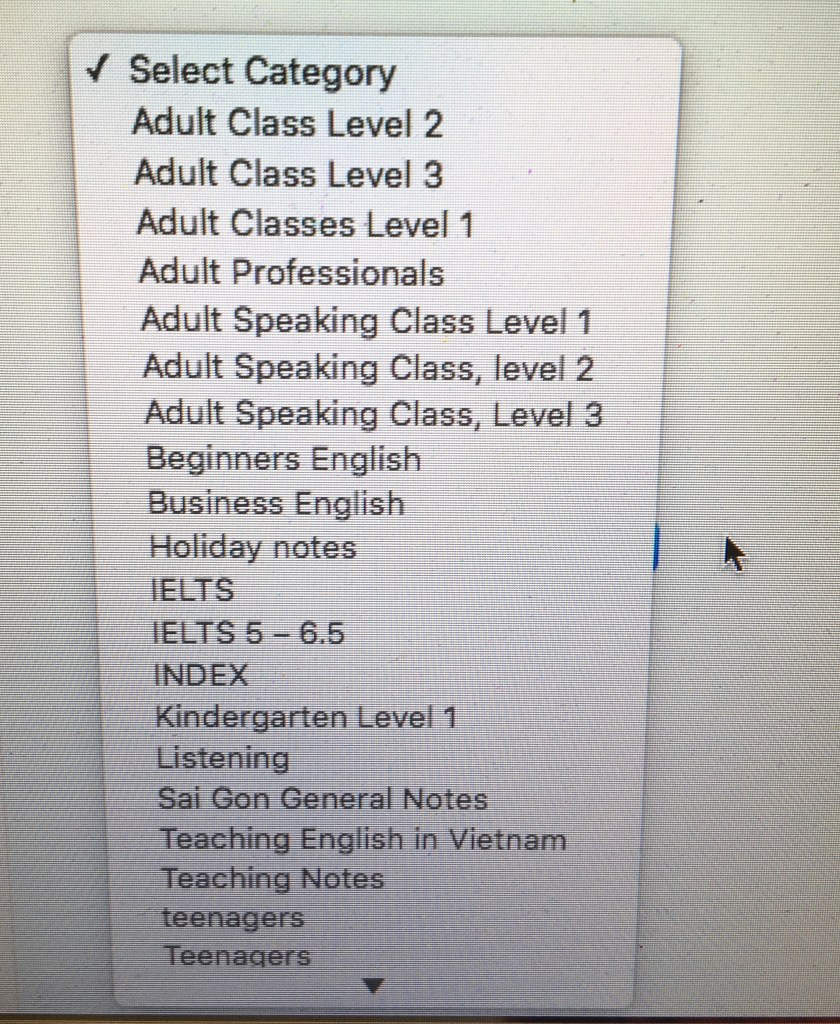
If you want to find blogs that are aimed at your level, scroll down (go to the very bottom of the page) until you see:
Classes
Then a box that says:
Select category
Click on the blue arrows and you will see a menu – a list of different classes and subjects.
Adult classes Level 1, 2 and 3
These are lesson plans and extra notes, work and information for students who are over 16. They are based on the text book my centre uses (‘American English File’).
Adult Professionals
English at a higher level, and specifically aimed at engineers and mechanics. The subject are often science-based, including various video clips for the English terms as well as an opportunity to hear native-English speakers.
Adult Speaking Classes, Levels 1 – 3
My own plans and teaching notes aimed at increasing the students’ skill, as well as affording the chance to use English, construct complex sentences, listen to ‘real-world’ English speakers and be introduced to various types of music. Many blogs are theme-based, focusing on different countries or subjects. The higher level blogs are primarily for my online followers.
Beginners’ English
Simple lessons for students who have started learning English. Lots of photos and basic grammar, vocabulary and help with speaking in sentences.
Business English
Exercises for people who have a good command of English, but want to cultivate their skills especially with regards to business, such as email-writing or interview techniques.
IELTS (4- 5.5 & 5 – 6.5)
Lesson plans for IELTS students, emphasising the requirements and expectations needed in order to pass the test with superb results. Contains extra work not covered in the class. Highly recommended for students who are serious about passing IELTS.
Kindergarten
Lesson plans with video links, photos and pictures to introduce young learners to English
Teenagers
Various lesson plans and links, photos and music.
Young Learners Beginners, Levels 1 – 5
Based on the ‘Everybody Up’ text book. Extra work and links to help bring the lesson alive and engaging for students aged 5 – 11.
Young Teens
Lesson notes for students aged 12 – 15. Ideas for class games and activities, video links and suggestions for improving language skills.
Additionally, there are various personal sections, recording various aspects of life in Sai Gon in general and Viet Nam in particular. These are generally written in a more natural style, so students will encounter new words, phrases and expressions.
These sections include posts on food and coffee … I LOVE coffee … accommodation, my holidays and general life here in Asia.
In terms of tone, I have chosen to adopt the attitude of Godard, Truffaut et al when they were writing their ‘Cahier du Cinema’ articles; why waste time writing about bad films, when you can write so much about GREAT films. To avoid any unnecessary argy-bargy or aggro, I try to focus only on the positives. Furthermore, I do NOT mention any schools or centres by name although if any prospective teacher has a question, I will answer in a direct mail.
Following on from the above, I do not post any photos of my current centre as it is private property and I have to respect their wishes. Ok, full disclosure, I did it ONCE and … there was a request that it be removed. Said photo highlighted the reality of teaching in Viet Nam … let’s just say that not all students are attentive, motivated and respectful.
Alternately, you may wish to study up on a particular subject.
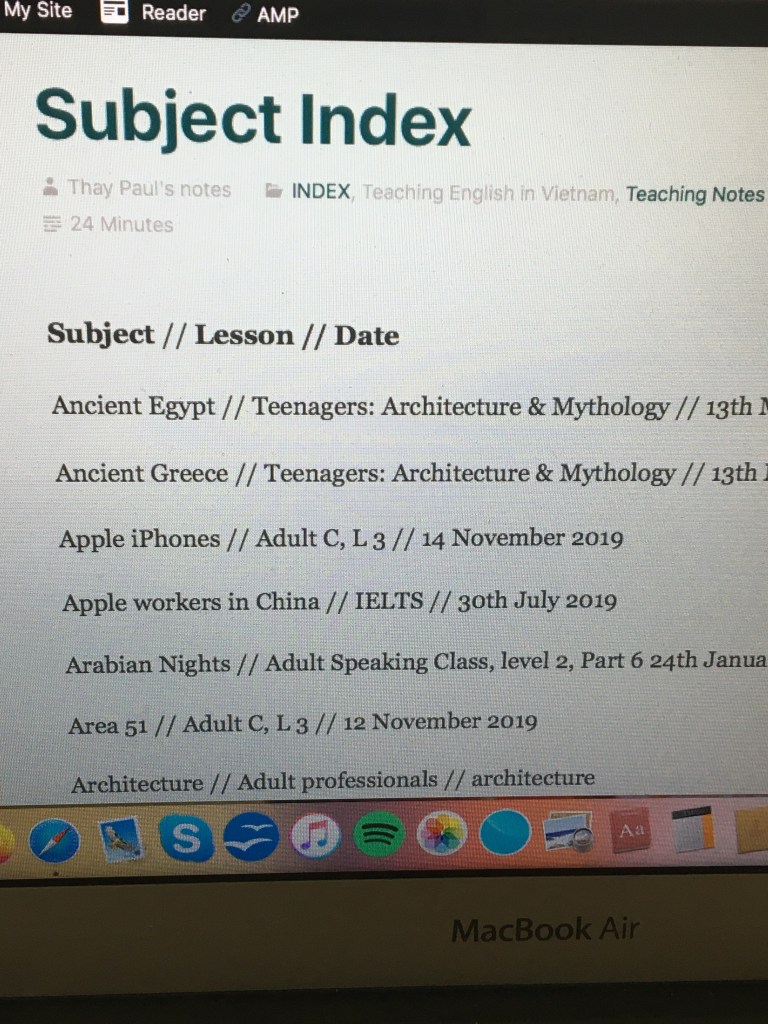
At the top of the page you will see ‘Subject Index’
Click and you will see a blog page:
The contents are:
Subject:
Dialogues: short conversation pieces for natural language practice.
Famous Quotes: used in the lesson: Shakespeare, philosophy, Bible, politics.
Films, TV & Theatre: list of media referenced in the blogs.
Grammar: blogs for all levels.
Games: activities and games for classes of all ages, including student surveys.
Music: list of artists and songs featured in the blog posts.
People: famous people mentioned or included in the lessons.
Photos: interesting photos used in the plans.
Thay Paul Photos: photos of the blog author. Not recommended !
Reading exercises: a very useful resource. Where to find English literature online, but in simple English, specifically for language students.
Sentence building: exercises to help students speak and write more fluently.
Speaking exercises: including grammar practice.
Video Clips: a one-stop list of all videos used in the blogs. Please note, sometimes video are removed from YouTube, or a certain clip will not play in a certain region.
Vocabulary building
Vocabulary exercises
Writing exercises and reading exercises links: a brief collection of useful links for students at a higher level.
So … how does it work, Thay Paul ?
It’s Easy.
Find a subject that interests you, look at the category and then the date.
Go to Classes and ‘Select category’.
Click on category
When that page appears, scroll down until you find the date.
You may have to click on the ‘older posts’ button to see more posts:
Hey, Thay Paul, can you give me an example ?
Sure can … OK, say, for example, you have an interest in seeing my blog on Apple iPhones. It is on an Adult Class, Level 3, from the 14th November 2019.
Go to Classes
Select category
Select Adult Class, Level 3
Scroll down, look down the page until you see 14th November 2019
And … Bob’s your uncle. Oh, sorry, that’s an English expression which means ‘there you are’ or you have finished your job or what you need to do.
So … hope this helped
This is Thay Paul saying … “Good Night … and Good Luck”
A compilation of games and exercises to increase your word power
Match the words with the meanings
Give the students some new vocabulary, teach them pronunciation and see if they can match the word to the definition. After, give them a chance to use the new words.
describe planned, in order, not a mess
imagine having to do too many things
typical feeling you have too much work
pressure normal, usual
organised to tell what something looks or like
community to think about something
stressed the place or area where you live
Practice:
The student was under ______ to finish the project on time.
All the neighbours are friendly. It’s a nice ________ to live.
Can you __________ what the man looked like ?
After teaching 20 young children, I felt very _________.
The German workers all knew what to do, they were so _______
Close your eyes and _______ you are relaxing on a beach.
On a _________ day, I drink coffee, go to work, come home and watch TV.
I think he could be a … / She seems to be …/ I get the impression that she is … / From his build, I’d say he was a … / Because of her appearance, I feel she must be a …
Personality adjectives (negative – arrogant). These are strong adjectives:
arrogant // self-obsessed // pretentious // obnoxious // full of themselves
Relative Pronouns
Let’s kick off with some basic information about my friend Pete:
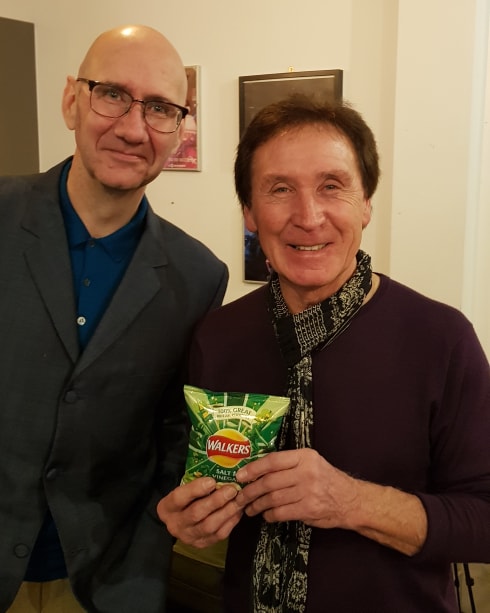
Pete (left) with drummer Kenny Jones of The Small Faces & The Who
Pete’s family are Irish. He was born in Kent, south England. He loves music especially Jazz and he can play saxophone, keyboards, guitar and bass. He is 40 years old. He is bald, and wears glasses. Currently he plays bass in a band called ‘The Deep Six’. They have a video on YouTube. In the photo, Pete is with the famous 60s drummer Kenny Jones. He was in The Small Faces. Later he joined The Who after their original drummer died.
Example:
Pete, who was born in Kent in the south of England, is of Irish heritage. Although he is just forty, Pete looks older, probably due to the fact that he is bald, as well as having to wear glasses. His great passion in life is music, especially Jazz, but his interest is not merely passive; he plays several instruments. In addition to saxophone and keyboards, Pete is proficient on guitar. Having said that, he actually plays bass now in a band named The Deep Six, who have a video on YouTube. Pete is seen here with the legendary drummer Kenny Jones whorose to fame in the 60s as drummer for chart-topping band The Small Faces before joining The Who following the death of their original drummer.
Now, a quick practice:
This is Wei Minzhi. She was born near Beijing. She was chosen to be in a Chinese film called ‘Not One Less’. She was 13. She played a substitute teacher but had no experience teaching (and no experience acting). The area is very poor. Some of the children have to leave school to work. The film was shown all over Europe, even at special film festivals. She was famous. She did no more acting. She studied in USA. She lives in Hawaii. Wei is married and has two children.
Small talk responses
A great way to increase conversation and use more natural language is to practise keeping conversations going for as long as possible. Think of it as verbal tennis – keep ‘hitting’ questions and responses at each other.
Example:
What do you do ?
I’m a student ?
Really ? Where do you study ?
Engineering.
That’s interesting. What branch (what area) of engineering ? Mechanical, electrical ?
And this be continued – where does the person study, does the student like the course, the university, the teachers, the fellow students etc.
Really ? // I see // Are you ? // Right // That’s interesting // That’s a good point // Where is that exactly ? // Oh, me too // Do you enjoy it ? // Do you like it there ?
Tourism
Now was a chance for some new vocabulary, words and phrases associated with holidays and travel.
Now is the perfect time to visit London, England’s glorious capital. The weather is perfect for walking, so you can enjoy the lush parks, world-famous museums and incredible, unbelievable shops. There is something for everyone … and more ! Like sports ? Go to one of the many Premier League football games. Love shopping ? Everything is here – shop till you drop ! Adore culture – soak up hundreds of years of history.
NOTE – the use of adjectives to really bring the presentation alive and make it exciting.
Flights from TSN airport daily. Seven-day all-inclusive package tour starting from only 50m VND ! All transfers and transport included. Air-conditioned mini bus with Vietnamese-speaking guide.
Travel
Students are put into small groups and take turns speaking. The topic shall be travel, and the students have to use the following:
amazing / attachment / incredibly / predict / first impressions / you’ve come to the right place
With all speaking exercises, it helps if the teacher or a top student models first, so that all the students understand what they have to do. I shall use the same words but my theme shall be food:
On Saturday, I was out shopping and I felt very hungry. I went into a restaurant and my first impression was not encouraging. It looked a bit dirty and I predicted that the food wouldn’t be very exciting. However, they had an interesting menu with vegetarian options, which was amazing ! I ordered some pho and salad and it was incredibly delicious. I thought to myself I’ve come to the right place. I took some photos so I’ll send them to you by attachment on my next email.
Travel – hotel recommendation
I’m planning a trip to Nha Trang (a beach town in South Vietnam, about an hour’s flight from Ho Chi Minh City). I have two hotels in mind, but I need advise from some Vietnamese. They also have to use as many of these words as possible:
visually stunning / mouth-watering / you get what you pay for / spectacular / a waste of money / significantly / somewhat / according to / how can I put it ?
Students must tell me about the hotels, the area, the food and which one they would choose for me:
Victory Hotel 2* Rooms not very clean, no view. No complimentary breakfast.
Sandy Bay Hotel 4* Much more expensive, although it has breakfast buffet, and room has a balcony with view of the sea.
Trip Advisor recommends Sandy Bay, but they said Victory was dirty and very over-priced.
Local food is great
WILF (What I’m looking for): can the students describe the scenery and food ? Can they compare price and quality difference ? Can they use expressions appropriately ?
With the adjectives, I’ll be listening out for intonation – ‘spectacular !’
To quote another source of information, ‘according to’ and for the prices, the 4* is ‘significantly more’ expensive than … Then, in conclusion, can they make a judgement – ‘a waste of money’ or accepting that high quality means high prices, ‘you get what you pay for.’
Travel: Life in Sai Gon
ubiquitous everywhere, very common
naïve innocent, inexperienced
stroll a gentle walk, for exercise (collocation: take a stroll)
a bazaar (noun) a permanent, covered market
bizarre (adjective) very strange, unusual
absent-minded extremely forgetful
sky-high, astronomical very expensive, maybe too expensive
messy untidy
laundry / laundromat dirty clothes / a place to wash clothes (collocation: do laundry)
predictable it is possible to guess the answer, people doing the same thing
hawkers
Street _______ are common in Vietnam, and they are _________ in District 1. It is nearly impossible for a westerner to take a ________ without being approached. Some claim to sell Ray Bans or designer sunglasses, but you would have to be extremely ________ to believe they are genuine ! They are all fake, probably made in China. Many people try to _____(collocation) money by selling to tourists especially around Ben Thanh Market, a kind of _______, though this is strictly for tourists as the prices are ____________ !
What Difference Does It Make ?
I give students a paper with two words or phrases that are related but different. They have to clarify the distinction, for example
26th November 2019. AEF 3 Listening Part 2 & Units 5 & 6 review (p.63)
Tonight, the lesson is heavy on listening and review. I try to get as much student-talking time as possible, so I’m got some ideas up my sleeve to, hopefully, lighten and brighten the class.
The topic is celebrity interviews, especially interviewing famous people who may be:
arrogant // self-obsessed // pretentious // obnoxious // full of themselves
Which of those words would, in your opinion, apply to these people:
Use opinion phrases (In my opinion, For me, He seems to be, I get the impression she is …)
a lawyerRonaldo celebrates a goal … but is this too much ?
A celebrity is anyone famous, but most often it’s an actor, musician, TV personality or just a regular person who has made the news (had a story about them in the newspaper, online media etc). Sometimes they can be arrogant or full of themselves in interviews. However, occasionally the interviewer may upset the star. What do you think is happening here [start at 04:23] in this Robert Downey Jr interview:
I have an assortment of activities for the speaking.
First up – small talk
I’ll hand out some papers with a short dialogue of small talk. This is basically learning how to keep a conversation going by using appropriate responses.
Students can use the following:
Really ? // I see // Are you ? // Right // That’s interesting // That’s a good point // Where is that exactly ? // Oh, me too // Do you enjoy it ? // Do you like it there ?
Then the students can pair up and ask each other questions such as:
Why are you studying English ?
Where do you live ?
Where would you like to visit ?
What do you do in your free time ?
What do you want to do in the future.
Students can change partners for each question.
Next up – Call My Bluff
Class put into two or three teams. Each team has a sheet with four words or phrases, followed by three definitions. A different member of the teams reads out a definition, embellishing the wording to make it more convincing. The opposing team have to guess the correct definition.
Finally, for a fun ending, the students can interview each other, but one pretends to be a difficult celebrity. They can use language from tonight’s lesson, or preferably, invent their own.
Please Note: All photos are taken from Google Images or free photo sites, and are used for educational purposes only. No copyright infringement or offense is intended. If I have used your photo or image, and you wish me to remove it, just ask. This site is not monetized, I run it on my own dollar. Thank you.
The first song is romantic; the man doesn’t care about money, he wants love. However, the lady sings, “I want your money !” This is called being materialistic, wanting expensive things and money.
Vocabulary – p. 154. Verbs pertaining to money.
Activity. You inherit a small fortune and want to splurge out (spend a lot of money). Working in small groups, tell what how you would spend your luxury day.
Plan a luxury day
To develop narrative writing and speaking skills, use words or phrases such as:
Firstly // Initially // I would start // It would kick off with …
secondly, thirdly etc
after that // afterwards // following that // and then …
for a change // as a contrast// for a break // to take a break from all the …
lastly // I’d end up // I’d round the day off with
See Barcelona play // Attend a play at a London theatre
OR add your own ideas
Where would you go ? What would you do ? What would you buy ?
Activity: Devil’s advocate.
This is to develop argument skills, how to politely disagree with someone.
Example: one student wants to buy a beautiful, luxurious Rolex watch. It really is an outstanding timepiece:
Without doubt, this is a luxury item. The pros …
It is gorgeous and so elegant. I will feel so special wearing it. People will admire and look up to me. They will think I am wealthy and have a great career. I will attract many cute women (or handsome men, whatever !). I may feel superior to other people who only have cheap watches or nasty fake knock-offs – like Thay Paul 🙂
Now play Devil’s advocate. Say what are the cons of owning such an item. Firstly, agree with the first student – it is without question a luxury item. Having said that …
It will attract attention … but maybe from thieves or pickpockets. It is a lot of money, maybe an obscene amount of money when so many people are poor. Can you justify living in a Socialist country and owning such a materialistic item ? Will it make you arrogant ? Will you think you are better than other people BECAUSE of a thing ? Finally … what does it DO ? Fundamentally, it tells the time. My fake Rolex will tell the same time … but it cost $20 NOT $ 5 000 !
Now students’ turn. Similar concept but this time, the latest iPhone:
The iphone 11 (woooooowwwwwwww !)
One student wants to buy it, the other must give reasons why it is not such a good idea.
Useful phrases: a waste of money / not necessary // a fashion accessory // you can’t afford it //
Role play game:
Three students will act out working in a department store, a shop with a sale on, and a street market. Other students have a set budget (say £100) and have to buy three items.
They can practice with the following language:
How much is this, please ? // Could you bring the price down for cash ? // Do you take plastic (credit cards) ? // If I smile, can you take off 10% ?
Wow, that’s a bargain ! // Sorry, that’s too much // Is that your best price ?
I’ll take it ! // Wrap it up ! // Let me think about it and come back // Sorry, that’s too much.
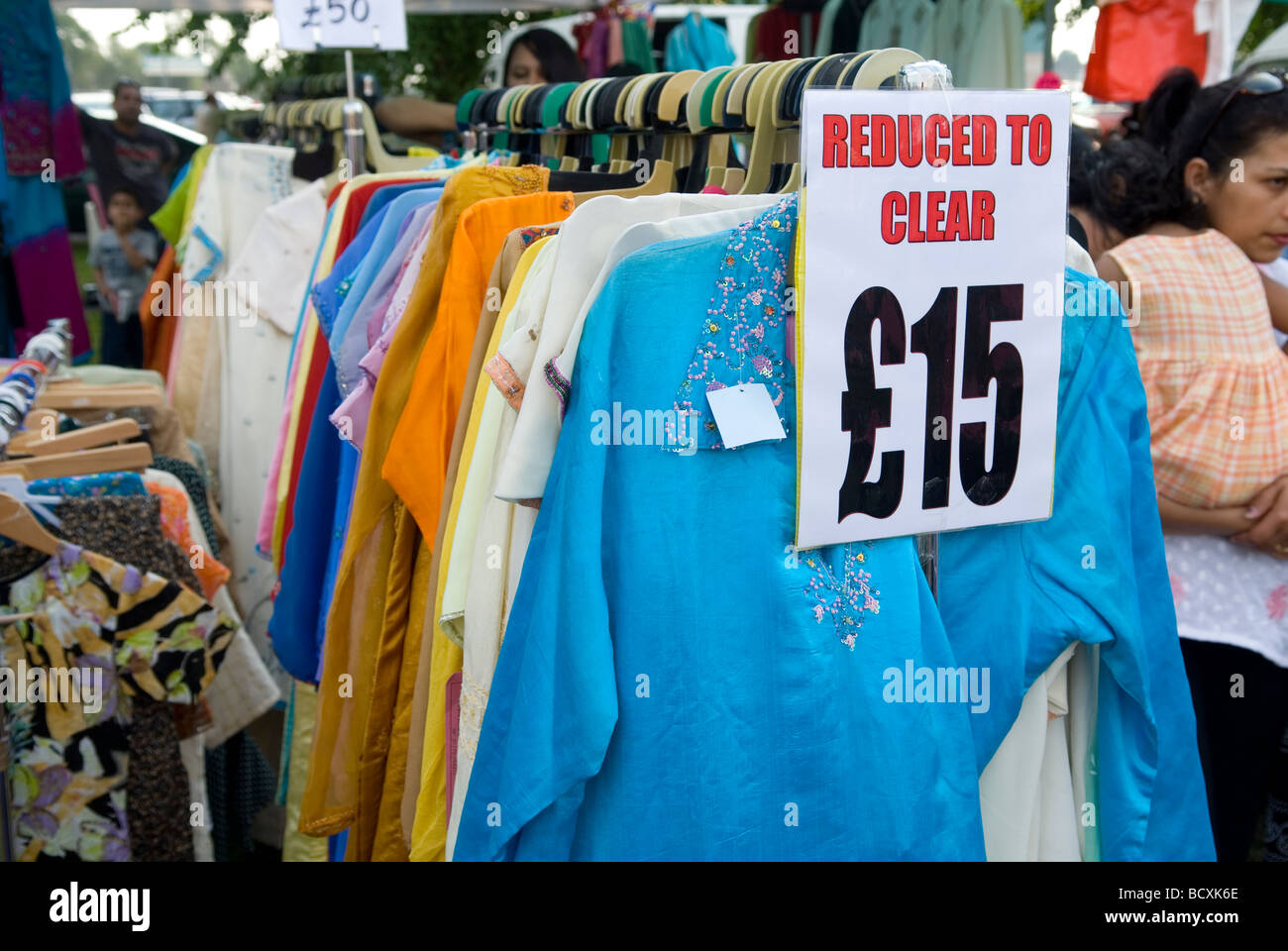
A department store selling expensive designer shirtsClothes on sale – ‘to clear’London street market.
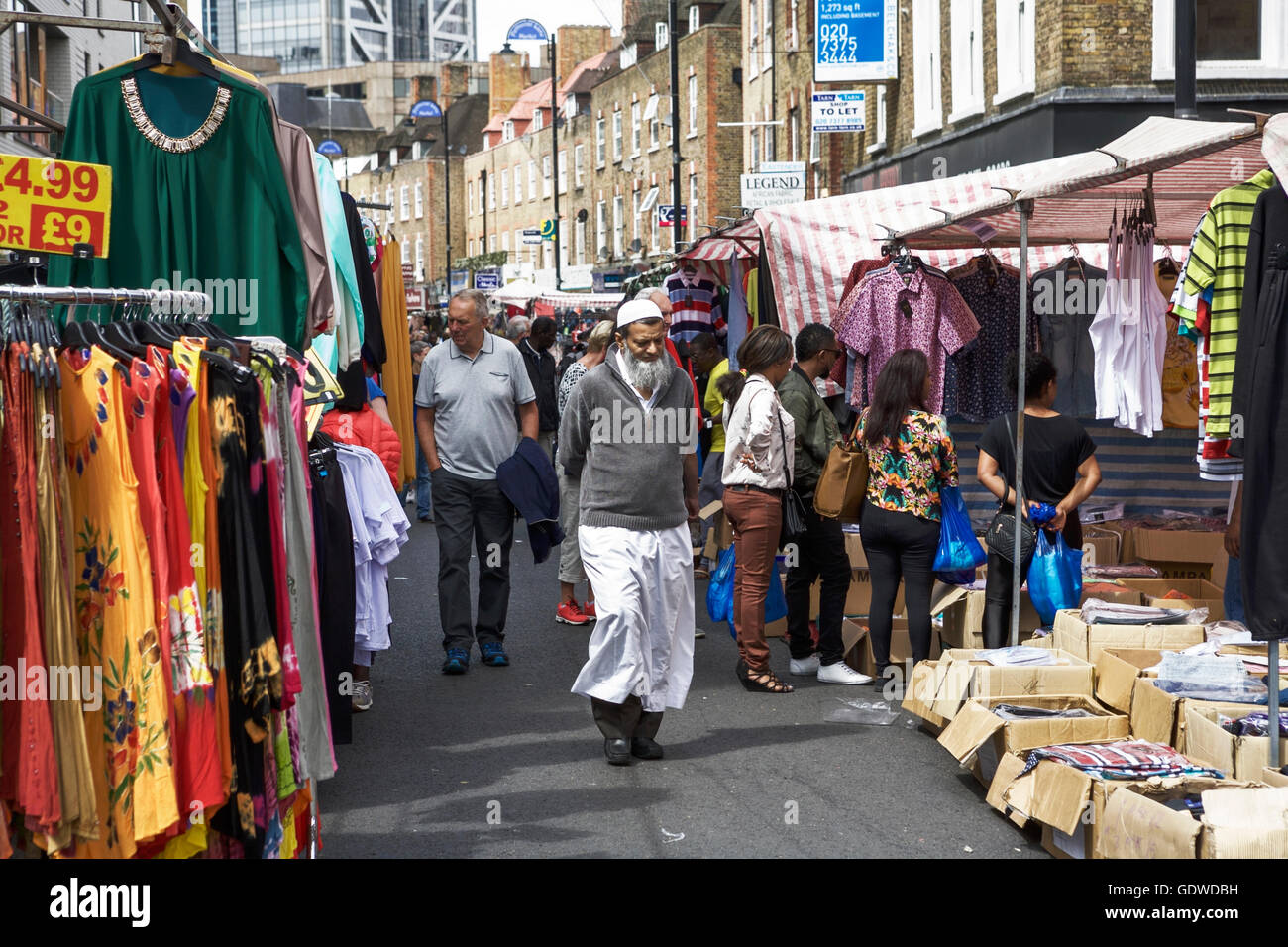
NOW – to make it more animated – the people working in the shops will no doubt be using different varieties of English. Let’s see if the students can alter their voices to portray an upper-class, well-spoken salesperson; a basic shop worker and a working-class street trader. I (old ham actor that I am) shall demonstrate. Yes, it’s not a conventional lesson but maybe the students will appreciate something different (even if the management don’t).
To end, I really want the students to gain confidence in speaking, so a lot of talking in small groups. I have various talking points they can discuss, and once they feel relaxed, we can play:
Just a Minute: students are given an open subject and must speak for one minute without deviation, hesitation or repetition. Other students time them and judge their performance.
Language review: students must give the correct word to a definition pertaining to tonight’s theme.
And then … take care, see you next week, later, dude !
In the UK, we do have a morbid fascination with murder. This man is Alfred Hitchcock who made films from the 1920s to the 1970s, mostly suspense, thriller or murder dramas. ‘Hitch’, who was born where I live in east London, made many famous films but in my opinion ‘Psycho’, which was filmed in black and white in 1960, is his best.
Do you know these British characters ?
What do the book titles mean to you ?
Sentence building:
Do you like to read murder mystery books or to watch murder films ?
Plan – don’t just answer ‘yes’ or ‘no’ ! Make a short introduction, just one or two sentences:
I enjoy all types of films, however I especially like a good mystery ….OR
I don’t really read much because I am so busy studying. However …
Say what film or book you like, tell me about the author and other books.
Tell me about the story and then why you think it’s good
Conclusion – “Maybe this book is not for everybody, but if you enjoy a great mystery story, then I would recommend it.”
Vocabulary building: Some useful words –
thrilling // suspense // gripping // well-written // superbly acted // atmospheric // creepy // scary // a page-turner // I was on the edge of my seat.
However, we must move from the world of fiction to the world of fact. Before we move onto a true story from the USA, let’s keep it closer to home.
What can the students tell me about Lê Hoàng Hùng ?
Students can work in small groups. They have five minutes to make a short presentation. Information can be found on these sites:
Then it’s time to get to tonight’s topic – murder, unsolved crimes and mystery. The lesson focuses on the mysterious death of the actress Natalie Wood. To introduce her, I’ll show a short clip of her acting, then the actual news report on TV on her death:
That clip, which has English captions, is from the film ‘Rebel Without A Cause’, from 1955. Now for the news footage:
Grammar: tag questions
Are you from Korea ? (a normal question, where we don’t know the answer)
You’re (you are) from Korea, aren’t you ? (using the tag ‘aren’t you’ to confirm what we think or know)
Take the pronoun (here it is ‘you’) and then the verb (‘are’). Invert the verb, that is, make it negative then add the pronoun. Hence ‘are’ becomes ‘are not’ = aren’t – aren’t you ?
Try these: First, decide on the appropriate pronoun (he, she, it, we etc).
Bangkok is the capital of Thailand, ……….. ?
Natalie Wood was American, …………….. ?
We still don’t know who killed her, ………….. ? (here the verb is negative, so make it positive)
He’s a brilliant actor, ………….. ?
For the remainder of the lesson, I want the students to talk, talk and talk (and, yes, I mean in ENGLISH !)
Firstly, they can review tonight’s book work and air their views, thus enabling them to review negotiation language (I see your point but …. // I can’t go along with that // you raise an interesting point // I’m not sure I entirely agree … etc).
Questions:
What did they think of the subject ? (interesting, relevant, morbid, inappropriate)
Do they enjoy reading as part of class time ? Do they feel that is a good way to learn ?
How was the listening ? How much could they follow (understand ?)
What is their opinion on the amount of new vocabulary encountered ?
Naturally, I expect other students to play Devil’s advocate – to argue a point even if they personally don’t fully agree with it.
EXAMPLE: “Playing Devil’s advocate, I would say the best way to learn vocabulary is to read new words and see how they are used in a sentence.”
Activities – Just a minute
Here, students work in pairs – there are given a very open subject (work, food, family, their hometown etc) and have to talk for one minute without hesitation, deviation or repetition.
Students can be given new questions and then made to change partners regularly.
Also, encourage peer help – allow the students to correct each other, as well as giving advice and encouragement.
And finally … Mysteries – what do you think ? True or false or … ?
The Loch Ness Monster from Scotland
Area 51 in Nevada, USA. Did an alien spaceship crash here and aliens come to earth ?
Please Note: All photos are taken from Google Images or free photo sites, and are used for educational purposes only. No copyright infringement or offense is intended. If I have used your photo or image, and you wish me to remove it, just ask. This site is not monetized, I run it on my own dollar. Thank you.
‘Tell me what you want, what you really, really want,’ in standard English or –
‘Tell me whatya want, whatya really, really want,’ in non-standard, with the linking sounds as well as the swallowed ‘t’ in ‘want’.
To counter the argument that this is not appropriate for an English lesson, I would say that students need to be exposed to a variety of Englishes … the linking and swallowing of words and letters is how many native speakers speak … as students will discover listening to films, TV and, as is the case here, music. What I listen for in my students, of all ages, is NOT a robotic, flat repetition of an abstract sentence, but intonation, linking and natural rhythm.
Next, I will board the remaining five jobs, but scrambled. The students, placed into two teams, must unscramble the chosen word (one student per team). One point for the first to complete, bang the board and shout out the word. Then, to add a variance, I will hold three flash cards, one of which will be the job. If they guess correctly, they earn an additional five points.
1 – a microphone // 2 – a piano // 3 – a paintbrush
Who uses clay, paint or metal in their work ?
1 – a scientist // 2 – a musician // 3 – an artist
Brad Pitt, Kirsten Stewart, Emma Watson and Robert Downey Jr are all famous …
1 – musicians // 2 – game designers // 3 – actors
Angry Birds and Candy Crush and Donkey Kong were made by …
1 – game designers // 2 – actors // 3 – Thay Paul
One student from each team will run to the board and slap a number … they can change their mind for five seconds but then they have to stay where they are.
British culture.
As a break, a little introduction to the UK and its history and traditions. The beginning of November sees Bonfire Night or Guy Fawkes Night
In 1605, a group of men wanted to kill the King of England, James I. They wanted to blow up the building where the King was going to be, so they hid 36 barrels of gunpowder under the building. However, the King’s soldiers found one of the men, Guy Fawkes, and arrested him. The King was safe ! To celebrate, people made giants fires called bonfires.
We still do this today. Also, children help to make a Guy Fawkes from old clothes and old bags, and then adults put it on the fire. Finally, there are fireworks, sometimes at home, sometimes in parks so everyone can see.
Some young children are holding sparklers – they have to wear gloves and be VERY CAREFUL.
What do you want to be or do ?
I will give the students boards and they have to write the three future plans. The last one (making movies, make a movie) is from a previous lesson, while the photo was taken in Berlin, Germany … long before my students were even born !
And now farewell … but next week, we leave the planet and go into space …
4th November for 5th November 2019 AEF 10A, pp. 94 – 95
Tonight we’ll discuss modern icons, titans of the business world, in both USA and Vietnam. It’ll be no surprise that Steve Jobs and Mark Zuckerberg, who are both from the USA, are included although Vietnam also has a number of wealthy, super-rich who may not be as well known on the global stage. However tonight, which is a special day in the UK, we’ll warm up with the story of Guy Fawkes whose image is now iconic. He is part of the history of London where I was born. If you don’t know the name, maybe you’ll recognise these:
In 1605, a group of people wanted to blow up (like a bomb) Parliament (where the government meet) during a visit from the King. The group were caught; Guy Fawkes was discovered in the cellar of Parliament with 36 barrels of gunpowder. All the conspirators were executed for treason.
A good history, with notes for English-language learners, can be found here:
Now, without further ado, tonight’s lesson: modern icons and, for grammar, relative clauses, hence the bold font earlier on the words who, where, which and whose.
I’ll be honest with you – this can be a little complicated, although it should be easy:
Relative pronouns
Who // for a person. Mark, who is from Chicago, is working in Ha Noi
Where // for a place. Ha Noi, where Mark works, is in north Vietnam.
Which // for a thing. The guitar, which is Japanese, was a bargain at £35.
Whose // possessive. The man whose guitar was stolen was very upset.
So far so good BUT … check this out:
London, where I was born, is the capital of the UK
London, which is in the south of England, is my hometown.
In a practice, we have an example similar to this:
London where I was born is the place which I love the most.
I’ve tried to think of a way to explain this in clear simple English … here goes !
In the first clause (London where I was born) we can ask “Where were you born ?” The answer is London. However, in the second clause (the place which I love the most) try the same pattern … “Where do you love the most ?” Here, the answer is “The place.” That is not a suitable answer – it is not a real location, so it becomes a thing – therefore we use which.
Oi troi oi ! English grammar !
Now, let’s put it into practise.
Mark Zuckerberg: born 1984 in NY, USA. Studied at Harvard. Co-founded Facebook. Net worth estimated at 70.3 billion USD (wow !).
Mark Zuckerberg, who was born in 1984, grew up in NY state which is in the USA. Harvard, where he studied, is the oldest university in the States (USA). Zuckerberg, whose net worth is estimated at over 70 billion dollars co-founded Facebook which is used all over the world.
Speaking of Facebook, one of my favourite films is ‘The Social Network’ about how the company was founded. The film, which was made in 2010, is scripted by Aaron Sorkin who is, in my opinion, a fantastic and highly talented writer.
Now try with Steve Jobs: born San Francisco // was a college drop out // first worked at Atari, a video games company // Apple computers were the first to utilise a mouse // co-founded Pixar in 1986 (what is Pixar ?) // died 2011, aged 56.
Now … team work. Class in two teams and they have to make a presentation about two Vietnamese business icons: Pham Nhat Vuong & Nguyen Thi Phuong Thao.
Students may use the internet and their own knowledge to tell me about these icons.
Give me the facts (where and when were they born, how did they get rich, what is their area of business ?) and use relative clauses to produce longer, complex sentences.
Students may, indeed I would encourage them to, use the internet and projector to bring their presentation alive. All members of the team must speak.
Team discussion:
Last week we covered negotiation language, phrases such as, “I see your point, but …” “I’m not sure I entirely agree with you,” “That’s interesting, however have you considered.
Today, the topics will be:
Do people spend too much time on Facebook ? Is it a good or bad thing ?
I need a new laptop; what should I buy, an Apple or Windows ?
I want to hear different points of view and people playing Devil’s advocate (arguing or making a point, even if you don’t personally believe it … just to encourage the opponent to develop their idea).
15-inch Macbook Pro at $2 399HP Intel Pentium 15.6 inch screen. $299 Windows 10
To encourage students, and to give them lexical resources, elicit some answers and ideas first, and board them, as well as introducing new concepts. What are the pros and cons ? The decisive factors ? What points should I consider.
With Facebook – is the answer binary (yes OR no ?) … it’s more interesting to discuss the middle ground, and illustrate it with personal examples.
I recently went on a short break to a nearby beach resort where I took many photos. I need to upload them to Facebook … or do I ? Does anybody REALLY care ? Can I really afford to spend the time doing it ? Or is it relaxing and pleasurable ? Does it enable my European friends to see a little more of my life here in Vietnam … what do YOU think … ?
I want my students to know present and past tense of common verbs, a range of adjectives (both positive and negative) and a good selection of nouns. Additionally, I’d like them to be able to put them together in long sentences, and start to use English contractions.
And so, to kick off (to start), a past tense exercise.
Ask your neighbour, “What did you do today ?”
I will give present tense verbs – students must use the past tense.
Example:
This morning, I go out and drink coffee: This morning I went out and drank coffee.
Later, I meet an old friend and we have lunch together and talk and laugh.
In the afternoon, I sit in the park, play guitar and sing songs.
Adverbs – these make your English more interesting and give more information.
Sai Gon is hot. Sai Gon is so // very // extremely // incredibly hot.
Sai Gon has delicious food – Sai Gon has extremely delicious food and it’s so cheap.
NOW – sentence building:
I love Sai Gon because it’s so hot. Additionally, the food is incredibly delicious and very cheap. However, it can be extremely noisy, dirty and polluted.
Tell me about Nha Trang: Speak about hotels / food / how to get there / things to do
Tell me about these clothes and the people:
Language to use:
beautiful / stunning / eye-catching
cotton / silk / leather / straw / denim (jeans)
short hair / medium-length hair / shoulder-length hair / long hair
teenager / young / in his 20s / middle-aged / elderly / old
Contractions: when we speak quickly, we contract (shorten words) to make a new sound.
Example:
I am = I’m / you are = you’re / he is = he’s / she is = she’s
I am happy =
You are sad
He is angry
She is very eye-catching
I will = I’ll (sounds like ‘eye – all’)
Tomorrow, I will go to work = Tomorrow, I’ll go to work
I’ll send you an email tonight
Call me after 5pm, I’ll be free then.
Conversation Practice:
I want to speak to my sweet lovely student Ms Tram. However, she is at work.
Caller: Hello, may I speak with Ms Tram, please ?
Receiver: Certainly. Who’s calling, please ?
Caller: My name is ……….
Receiver: I’m sorry, could you repeat that ?
Caller: No problem. My name’s ……..
Receiver: Could you spell that, please ?
Caller: Surely (of course) . . . . . . . .
Receiver: Thank you. Hold the line, please. I’ll connect you.
Caller: Absolutely. I’ll hold.
Receiver: I’m afraid Ms Tram has just gone to lunch.
Caller: Again ? She’s always eating hahaha.
Receiver: I’ll transfer you to her office, then you can leave a message.
Caller: Great idea. Thanks a bunch !
Receiver: You’re welcome
Finally, where did Ms Tram go for lunch ?
What did she order ? Did she like the food ?
Adjectives for food:
delicious / bland / spicy / filling / appetising / healthy / unhealthy / vegetarian / traditional
protein / carbohydrates / fat / fibre / vitamins /
fried / deep-fried / baked / boiled
Please Note: All photos are taken from Google Images or free photo sites, and are used for educational purposes only. No copyright infringement or offense is intended. If I have used your photo or image, and you wish me to remove it, just ask. This site is not monetized, I run it on my own dollar. Thank you.






























































 Thay Paul's Notes