Tonight’s class will focus on the town of Green Bank, Virginia (which is a southern state in the USA). Green Bank is a very small town. The population in 2019, according to Wikipedia, was 182 yet it has become famous as the town without Wi-Fi. Wireless internet is banned and mobile phones (cell phones USA) are unable to make or receive calls, nor can they send texts. The reason …
the world’s largest fully steerable radio telescope
Telescopes can be used for light or for sound. The above picture shows the radio telescope, which is 485ft tall, at Green Bank. It listens out for sounds from space. You may hear electromagnetic radiation in the class video.
Light and sound travel in waves. A star will emit light waves but electromagnetic radiation can also travel by radio waves. Giant telescopes are situated in areas with low light pollution while radio telescopes need to be in areas without Wi-Fi or mobile telephone, which can cause interference. You may have experienced this on an airplane when you are told to switch off phones during take-off and landing.
And so to work … as a warm up, get a partner or a small group and ask each other the following questions. Remember to encourage each other to speak in longer sentences and give reasons.
Could you live in a town with no Wi-Fi ?
What would you miss most if you had no phone or Wi-Fi ?
How important is your mobile phone to you … why ?
How often do you use Facebook ? Is it essential or fun ?
Do you think you spend too much time on social media ?
If you are with friends and your phone rings, or you get an alert, do you ignore it or stop talking to your friends ?
How to build sentences: explain your answers … ‘because‘ // such as … //
Tell me your experience: ‘For me, mobiles phones are …’ // ‘I couldn’t live without Wi-Fi because …’ // ‘I rely on …’
New vocabulary: essential // imperative // convenient //
It would be like losing an arm // a vital part of my life // I control my Wi-Fi use, it doesn’t control me // prohibitively expensive // I would lose my mind !
No preamble, let’s just dive in; how to boost your lexical resources.
Firstly, replace all your basic verbs with ‘better’ ones, L-FWs as IELTS refer to them. Thus, fifteen of the most common English verbs:
be
have
do
say
get
make
go
know
take
see
come
think
look
want
give
Activity 1: Assign three verbs to students (individually or in small groups). They must write a sentence (the more complex the better) utilising the substituted verb. Students can use a thesaurus for assistance.
Example: ‘give‘
I always donate my old clothes to charity.
Activity 2: Convert a simple sentence into a jaw-droppingly magnificent IELTS sentence, employing the whole spectrum of resources, by which I mean phrasal verbs, adverbs, LFWs, idioms etc.
Example:
I always donate my old clothes to charity.
I have to confess that one of my passions is shopping, be it at a mall, a street market or online. As a young person, I adore buying clothes, though I have to restrain myself as many items cost an arm and a leg. Naturally, I accrue a vast wardrobe. From time to time I have a good sort out, sometimes being quite brutal. If I haven’t worn something for, say, two years, then I get rid of it. However, instead of simply throwing them away, or giving to siblings or cousins, I choose to donate to various charities such as UNICEF, Save The Children or Cancer Research. That way, I can contribute to improving the world.
Study the above example. Can you pick out the elements that differentiate this from a basic English class response ?
Write down new vocabulary and make a point of using new words.
Observe how points are introduced, and answers expanded.
How many phrasal verbs are you familiar with ? How about fixed expressions (here I added ‘From time to time‘) which brings us nicely to our next section …
Fixed expressions
As far as I’m concerned // I can’t wait to … //
If there’s one thing that I (love, hate, detest) it’s … // I’m looking forward to … //
It may surprise you to learn that I … // It’s no surprise that … //
The first thing I’d going to do when I … // There’s nothing I like better than … //
Activity 3: Practice using these expressions
Example: After a hard day of teaching, there’s nothing I like better than watching a great movie. Only last night, I saw a fantastic film, ‘The Trial of the Chicago 7’ by Aaron Sorkin who is a highly respected American writer.
The previous blog demonstrated how to form complex sentences whereas this one will give you a chance to actually incorporate them into your everyday speech or, more importantly, your IELTS test which you will want to pass with flying colours.
Let’s dive in !
A typical IELTS question will be about your family. Time to show off your knowledge of adjectives and phrases.
Start with mother. Some positives:
My mother has a heart of gold // She is so kind and caring // She always puts others first.
On the other hand:
I’m afraid my mother is a ‘tiger mum’ // She expects too much of me // She is never satisfied with my work.
As for father:
My father is industrious and so hard-working // My father always has his nose to the grindstone, providing for his family // People say I take after my father // He is firm but fair.
On the other hand:
My father never lets me stay out // He drinks like a fish on holidays // He is a very strict disciplinarian.
Older brother:
He is my role model // I always look up to him // He looks out for me and takes me under his wing.
On the other hand:
My brother is a total slacker // My brother gets aggressive when he’s been drinking // My brother lacks ambition and drive.
Don’t forget sister:
My sister is a little angel // She has the sweetest soul // She has a kind word for everybody.
On the other hand:
My sister is such a prima donna // She only thinks of herself // She won’t lift a finger around the house // She spends all her money on herself.
Let’s extend the family: uncle, aunt, cousin etc. Remember, always be thinking of how you can use IELTS language such as idioms and expressions.
EXAMPLE:
Your uncle lives in a different city (how often do you see him ?) He has a great job, a lot of influence (an expression ?)
Tell me about the people you live with
Allow me to introduce my family to you. Firstly, there is my mother, who has a heart of gold, I can tell her anything. She’s always working, cooking or cleaning. I would say she is the biggest influence in my life. My father is very industrious by which I mean he gets up early, every day, works long hours at his office which is very far away. However, he likes to relax at holiday time. His brother, my uncle, who is a mover and a shaker, occasionally pays a visit at Tet (Christmas, Hanukkah etc) and the two of them drink like fish ! That’s because my uncle, who lives in (a far-away city), only comes to (your city) once in a blue moon.
Piece of cake, right ?
First, decide what idioms are appropriate.
Second, select some impressive L-FWs or phrases.
Finally … it doesn’t have to be true ! We are here to check your command of English, we are not going to check if your uncle really is a mover and a shaker !
Class work:
Ask each other the following questions. Check how many IELTS features the speaker uses, and give encouraging feedback.
Which member of your family are you closest to ?
Which member of your family do you take after ?
How often do you see your cousins, or grandparents ?
Is family important in your country ? Why ?
Do you want to live in a nuclear (small) or extended family ?
What qualities do you admire in your family ?
Now … think on your feet.
Tell me about your brother, who is an actor.
Tell me about your aunt, who teaches music.
Tell me about your cousin, who wants to study at Oxford.
Tell me about your mother, who demands that you get A++ for every exam.
What’s the best thing about being in a relationship?
What’s the best thing about being single?
What headings would you put these under ?
Life is more fun than being alone. Problems are easier to solve.
We have total, 100% freedom ! Do what we want, when we want.
We have less responsibility.
No lonliness
If you meet someone you like, you can ask them out on a date.
There’s a time to play and a time to settle down and raise a family.
No in-laws !
How do couples meet ?
How did you meet your: wife / husband / boyfriend / girlfriend / partner ? Or was it a blind date ?
Activity: Arrange a blind date for these three men. Which lady is the best choice … and why ?
How do you think the dates will be ? Will they keep meeting, maybe get married … or never see each other again ?
Peter
JamesDavid
PETER. Age 46. Lawyer. Likes cooking, travelling, wine, driving, tennis. Divorced, 2 children. Looking for a quiet lady with no children, to look after the house and him.
JAMES. Age 26. IT worker. Likes music, dancing, going to clubs, beach holidays. Single. Looks for young lady who is loud and fun, likes to party.
DAVID. Age 22. Model. Likes fashion, clothes, cocktail bars, smoking cigars. Looking for a women who is a model so we can look great together. Must be very beautiful and wear expensive clothes.
And now … the ladies:
Jane
LisaEmily
JANE. Age 22. Likes fashion, clubbing, kittens, holidays in the sun. Looks for a man with a steady job and ‘down-to-earth’. Non-smoker only.
LISA. 28. Banker. Likes quiet restaurants, badminton, travelling. Looks for a mature man with good income for long term relationship. No boys, please !
EMILY. 20. Likes dancing, fashion, going out with my friends. Movies. Wants a young, cute boy-friend so we can go to parties together. No boring old men, please !
And … if all goes well, there could be wedding bells
FREE SPEAKING: What is a traditional wedding in your country ?
In the UK and many western countries, the bridegroom waits in the church next to the Best Man, who has the rings. The church music starts and the Bride walks down the aisle next to her father, who will ‘give her away.’ Behind the Bride are her Bridesmaids. The Vicar will start the service. At the end, the Bride and Groom kiss.
Vocabularybooster
Match words with meaning
Honeymoon // a secret relationship
Romantic // promise to do something/ be loyal to someone.
Divorce // when people decide they will get married
After three or four lessons, I expect my students to know several common idioms (their meaning and how to use them appropriately), a number of low-frequency words (L-FWs), how to introduce an answer, how to form a complex sentence and to demonstrate varieties of intonation and stress.
Without these features, you ain’t gonna get above a ‘5’, no way. Therefore, time for a quick review, see how you’re measuring up to the standard, whether you need to turn over a new leaf and put your nose to the grindstone.
Therefore, let’s recap
Idioms:
it’s raining cats and dogs
it costs an arm and a leg
piece of cake
I’m burning the candle at both ends
once in a blue moon
pass with flying colours
turn over a new leaf
put your nose to the grindstone
Students putting their noses to the grindstone
Part 1: What do the aforementioned idioms mean ?
Part 2: Give each student an idiom. They have to use it, correctly, in a sentence.
absent-minded // sky-high, astronomical // an entrepreneur //
hawkersor peddlers // a mover and a shaker // consider //
Part 3: Students have to describe their neighbourhood, using as many L-FWs, and idioms, as they are able.
Students burning the candle at both ends
Introductions:
That’s a very interesting question
Well, that’s a great question
Well, there is so much to say about that subject, where shall I start ?
It’s funny you put that question to me because earlier today I was just thinking about …
As a young Vietnamese (add your own nationality), I …
Part 4: Students have to demonstrate they know how to introduce their answer.
What do you want to do in the future ?
Give them one minute to prepare a very short reply.
It’s funny you asked me that question because recently, I have been considering moving to Australia …
Complex Sentences:
Part 5: Moving on, students have to form complex sentences out of the following information, using intonation to reflect excitement or a positive point and, conversely, a negative factor. Discourse markers to be employed in order to link ideas, naturally. Furthermore, I shall be listening for adverbs and adjectives.
First, choose the correct relative pronoun (who, which, whose or where)
London //
capital of UK // many shops and museums // expensive and cold
Teacher John //
from New Zealand // smiles and plays guitar // talks too fast
Ironman //
real name Tony Starke // very rich and intelligent // is fictional
Thailand //
90 minutes flight from HCMC // friendly people, great food // many western tourists and crowded
ABC English Centre //
located in city centre, District 1 // use laptops and tablets in classes // lessons are four hours long, with extra homework.
Team work
Part 6: Class split into two teams. They have to plan a day in their city (here, of course, it’s Sai Gon) for my friend Ethan.
Describe these pictures, using adjectives and your opinions.
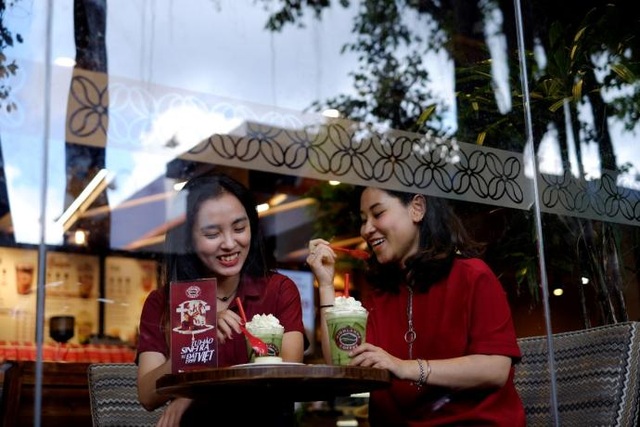
Highlands Coffee has great coffee, air-con and free wifi. Having said that, the service is a little slow, there are no waiters and the cost is unbelievably expensive !
Vietnam is famous for coffee; coffee shops are ubiquitous. In fact, there are so many, it’s hard to see (difficult to understand) how they stay in business let alone turn a profit.
Be that as it may, let’s use this as a learning opportunity. To practice making longer sentences, and as a warm up exercise, the students can ask each other, “Where do you go for coffee ?”
Tips:
Don’t answer the question directly and immediately; Begin with a short introduction:
Sai Gon has so many coffee shops, some are cheap while others can be quite expensive although they have a wide range of delicious coffee. Personally, I like going to …
Then
Explain:
How MUCH do you like it (adverbs) ?
What kind of coffee (adjectives) ?
What do you think about this ? (opinions)
WHY do you like it (give reasons)
Interesting words, phrases, idioms
Personally, I like Tap Coffee which is an independent shop where I live. I enjoy going there so much because the owner is very friendly and tries to speak English with me. There isn’t a lot of choice, so I order cappuccino with hot, fresh milk. In my opinion, it is good value and tastes delicious. What I like about the shop is the free wifi, the comfortable chairs and the atmosphere. Furthermore, it is usually very quiet and it therefore a good place to read. I love to put my feet up, kick back and sip my damn fine coffee.
Before the exercise, elicit and board as many relevant words and phrases as required. The students have a discourse marker list, so I could insist that they use certain words (moreover, therefore, consequently etc). Additionally, I’ll need to explain vernacular phrases such as ‘kick back’ and ‘put my feet up’.
IF a student doesn’t like coffee, then they can say where they go and what they drink. IF they don’t go anywhere or like anything (yes, I have had that in a class), then they can explain WHY NOT!
Key vocabulary: ambience // aroma //atmosphere
Grammar Note:
In a list of three, use one comma and a linking word (and):
The service is a little slow, there are no waiters and the cost is unbelievably expensive !
In a list of two, just use a linking word (and):
Mega Mart has amazing choice and is good value for money.
How to make Vietnamese coffee
Tell me: what do I need ? What type of coffee is best ? Where can I buy it ?
New verbs: pour / stir / fill up /
Make a long, fluent presentation.
Signpost expressions: used to help tell a story or a narrative. They allow the listener to help organise the information.
Useful words or expressions:
Firstly / afterwards / and then / following that /
don’t forget to … / you can always ….
lastly / finally / at the very end …
In your experience, what coffee is best ? Trang Nguyen, Highlands or Milano ? Maybe street coffee ?
Speaking practice:
Pat Well, I’m exhausted. I need a damn fine cup of coffee and a big piece of pie.
Sam There’s a Highlands over the road, or we can go to Coffee Bean or Milano.
Pat I’d prefer Tran Nguyen but it costs an arm and a leg. Highlands is also incredibly expensive.
Sam But great quality and superb cakes. Come on, I’m starving, I need coffee now !
Pat OK, hold your horses hahaha. After we can meet up with Thay Paul.
Sam Sounds good. Now … shall we have chocolate cake or fruit cake … ?
costs an arm and a leg = very expensive
hold your horses = please be patient and wait
Inside HighlandsCoffee Shop
Highlands Coffee, a Vietnamese coffee chain
Sam Hi, I’ll have a large cappuccino, please. What do you fancy ?
Pat Tough decision. I’m going for the cheesecake and a slice of blueberry pie.
Sam Oh, me too. Big slice, no, only joking, I have to watch my weight.
Pat I think you look great. Lets also get some chocolate cake and we can share.
Sam Brilliant. Oh, did I show you my recent photos ? Here, on my phone.
Pat Let me see … oh, so funny. Who’s that ? The man next to Niall ?
Sam That’s Jimmy, he’s in Niall’s band. He plays drums and drinks like a fish !
Pat And that’s you, a selfie. You look adorable. Butter wouldn’t melt in your mouth !
A very sweet young lady – butter wouldn’t melt in her mouth
drinks like a fish = drinks a lot of alcohol
Butter wouldn’t melt in your mouth ! = looks very sweet and nice … but can be very naughty
Let’s kick off with an old friend: Peter from England.
Peter
Age 24 // MA in Business Studies Born in Surrey, close to London Unemployed // Single //
Enjoys pubs, tennis and movies Wants to run his own company
From that information, build a complex sentence – basically combine two, three or more facts and connect them with relative pronouns and discourse markers:
Peter, who has a MA in Business studies, wants to run his own company.
Peter, who is from Surrey, enjoys pubs, tennis and movies.
From this point, the sky is the limit.
Despite being unemployed, Peter, who has a Master’s Degree in Business Studies, has entrepreneurial dreams of owning his own company.
Although he has an MA and is actively seeking employment Peter, who is from Surrey which is close to London, still finds time to indulge his passion for tennis, even becoming a member of an exclusive sporting clubs, whose membership fees are sky-high.
NOW …YOUR TURN
Write and then present a complex sentence about your partner. Gather some basic information, such as:
Age (if they are willing to say) // where they are from
Job or Study // Where they work or study //
What they like doing// What they dislike // Plans for the future
For Speaking Class level 2, I expect at least one relative pronoun (who, where, which, whose).
For IELTS, try for two relative pronouns, two L-FWs and at least one expression or idiom.
Vocabulary Review
You should be familiar and able to use these words at the drop of a hat:












































![Four best hairstyles for Kenyan women [Photos]](https://thaypaulsnotes.com/wp-content/uploads/2020/11/image-42.jpeg?w=225)



 Thay Paul's Notes