Happy St Patrick’s Day – St Patrick being the patron saint of Ireland, a country famous for enjoying a drink … and then some ! In Chicago, which is a bustling, vibrant city in USA’s mid-west, the river is coloured green. However, too much
Guiness will give me a bad headache the following morning. I will definitely have a hangover. That means it’s time to stop drinking so much, I need to change my bad habits … which brings us to an idiom for my new class; it’s time to turn over a new leaf.
In this case, a four leaf clover for good luck.
So, we have a new class and they need to start learning language that will help them ace the IELTS test.
Let’s hit the ground running and recap the basic idioms you’ll be using every week, as well as the new vocabulary from last night. Are you ready … ?
Let’s go !
First off the bat, some basic idioms:
it’s raining cats and dogs
it costs an arm and a leg
piece of cake
I’m burning the candle at both ends
once in a blue moon
pass with flying colours
turn over a new leaf
put your nose to the grindstone
These are the basic idioms I introduce, as they can be employed in many situations.
A good introductory blog, with IELTS tips and advise may be accessed here:
Let’s hit the ground running and put it to the test – what idioms would you use ?
Taxis in Sai Gon are very expensive, they _______
I want to get a high score, I want to ______
We can’t go out in the rainy season because it’s always ____________
You need to stop going out every night and missing school. You need to _____________
The test was so easy, it was a __________
She works all day, then studies all night; she’s _________________
I must be more serious about learning Vietnamese. I have to _______
Ms Liêu simply adores Champagne however, because it _____________ , she only drinks it __________________________________.
Last night’s class also generated some additional idioms, expressions and vocabulary, to wit:
bear with me – please wait a very short time
like a madhouse – a place or area that is crazy, too noisy, too busy etc
Kick the bucket – UK idiom, very informal, means to die
My hands are tied – I am obliged to do something, I have no choice
An expression – to kill two birds with one stone – to achieve two different results by doing one action:
“Hey, let’s meet at the coffee shop. We can meet up and work on the project at the same time.”
I also introduced you to borrowed words – vocabulary from other languages. Our first example derived from Italian – lingua franca (a common language)
EXAMPLE:
I am studying English, which is incredibly important, because it is a lingua franca meaning it will enable me to communicate with people from all over the world.
Furthermore, we covered some adjectives to describe various neighbourhoods:
gritty / industrial
quite / safe / residential
boring / peaceful / suburban
bustling / vibrant / city centre
Extra advise – any time you hear a new word or expression:
Finally for Ms Dương, who expressed concerns over the amount of vocabulary one needs to learn, here’s the quote from the Chinese philosopher Lao Tzu (C6thBC) :
I have conducted a number of speaking tests recently and noticed some areas where students can, with very little effort, boost their scores.
Remember, IELTS requires you to demonstrate that you will be able to live and study in an English-speaking country.
Firstly, there is fluency: are you able to speak without hesitation ?
Secondly, is your vocabulary broad enough ? You will be studying at university level (1) therefore you should be acquainted with low-frequency words (L-FWs), while living in an English-speaking country will necessitate you being familiar with phrasal verbs, idioms and expressions that comprise the bulk of everyday language.
Obviously, grammar is imperative, especially the ability to form complex sentences. You will need to combine several pieces of information in one sentences, using clauses and discourse markers.
Finally, pronunciation; this is not merely the clarity and accuracy of your speech, but features such as intonation, stress, pacing, body language, rhythm, chunking … features which are best learnt by listening to native-speakers and imitating what you hear (2).
To sum up, if you have been disappointed by your score, listen to the feedback your instructor gave you, and work on those areas.
(1) Even if you study in your home country, many textbooks are only printed in English. I’ve known friends from Greece, Sweden and Germany who had to use English language books
(2) There will be an incredible variety of accents, dialects and linguistic features within one large city, but for the purposes of teaching, I’m referring to features that may be particular to English, namely adding the letter ‘s’ to form plurals, how words ‘run into’ one another and how less important words are swallowed, while key words are stressed.
No preamble, let’s just dive in; how to boost your lexical resources.
Firstly, replace all your basic verbs with ‘better’ ones, L-FWs as IELTS refer to them. Thus, fifteen of the most common English verbs:
be
have
do
say
get
make
go
know
take
see
come
think
look
want
give
Activity 1: Assign three verbs to students (individually or in small groups). They must write a sentence (the more complex the better) utilising the substituted verb. Students can use a thesaurus for assistance.
Example: ‘give‘
I always donate my old clothes to charity.
Activity 2: Convert a simple sentence into a jaw-droppingly magnificent IELTS sentence, employing the whole spectrum of resources, by which I mean phrasal verbs, adverbs, LFWs, idioms etc.
Example:
I always donate my old clothes to charity.
I have to confess that one of my passions is shopping, be it at a mall, a street market or online. As a young person, I adore buying clothes, though I have to restrain myself as many items cost an arm and a leg. Naturally, I accrue a vast wardrobe. From time to time I have a good sort out, sometimes being quite brutal. If I haven’t worn something for, say, two years, then I get rid of it. However, instead of simply throwing them away, or giving to siblings or cousins, I choose to donate to various charities such as UNICEF, Save The Children or Cancer Research. That way, I can contribute to improving the world.
Study the above example. Can you pick out the elements that differentiate this from a basic English class response ?
Write down new vocabulary and make a point of using new words.
Observe how points are introduced, and answers expanded.
How many phrasal verbs are you familiar with ? How about fixed expressions (here I added ‘From time to time‘) which brings us nicely to our next section …
Fixed expressions
As far as I’m concerned // I can’t wait to … //
If there’s one thing that I (love, hate, detest) it’s … // I’m looking forward to … //
It may surprise you to learn that I … // It’s no surprise that … //
The first thing I’d going to do when I … // There’s nothing I like better than … //
Activity 3: Practice using these expressions
Example: After a hard day of teaching, there’s nothing I like better than watching a great movie. Only last night, I saw a fantastic film, ‘The Trial of the Chicago 7’ by Aaron Sorkin who is a highly respected American writer.
The previous blog demonstrated how to form complex sentences whereas this one will give you a chance to actually incorporate them into your everyday speech or, more importantly, your IELTS test which you will want to pass with flying colours.
Let’s dive in !
A typical IELTS question will be about your family. Time to show off your knowledge of adjectives and phrases.
Start with mother. Some positives:
My mother has a heart of gold // She is so kind and caring // She always puts others first.
On the other hand:
I’m afraid my mother is a ‘tiger mum’ // She expects too much of me // She is never satisfied with my work.
As for father:
My father is industrious and so hard-working // My father always has his nose to the grindstone, providing for his family // People say I take after my father // He is firm but fair.
On the other hand:
My father never lets me stay out // He drinks like a fish on holidays // He is a very strict disciplinarian.
Older brother:
He is my role model // I always look up to him // He looks out for me and takes me under his wing.
On the other hand:
My brother is a total slacker // My brother gets aggressive when he’s been drinking // My brother lacks ambition and drive.
Don’t forget sister:
My sister is a little angel // She has the sweetest soul // She has a kind word for everybody.
On the other hand:
My sister is such a prima donna // She only thinks of herself // She won’t lift a finger around the house // She spends all her money on herself.
Let’s extend the family: uncle, aunt, cousin etc. Remember, always be thinking of how you can use IELTS language such as idioms and expressions.
EXAMPLE:
Your uncle lives in a different city (how often do you see him ?) He has a great job, a lot of influence (an expression ?)
Tell me about the people you live with
Allow me to introduce my family to you. Firstly, there is my mother, who has a heart of gold, I can tell her anything. She’s always working, cooking or cleaning. I would say she is the biggest influence in my life. My father is very industrious by which I mean he gets up early, every day, works long hours at his office which is very far away. However, he likes to relax at holiday time. His brother, my uncle, who is a mover and a shaker, occasionally pays a visit at Tet (Christmas, Hanukkah etc) and the two of them drink like fish ! That’s because my uncle, who lives in (a far-away city), only comes to (your city) once in a blue moon.
Piece of cake, right ?
First, decide what idioms are appropriate.
Second, select some impressive L-FWs or phrases.
Finally … it doesn’t have to be true ! We are here to check your command of English, we are not going to check if your uncle really is a mover and a shaker !
Class work:
Ask each other the following questions. Check how many IELTS features the speaker uses, and give encouraging feedback.
Which member of your family are you closest to ?
Which member of your family do you take after ?
How often do you see your cousins, or grandparents ?
Is family important in your country ? Why ?
Do you want to live in a nuclear (small) or extended family ?
What qualities do you admire in your family ?
Now … think on your feet.
Tell me about your brother, who is an actor.
Tell me about your aunt, who teaches music.
Tell me about your cousin, who wants to study at Oxford.
Tell me about your mother, who demands that you get A++ for every exam.
once in a lifetime experience / never to be forgotten / unbeatable prices / book now to avoid disappointment / best decision you’ll ever make
holidays to suit all budgets , from 7* luxury to backpacking
Structure:
To begin with / furthermore … additionally / the fact is … / therefore
Demonstration with an advert for London:
Now is the perfect time to visit London, England’s glorious capital.
To begin with, the weather is perfect for walking, so you can enjoy the lush parks, world-famous museums and incredible, unbelievable shops such as Harrods, Selfridges and so many more.
Furthermore, there is something for everyone … and more ! Like sports ? Go to one of the many Premier League football games. Love shopping ?
The fact is, everything is here – shop till you drop !
Additionally, if you adore culture – soak up hundreds of years of history.
Flights from TSN airport daily. Seven-day all-inclusive package tour starting from only 50m VND ! All transfers and transport included. Air-conditioned mini bus with Vietnamese-speaking guide.
Therefore, don’t delay … book TODAY !
Sell a holiday
Advertising vocabulary and intonation
Prepare a presentation to market / sell a holiday.
Review: New vocabulary
sensational / once in a lifetime / luxury / all-inclusive / unforgettable experience / mysterious / majestic / breathtaking / visually-stunning
book now to avoid disappointment / exhilarating / world-famous
local food / new cultures / visit our website / worth every penny
fun for all the family/ the perfect getaway /
Plan a tour of your city for my friend
My friend Ethan is coming to visit your hometown
It is his first time in your hometown. He likes history, traditional food, and he wants to buy souvenirs.
Think about:
What time to start
What to do first
Logistics – how Ethan can get around the city (subway, bus, taxi, Grab or Uber)
Food – where to eat and what to choose. Remember, he only speaks English
Where to go (remember the heat OR the rain could be an issue / a problem).
I start by writing the word ‘travel’ on the board, and see how many avenues spread out from it. Start with the grammar; what type of word is it (noun) but it can be made into a verb (to travel, travelling) and the students should remember how to apply it to a person (traveller).
Then we have expressions such as ‘travel broadens the mind.’
We have this quote which introduces metaphor – the world as a book:
Then more pedestrian aspects of travel; how do we travel (transportation), preparation (booking tickets, hotels, visas etc), what do we bring with us (different clothes, sun cream, currency, sun glasses etc). How about culture shock ?
Next, what are the positive aspects of travelling (new cultures, fun, adventure, relaxation) and conversely, the negatives (delays, waiting in soulless airports, getting ripped off, tourist traps, bad hotels etc)
Pair work: students have to write a short passage using ‘although‘ and ‘despite‘ to encapsulate their travel experiences or wishes.
EXAMPLES: Although I absolutely love travelling, there are many drawbacks. Firstly, there is the cost; it can be incredibly expensive what with plane tickets and hotels not to mention having to eat out in restaurants. Despite these issues, travelling can be so relaxing or exciting, seeing new places and doing new things or simply as a break from our normal lives.
Vietnam has many beautiful towns and places of interest although I have only been to a few of them despite travel being relatively cheap in this country. We can fly everywhere within one or two hours, at very reasonable prices although some cheap airlines, such as Vietjet, are notorious for delays.
I have always wanted to visit Beijing in China which is not excessively far from Sai Gon. Despite that, I haven’t been because I am not sure about the visa and how expensive it would be to visit. Additionally, I hear some negative things such as terrible pollution and many tourist scams. Despite the drawbacks, I really want to see the Great Wall, the Forbidden Palace and all the temples. Although Vietnam and China have a complicated relationship, most Vietnamese would agree that Chinese food is delicious.
These exercises help to increase vocabulary and confidence. Furthermore, the repetition helps to make the target language part of the students’ lexical resources.
As a break from the book work, I’ll show the class a vlog from YouTube, two tourists who come to Sai Gon and what they think of the city: https://www.youtube.com/watch?v=2iw_K-1AmVk
How do the tourists feel about the city ? As residents, do you agree with the review ?
Students can discuss the video using the following language:
I agree totally // I agree to an extent // I disagree // I’m not entirely sure // No way ! They don’t know what they are talking about !
Group work: Prepare a guide to Sai Gon for tourists.
Allow students access to the class computer for Google images if required.
Include
What to see and do // where and what to eat // what to buy //
What they can do for entertainment
Travel tips
Safety and scams
Cultural differences – what should people do or NOT do in Vietnam ?
Use of interesting adjectives to describe the city centre.
Groups can then present to the class, with all students taking turns speaking. I shall be listening for relevance, pronunciation and use of expressions and discourse markers. Furthermore, I may learn some interesting tips.
My friend Andy is coming to Sai Gon
Using ‘should’ to give advice or information, make suggestions for Andy.
He loves history … what should he visit or see ?
He loves traditional food … what should he eat ?
He can’t ride a motorbike … how should he travel ?
He likes a beer a night (!) … where should he go ?
My Thai friend is coming to Vietnam:
Ms Namsum is young and energetic. She’s into (really enjoy) clubs, sightseeing and shopping.
I suggest she starts the day with a traditional bowl of pho then goes to Sai Gon centre. She can walk there from her hotel in District 1 or take a taxi (Vinasun or Malin ONLY). She will be out of the heat and has a lot of shopping choices and places to eat or grab a coffee. She could rest at her hotel in the afternoon, then go to Nguyen Hue walking street when it gets cooler in the evening. She has many restaurants in this area. Furthermore, there are many English-language menus. Finally, she can go to Bui Vien street where there are many clubs and bars, as well as many tourists speaking English.
What do they students think ? Is that a good plan ? Have I missed something important ?
Language to use:
I see your point
That’s a good idea but …
If I may make a suggestion …
I’m not sure that’s such a good idea.
For example – That’s a good idea but you haven’t thought about sightseeing.
Or
Bui Vien can be very noisy so I’m not sure that’s such a good idea for a young lady on her own.
Two of my friends, Tom and David who are both actors, are coming to Sai Gon. The students, in groups, have to arrange a fun day including sightseeing, shopping, eating and transportation. Then they have to compare their itineraries and exchange views and opinions. The students learn how to politely disagree with each and put forward their ideas and support their choices.
Tom and David
PLAN A DAY FOR TOM & DAVID
Where can they eat ?
What could they see or visit ?
How can they travel around ?
What can they buy as souvenirs ?
Where could they go at night ?
What safety advice would you give ?
What you need to know:
Both are 45-years old. They have good jobs and a good income. They like history and culture. They really enjoy good food and wine. Neither speaks any Vietnamese. They are too old for very loud clubs but they don’t mind having a few beers and maybe seeing some live music.
The students can make a presentation, and use the computer for images or maps to illustrate their plan. Then the other team can explain what they have organised, and the reasons why. I will decide which team has made the best choice.
Activity: Plan a day out for my friends.
Thay Paul with Tina and Michael.
I have two friends arriving in Sai Gon (or your city). They want a typical, authentic experience. Plan a day for them. It must include:
Breakfast
A museum
Somewhere for a snack
An interesting building or location
Lunch
Souvenir shopping
Something to do in the evening
Give tips and advice.
How do they travel around ?
What are their options and estimate the prices.
Try to use as much new vocabulary as possible, words and expressions.
Directions to Pham Ngo Lao Street District 1 // Directions to a city centre street.
Ask for help. Other must offer as much help – how to get there, the best way, the price, the dangers. Body language – distance, expression, intonation, eye contact etc
Is Sai Gon safe ?
Can you understand Vietnamese people speaking English ?
Do you agree with their points ?
Are there any words you didn’t understand ?
Do you have any bad experiences ? Tell the class your anecdote.
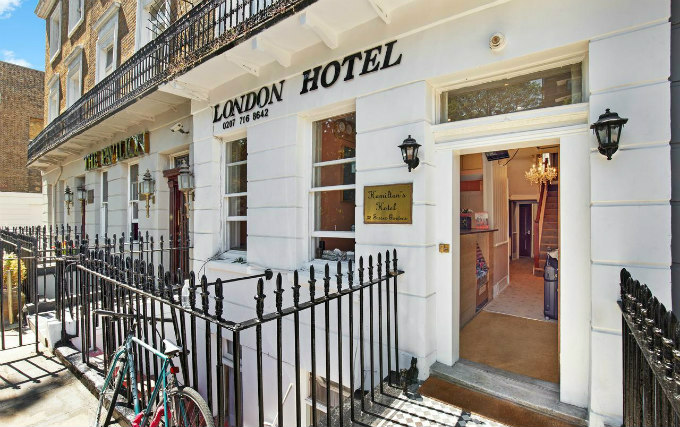
Word bomb– what do you think of when I say ‘hotel’ ?
Checking in to a hotel
Vocabulary:
reception / lift or elevator / single or double room / king size bed or twins /
first floor / complimentary breakfast / key deposit / luggage storage / safe / mini bar
What would the conversation be ?
Reception: How may I help you / May I ask your name ? / Can I see your reservation code ? / That’s fine. You stay for three nights ? / May I have your passport, please ? / You’re in room 237. That’s on the second floor / Thank you. Sign here, please / Yes, the lift is just over there. / Naturally, as well as a hair dryer, coffee machine and mini bar. / Enjoy your stay.
Guest: Hello, we have a reservation / We booked a room online / My name’s ….. / Certainly, it’s on my phone. / Yes, that’s right. / Absolutely. / Correct. / Just a second; here you are./ Is there a lift ? / The second floor ? / Is there a safe in the room ? / Perfect. Thanks very much
Make a conversation. One student will be the reception, the other(s) a guest or guests.
Write your own conversation
You are in a hotel bar and you meet another guest. Start a polite conversation, but you have to use your English.
Greet each other
Why are you in this city ? (holiday or on business)
Offer to buy a drink (accept or decline – maybe you don’t drink alcohol)
How long are they staying ? What do they think of the hotel ? What can they do in the area around the hotel ?
Small group work
You are two married couples who meet on a tour and are staying at the same hotel OR you are on a business trip and meet some other business people.
Use the following sentences, as well as your own, to make a conversation. try to keep speaking for as long as possible by using small talk techniques (oh, really / that’s interesting / tell me more / what do you do exactly ? / where is that ? / Sounds interesting)
My wife and I are delighted to meet you
Shall we go to the bar or cafe ?
Can offer name first (I’m Simon, what’s your name ?)
Would you fancy a drink … ?
Is there anywhere special to do here ?
Sorry, I have to get my head down, it’s been a long flight (I need to sleep).
My colleague and I were going out to eat.
I fancy a beer or something alcoholic
Oh, I’m sorry, I didn’t ask where you are from.
Reasonable (cheaper)
Would you like to join us ?
Peckish (little hungry)
What do you think of these hotel rooms ?
What do you think of the design ?
Would you like to stay in any of these ? Why, or why not ?
Sometimes students arrive at class after a long day, bereft of energy and motivation. In such situations, it’s best to hit the ground running, get them talking and ready for a lesson. This needs to be done before they pull out their mobiles and start concentrating on their cyberlife … after which time, they are lost to reality.
Therefore, before they can hit that ‘Post’ button, pair them up and make them ask each other various questions, demanding that the answers be as complex as possible, incorporating big words (‘Low-Frequency Words’), discourse markers and relative pronouns, along with appropriate expressions.
Example: Where would you most like to visit ?
Bad answer: Nowhere. Bad answer: New York.
Better answer:
Introduce your answer THEN state the location THEN explain why.
Ah, that’s an interesting question because I really need a holiday. However travelling now is not a good idea because of the COVID 19 which is an extremely serious pandemic. So, I have to think about after, when it is safe to go on holiday.
I have always wanted to visit Singapore, because it looks so clean and modern and, not forgetting, so many shopping malls. I love shopping, it is my passion. I would buy so many things such as clothes, makeup and presents for my family.
IELTS students should be able to add a number of idiomatic language to really spice up their presentation. I would expect to hear:
cost(s) an arm and a leg / prices (can be \ are) sky high / mouth-watering / world famous / ubiquitous / pristine / that’s a bit of a sore point (because we CAN’T travel) / such a wide array / shop till (I \ you) drop / overwhelming / spoilt for choice / retail therapy
Remember … there are some affordable shopping areas in Singapore although they tend to be away from the city centre but well worth a visit.
NOW … your turn
Questionnaire / Discussion
What kind of music do you like ? (do you play or listen ?)
Can you name any plays by Shakespeare ? (if not what writer do you like ?)
What time do you usually get up ? (weekdays and weekends)
How do you relax ? (do you have time or do you study, have family, work overtime ?)
Can you play a musical instrument ? (would you like to ? Why ?)
What skill(s) would you like to acquire ? (be creative here – what stops you learning ?)
What is the best thing about Sai Gon ? (or YOUR city)
However, this is not a one-way street. The person asking is expected to make small talk, to elicit – to encourage – the speaker to open up and expand on their answers.
Use small talk phrases such as:
Really ? That’s interesting // Tell me more // Why do you say that ? // Oh, me too // What do (did) you like best // Where is that (exactly) ? // I’ve heard about that // I haven’t heard about that, can you explain // Why do you say that ? // Oh, I get it // I’m not sure I follow.
And if your partner is stonewalling you (not talking), here’s a great idiom:
The Bash Street Kids … from ‘The Beano’ which is a famous comic from the UK, first issued in 1938.
Tonight we have a listening lesson which, although tremendously important, not to say imperative, can be somewhat tedious for the students.
One factor is the vocabulary. If students don’t know some of the words, they will not be able to answer some of the questions; that stands to reason.
that stands to reason = it is obvious, it is common sense, it can be understood. I live in Vietnam but only speak a little Vietnamese. It stands to reason that if I spoke Vietnamese, I would be more independent.
Therefore, allow me to explain a little about the UK educational system while, at the same time, pre-teaching some new vocabulary.
First up, we have Kindergarten or nursery:
As you can see, the age for Kindergarten is 3 – 5. It can be free, or parents can choose to send their children to a private Kindergarten or nursery.
Maybe the word Kindergarten looks a little strange in an English lesson – quite right, it is, in fact, a borrowed word from German. If you have seen my other IELTS posts, you may have come across ‘prima donna‘, which is a borrowed word from Italian. If you can use borrowed words in your IELTS tests, it will surely impress the examiner.
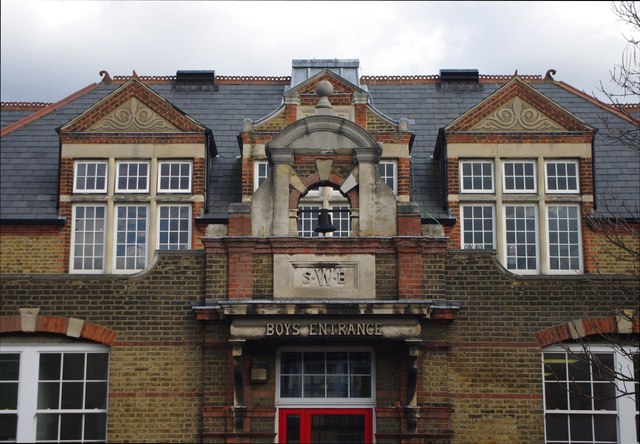
Next, we have primary school for children of 5 to 11. When I was at school, it was broken down into Infants and Juniors. Infants school was two years, then we moved up into a new building, attending four years of Junior school. This was a mixed school by which I mean boys and girls were in the same class.
Woodside Primary school in north-east London
Following on from Primary school we have, quite logically, Secondary school:
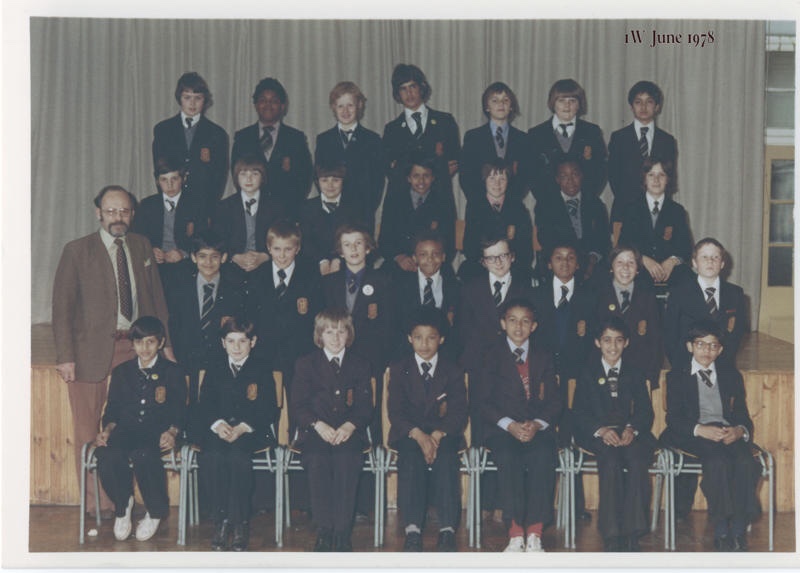
A typical class photo from the late 1970s. As you can clearly see, this is a single-sex school. Furthermore, the pupils had to wear school uniform of trousers, blazer and school tie.
Pupils spent three years here, from ages 11 – 14 at Junior High, after which they progressed to Senior High:
Pupils have to attend school until they are 16; it is compulsory.
You must then do one of the following until you’re 18:
stay in full-time education, for example at a college
Pupils can either stay at school and enter the VI (Sixth) Form, or go to a Further Education College which differ in that they offer a much wider selection of options such as vocational courses which are more practical and can help students train for a specific job. VI Forms, on the other hand, are academic (theory), preparing students for university.
The VI Form is usually in the same building as the Senior High, so pupils are familiar with the teachers and students. Going to a new college, meeting new staff and students means that time is needed to settle in or settle down.
Qualifications are imperative these days, so many students want to go to University.
Finally, we have Adult Education which, as the name implies, is for adults who wish to further their job prospects, or simply learn for their own pleasure. As many people are working, these type of education often takes place in the evening or at weekends.
New Vocabulary:
term – part of the teaching year for example First Term is from September to December
it’s a pity – it is sad or it is unfortunate
Fresher’s Week – a week for new students (Freshmen in USA) to get to know what their college has to offer, such as clubs and events.
GCSEexams – tremendously important exams taken at age 15 or 16. Good results mean the student can to VI Form or have to re-sit the exam.
tertiary – means the third – after Primary (first) & Secondary (second), tertiary refers to Higher Education, taken after the age of 18.
NVQ National Vocational Qualification – this is more practical as opposed to academic, designed to teach skills needed for a particular job:
An NVQ card stating that the holder has passed exams to work in the construction industry
BA or BSc – (Bachelor of Art or Science) degrees in the arts or science. Usually attained after a three-year course. The next step is a MA (Master’s Degree) and then a PhD.
internship – gaining real-life experience by working for a company, often for low or even no pay.
Graduate Fair – a chance for students to think about what career to follow, or what company to join. They can speak to people who represent organisations:
My classes at campus have practised (and practised; I make those guys put their noses to the grindstone) Parts I and II of the speaking test. To recap:
Part I: 4 – 5 minutes, warm up questions. Answer with two, three or four sentences, throwing in a few L-FW (big words), idioms as appropriate, and demonstrate you know how to form a complex sentence.
Part II: 1 minute to make notes, 2 minutes solo speaking. This is your chance to shine, show all you’ve learnt, and score points for vocabulary (including idiomatic language, low-frequency words, adverbs and adjectives), grammar including, as you know, complex sentences which will earn you a higher score as well as being much more interesting to listen to as opposed to short simple sentences. Fluency, so make use of those multi-purpose sentences such as, “Well, that’s an interesting question,” “It’s funny you ask me that question because I have just been thinking about …” etc. Lastly, and not to be underrated, pronunciation, intonation and stress.
Now, we come to Part III
Yes, I know, it can be a nightmare ! The questions are so complex, how could you possibly answer even in your native language ? Well, you can’t … no one can, especially not in a minute or so and under the pressure of a test.
Take a look at this example:
Does the media have a positive or negative effect on the music people in your country buy ?
What a question ! You may be tempted to say, “I haven’t the foggiest idea,” “I haven’t a clue,” or “I have absolutely no idea, next question, please.”
The secret is to take power back – make yourself comfortable with the question … and here’s how:
Firstly, we need a great introduction. Some examples are:
Well, that’s a very complicated question …
What a hard question, I may have to think about this …
I’m not sure I know how to answer that because I don’t have enough information, however …
The secret is to take this general question and make it personal, so you can speak about what YOU know, as well as using IELTS language.
Show that you understand the question by defining ‘media’.
I usually get my information from the internet, although I know some people use TV, radio or newspapers.
For me, the internet is great for learning about new singers or groups with sites such as YouTube or Spotify as opposed to newspapers where I can only read about music.
The media is tremendously important for musicians. They are able to upload videos to YouTube, have a Facebook page or a Twitter account. Fans can know when they have a new song or go on tour.
This time, instead of using expressions such as in my opinion, you can use:
in my experience
allow me to tell you what I do
I can’t speak about other people, but I …
EXAMPLE:
Well, that’s a very complicated question but I will endeavor to answer. I usually get my information from the internet, although I know some people use TV, radio or newspapers. Usually, I join a Facebook page of a band I like, or follow them on Instagram. Naturally, I look at YouTube which is great because it suggests other music I may like. Therefore, I am able to hear new artists. I’m not sure how much this affects how other people buy music. In my experience, I will buy music if I really like it, for example, downloading a song on iTunes. I can just buy the songs I like, so it doesn’t cost an arm and a leg.
This time we can use examples:
I’m not sure I know how to answer that because I don’t have enough information, however I can think of one example. I remember when Taylor Swift won an award for best video but Kanye West stopped her speech. This made a lot of people think very badly about him, so maybe they stopped buying his music.
I’m not sure I know how to answer that, but let me try. The media is tremendously important for musicians. They are able to upload videos to YouTube, have a Facebook page or a Twitter account. Fans can know when they have a new song or go on tour. I can’t speak about other people, but I rarely buy music anyway, just once in a blue moon.
What a hard question, I may have to think about this … oh, I know, fans can follow their favourite singers on social media, such as Twitter, Facebook or Instagram. I usually get my information from the internet. I would be over the moon if a music star replied to my comment. On the other hand, if they don’t answer, some people may stop liking them.
Well, that’s certainly a hard question. I really don’t know what other people in Vietnam do, but allow me to tell you what I do. I like to listen to English songs, to help me improve my language skills. My friends and I tell each other about English or American bands and we look up the words … the lyrics … to help us. I can give you an example. My teacher played a song in class by a band called The Shins, who are from USA. I quite liked the song although most of the words are very difficult to understand. I know one of my friends bought the last CD because he liked it so much.
That’s a very complicated question. However, I can think of one singer who upset many people in Vietnam and Vietnamese people in USA. Do you know Kacey Musgraves ? She sings country music, which is not really my cup of tea, but that is not why she is famous. She wore an ao dai on stage, but only the top part … she didn’t wear the trousers. Many people thought this was so disrespectful. For me, I don’t think I would buy her records after this, even if I did like them.
One of my classes have their speaking test next week therefore, this is their last chance to practise, to demonstrate they know what they need to do to pass with flying colours.
Some tips to assist
An introduction:
That’s a very interesting question
Well, there is so much to say about that subject, where shall I start ?
It’s funny you put that question to me because earlier today I was just thinking about …
Well, that’s a great question
As a young Vietnamese (add your own nationality), I …
Opinion questions:
If you have a question with the following wording:
“What do you think ?”
You can use opinion phrases. We do not want facts, but want to hear if you are able to understand what is required by the question, and if you are able to articulate your thoughts.
In my opinion // From my perspective //personally // In my view / For me // From my point of view
Finally, there will probably be a chance to demonstrate your knowledge of adjectives and adverbs.
You may encounter a question such as:
What qualities are needed to be a good police officer ?
very / extremely / amazingly / unbelievably / quite / rather / undeniably / remarkably / totally / absolutely /
Combine into a complex sentence with discourse markers and relative pronouns and clauses. If possible, paraphrase key words (here I substitute ‘attributes’ for ‘qualities’).
EXAMPLE
A police officer, in my opinion, needs to have many attributes such as being extremely brave and caring although they will also need to be totally healthy as well as being strong and undeniably energetic. Working for the police, which can be a very dangerous job, is not my cup of tea. Having said that, I really admire the honesty and loyalty of these amazing people.
Now … your turn
What qualities are needed to be a … ?
Sports person / Film star / Doctor / Musician / Mother
















































 Thay Paul's Notes